Blogia
Vanity Fea

Evolución

Whig History and Mind Minding

lunes, 25 de mayo de 2015

A commentary to a post in New Savannah, "beyond Whig history to Evolutionary thinking":

Whig history shouldn't be entirely avoided, in the sense that a Whiggish sensibility does have some use in detecting those elements that (oh yes) eventually lead to a Whiggish disposition, which after all has not emerged from nowhere. Of course there is the attendant danger of hindsight bias etc. which has to be kept in mind. But at bottom this is an issue much resembling the question of the anthropic principle in evolution: wrong if you make highter consciousness a teleological aim in evolution, right if it forces you to reconize that, after all the whole tangled web of life, consciousness is both the most complex evolutionary phenomenon (or perhaps in a weaker formulation, one of the most complex evolutionary phenomena) and the only one where reflexive models on evolution are built (not so, e.g., in otherwise incredibly complex and refined cases of mimetism or animal/vegetable coevolution). That's one sense in which evolution IS, after all, directional, and not a mere matter of wiggling around. It is cumulative in many ways detailed both by Darwin and by population genetics, and it is also cumulative at the level of culture, which has been called Lamarckian in the sense that cultural evolution does preserve favorable acquired traits in a direct way. Now I would also say that considering that writers and reviewers are deliberate (or "Lamarckian") subjects is only the bare minumum; the intentional directionality of evolution has to take into account also the way minds make plans or make choices which direct and guide behaviour and thence evolution; I think this is in part the role of Darwin's 'sexual selection' being at all different from 'natural selection'; that is, in sexual selection it is a mind that makes the selection, whereas in natural selection it is the play of chance and the struggle for life. The role of minds has been underrated in evolutionary biology, but surely this is a mistake that evolutionary psychology is not supposed to repeat!

Rocío Orsi, Butterfield y la razón histórica: La interpretación Whig de la historia 


—oOo— 
 

Richard Dawkins reads On The Origin of Species By Darwin - Audio

lunes, 25 de mayo de 2015

Richard Dawkins reads On The Origin of Species By Darwin - Audio

Abridged audio, read by Richard Dawkins.


The Naked Fish

domingo, 17 de mayo de 2015

Richard Dawkins: "Yes, we came from apes. We and other modern apes such as chimpanzees came from ancient apes. And we and modern fish came from ancient fish."


Una pequeña teoría sobre el origen y desarrollo del lenguaje

martes, 5 de mayo de 2015

Una pequeña teoría sobre el origen y desarrollo del lenguaje (A Small Theory on the Origin and Development of Language)

El lenguaje surge de una dialéctica social y biológica compleja. Entre los elementos que entran en esta relación dialéctica podemos resaltar la interiorización de la interacción social, la retroalimentación de los procesos cerebrales asociada a una encefalización creciente, y los procesos de autoestimulación interactiva que se dan entre un bebé y su madre al pronunciar las primeras palabras. En cierto modo, los bebés inventaron, y reinventan cada día, el lenguaje. En este artículo proponemos una teoría que desarrolla las propuestas interaccionales sobre el origen del lenguaje sugeridas por George Herbert Mead, a la luz de teorías contemporáneas como las de Deacon, Bickerton, o Hrdy.


Ibercampus (March 27, 2015)


A Small Theory on the Origin and Development of Language: Internalized Interaction, Feedback, Encephalization, Self-Stimulation, and Baby Talk

 Language arises from a complex social and biological dialectics. Among the elements involved in this dialectical relationship may be pointed out the interiorization of social interaction, the feedback of brain processes associated to a growing encephalization, and the processes of interactional self-stimulation taking place between a mother and her child as the first words are pronounced. This paper proposes a theory which develops the interactional suggestions on the origin of language sketched out by George Herbert Mead, in the light of contemporary theories such as Deacon's, Bickerton's or Hrdy's.

Note: Downloadable document is in Spanish.

Number of Pages in PDF File: 17

El artículo ha sido aceptado en las redes temáticas de Antropología, Ciencia cognitiva y Filosofía de la SSRN, en estas secciones y revistas:

eJournal Classifications (Date posted: April 20, 2015)  
AARN Subject Matter eJournals
    
        
AARN Subject Matter eJournals
    
        
CSN Subject Matter eJournals
    
        
PRN Subject Matter eJournals


Una pequeña teoría sobre el origen y desarrollo del lenguaje

Dr Alasdair Richmond: The Anthropic Principle in Philosophy

viernes, 1 de mayo de 2015

Dr Alasdair Richmond: The Anthropic Principle in Philosophy (Philosophy ...


Arte, Estética, y Evolución

martes, 28 de abril de 2015

Arte, Estética, y Evolución

Ha salido el último número de ASEBL Journal en Brooklyn Heights, Nueva York—aquí la noticia en su blog.

ASEBL is an online, peer-reviewed journal published once a year, around January, and indexed in EBSCO Host. The editors are especially interested in writing that, broadly conceived, accommodates any treatment of the convergence among ethics, biology, and literature. Full details (mission, aims and scope, and submission guidelines) appear on the ASEBL blog: www.asebl.blogspot.com.

Aparece como pieza principal en este número un artículo cognitivista-evolucionista de Anthony Lock sobre pintura neozelandesa vista desde esta perspectiva crítica. Es lo que a veces se llama enfoques de "tercera cultura", o sea, consilientes, aplicando una perspectiva científica, sociobiológica, cognitivista  o evolucionista, a los productos culturales, para verlos... eso, en perspectiva.  Me invitaron a hacer un comentario, en el que propongo el término de "cuarta cultura" para un enfoque científico (evolucionista, adaptacionista, etc.) que sin embargo no renuncie al conjunto de las perspectivas aportadas por las humanidades—pues hay una cierta tendencia en la llamada "Tercera Cultura" a considerar que es palabrería o pseudociencia el enfoque humanístico sobre las humanidades, y a sustituirlo por el enfoque científico propiamente dicho, a veces con efectos de elefante entrando en cacharrarería. Una auténtica consiliencia no llevaría a eso, claro. Y en su respuesta Lock parece convenir conmigo e incluso aceptar la terminología de la "cuarta cultura".
Aquí  está la revista (en PDF también el artículo): ART, AESTHETICS AND EVOLUTION
ASEBL, por cierto, quiere decir Association for the Study of Ethical Behavior / Evolutionary Biology in LiteratureAl margen de mi comentario al artículo de Lock que aparece en esta publicación, ese artículo y algunas nociones provinientes de Dissanayake me sugirieron ideas para este otro artículo sobre el origen del lenguaje.
Y, en fin, ésta es mi última publicación en una revista académica—y además a título de experto, junto con Ellen Dissanayake, Mark Turner y otras eminencias, de lo cual me felicito. También es mi última publicación en Nueva York—con lo que quiero decir únicamente que no es la primera.
Insertamos la noticia, por supuesto, en Narratología evolucionista:


y en Evolutionary Narratology.

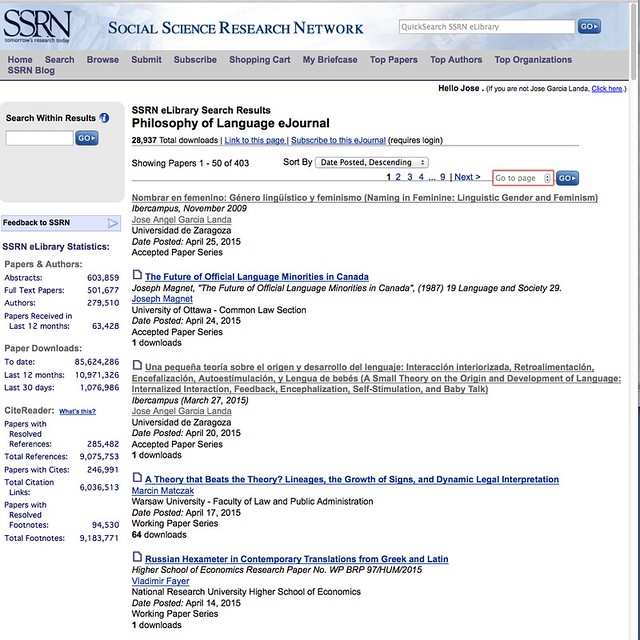
Aquí haciendo Philosophy of Language

lunes, 27 de abril de 2015

Aquí haciendo Philosophy of Language

En portada, por partida doble:
Aquí haciendo Philosophy of Language


—y también en Philosophy of Mind.

Mesa redonda - Diseño inteligente: fundamentalismos religiosos y científicos


domingo, 26 de abril de 2015

Mesa redonda - Diseño inteligente: fundamentalismos religiosos y científicos