Blogia
Vanity Fea

Filosofía

Understanding Human Nature with Steven Pinker - Conversations with History

domingo, 31 de mayo de 2015

Understanding Human Nature with Steven Pinker - Conversations with History


Marx y la naturaleza humana

miércoles, 27 de mayo de 2015

Marx y la naturaleza humana (Marx and Human Nature)

Evaluamos en este artículo la visión marxista de la naturaleza humana y de su relación con los procesos de explotación de recursos a lo largo de la historia, así como sus transformaciones, por vía de una respuesta a la conferencia de Terry Eagleton "Por qué Marx tenía razón". 

Marx y la naturaleza humana

Una historia de explotación de recursoso

http://ssrn.com/abstract=2600420


Ibercampus (April 22, 2014)


Marx and Human Nature: A Tale of the Exploitation of Resources

A paper assessing Marx’s view of human nature and of its relationship to the processes of the exploitation of resources in human history, as well as their transformations, by way of a response to Terry Eagleton’s lecture "Why Marx Was Right".

Note: Downloadable document is in Spanish.

Number of Pages in PDF File: 6
Keywords: Marx, Marxism, Materialism, Resources, Human nature, Exploitation, Ecology, Social relationships, Globalization, Complexity, Colonialism, Capitalism, Socialism


Marx y la naturaleza humana

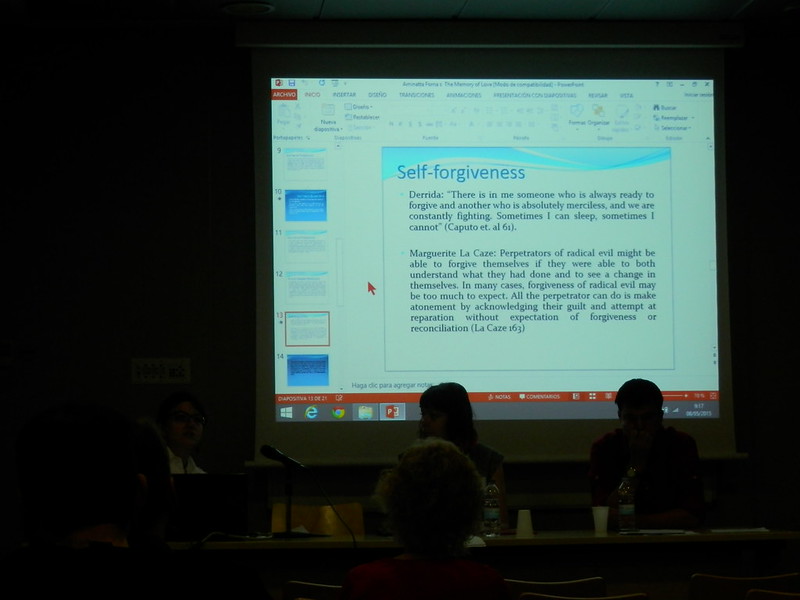
Derrida on self-forgiveness

martes, 26 de mayo de 2015

Derrida on self-forgiveness

Self-forgiveness

Bucles en la mente

lunes, 25 de mayo de 2015

Bucles en la mente

La realidad humana es tanto física como virtual; se construye interaccionalmente en un proceso dialéctico que comprende el entorno físico y social, la interiorización de ese entorno, y las representaciones simbólicas. Es una "realidad aumentada" que en parte nos rodea a modo de nicho ecológico, y en parte es también una proyección mental, en un proceso que podría definirse como una especie de alucinación colectiva consensuada. La estructura de la actividad cerebral tal como es descrita por Michael Gazzaniga puede tomarse como el correlato neurológico de la perspectiva proporcionada desde la psicología social por G. H. Mead y los interaccionistas simbólicos. 


 hindsight mirror

Loops in the Mind: Self-Interaction, Brain Feedback, and Reality as a Self-Fulfilling Expectation


English Abstract: Human reality is both physical and virtual; it is built interactionally through a dialectic which comprises the physical and social environment, the interiorization of that environment, and symbolic representations. It is an "augmented reality" which partly surrounds us as an ecological niche and is also partly a mental projection, in a process which might be defined as a kind of consensual collective hallucination. Michael Gazzaniga's account of brain activity may be taken as usefully providing the neural correlates for the social psychological perspective proposed by G. H. Mead and the symbolic interactionists.

Note: Downloadable document is in Spanish.
 

Number of Pages in PDF File: 10

Ibercampus, April 2015


eJournal Classifications  (10 May 2015)
AARN Subject Matter eJournals
    
        
AARN Subject Matter eJournals
    
        
CSN Subject Matter eJournals
    
        
PRN Subject Matter eJournals


La autointeracción, la retroalimentación cerebral, y la realidad como expectativa autocumplida


Andy Clark - Perceiving as Predicting

domingo, 24 de mayo de 2015

Andy Clark - Perceiving as Predicting

Otra conferencia de Andy Clark, interesante para estudiar el tema de la construcción de la realidad como proyección mental y como profecía autocumplida.


Professor Andy Clark: What 'Extended Me' Knows

domingo, 24 de mayo de 2015

Professor Andy Clark: What 'Extended Me' Knows


Panopticon of Topsight on The Order of Things

viernes, 22 de mayo de 2015

Panopticon of Topsight on The Order of Things


Or, a perspective on the paradoxical self-transcending of perspectives. A passage from Seán Burke's The Death and Rebirth of the Author, criticizing Foucault's blind or contradictory self-erasure of his own position even as he erases the agency of the author. There are here some implications for a definition of the concept of topsight, understood here not as information on a situation or set of relationships, but as comprehension or conceptual understanding of a field.  It is a topsight-related phenomenon (or should we say a paradox, the topsight paradox) which bears on any discourse of truth, not just archaeology—but is perhaps made more visible or paradoxical here because of archaeology's, and Foucault's, pretensions to erase agency and the subject while simultaneously setting up a theory of knowledge and of the subject as agency. The archaeologist (or Foucault himself) as a "detached overseer", to use Burke's phrase, is uncannily reminiscent of the prison guard's eye in Bentham's panopticon of universal surveillance—a position which, fairly enough, can be occupied by an actual guard or may remain empty, a subjectless position, since the topsight is structurally determined, not an accident of the overseer's volition or personal intention. The panopticon would therefore seem to be a diagrammatic icon of Foucault's discourse at a deeper level than is usually conceived—a regular mise en abyme of the notion of an order of things which can be described from a master discourse alien to it or escaping the frame-breaking countergaze of the Sartrean observer-observed.The Swan

More generally, though, we could argue that any discourse which sets itself up as innovative or as the disclosure of a hidden perspective on things (and which critical discourse doesn't set itself up as such?) also posits itself, in so doing, as transcending the present field of knowledge, as opening a perspective on reality as we know it, viewed from another order of things.


Within The Order of Things, more than in any other text, it was necessary for Foucault to deflect attention from his own status as its author. By the very act of constructing the discourse of the prediscursive ground, archaeology indemnifies itself against the system of constraints which it enforces upon all other discourses. The archaeologist will therefore always be a detached overseer. and never part of the discursive configuration itself; as a matter of structural necessity he will be outside of time.

This situation differs with respect to the descriptions of the Classical and modern epistemi, though only to the point of modifying the quality of temporal transcendence which the archaeological discourse implicitly arrogates to its practitioner. Obviously, the description of the Classical era will of necessity take place outside that arrangement of knowledge but neither can it issue from the vantage point of modernity, for Foucault would then be presenting not an understanding of the deepest stratum of Classical thought, but a history of the present as it views the past; an operation in which what are called the elements of Classical thought would be no more than merely material for allegory, for a revaluation of how our modern habits of thought negotiate the long distant past.

Moreover, and more worryingly still, the archaeological discourse of the modern episteme. cannot itself belong to the modern episteme, for then it could only speak for, and not about  the rules of formation for the anthropological arrangement. If it formed a part of the modern configuration, The Order of Things would represent another monument to the anthropological era, to the discourse on man, his destiny and ends. Kant writes of man as the end of all nature, Hegel of the end and fulfulment of man as that mystical journey of mind toward itself in time, Marx of the simultaneous dissolution and beatitude of man in classless society, Nietzsche of the übermensch, Huserl of an ultimate intersubjectivity, Heidegger of the shepherd of Being—there would then be no reason not to see in Michel Foucault's thesis of the-death-of-man-as-the-end-of-man the latest instance of the modern preoccupation with the eschatological horizons of humanity. (59)

Yet Foucault insists that this is not the case. Archaeology is a radical break with anthropologism, it transgresses the limits of this era. What he does not say, however, is that in order to transgress these limits, it must also transcend the formal conditions which dictate to all other discourses the ground and limit of their possibility. The episteme must be described from the point of view of an ideal exteriority. Only from a mystical and privileged continuum alterior to all epistemi can the archaeologist range, circumscribe and re-present discursive history, and only from this place can he proscribe its future (60). Foucault is therefore always already in possession of the transcendence which he bewtows upon Nietzsche for in the last analysis, it is still Foucault who purportedly has unique access to the true historical mission and significance of the Nietzschean discourse, he who has ultimate powers of appropriation within an archaeology of the human sciences which is all his own. His is the discourse of all discourses, the one site from which the rules of formation of four centuries of writing can be revealed. Foucault therefore cannot avoid becoming the author of his own text, and it is precisely the monumental and totalising nature of that text which conspires to make the authority of the archaeologist unconscionably problematic. (61)

The whole range of texts which make more modest or local claims, those which are avowedly impressionistic, fictional or subjective will not imply transcendentally remote authors; rather such a subject tends to arise from high philosophical or theoretical texts, particularly in the case of texts which—like Foucault's, like Hegel's—attempt to tell the truth of history, for such a tale can only be told from the annex of a pure distance, an ahistorical alterity. And where the problems of ideal detachment are grave enough for Hegelian history, they are entirely calamitous for a text which seeks to lay the ghost of the idealist subject. Prime amongst the ironies of Foucault's project is that, even supposing that it had succeeded in its aim, history would still have been left to depose the subject of archaeology. Foucault has little enough success in ousting those authors whose influence he wished to deny. The one subject he could never in principle dislodge is Michel Foucault.


(59) As Jacques Derrida says, 'The thinking of the end of man .... is always already prescribed in metaphysics, in teh thinking of the truth of man.' Jacques Derrida, 'The Ends of Man', Margins of Philosophy, trans. Alan Bass (Brighton: Harvester Press, 1982), pp. 109-36; p. 121.

(60). It is perhaps partly for this reason that Foucault maintains a scrupulous uncertainty as to whether we are still (at the time of writing) within the Age of Man, or are instead dazzled by the unaccustomed light of the coming episteme. The space between epistemi is the ideal point from which the archaeologist might speak for it frees him from the specific determinations of any particular configurations of knowledge and forms so to speak, a lyrical intermezzo between rigid, prescriptive systems. Foucault's elusiveness on the epistemic stationing of the archaeological discourse has led Pamela Major-Poetzl to postulate a fourth and contemporary episteme commencing in 1950, though she does so with no direct authorisation from the text. See Pamela Major-Poetzl, Michel Foucault's Archaeology of Western Culture, op. cit., pp. 158-9; 191-5.

(61). And Foucault's style does everything to confirm the transcendental status of the archaeological author. He writes with an omniscient assurance, in tones peremptory and portentous, with what Roland Barthes would call the voice of God. Indeed, Edward Said makes the point that Foucault's voice is undoubtedly the 'voice of an Author', though he sees no particular contradiction in an authorful and authoritarian discourse which recommends the anonymity of discourse. See Edward Said, 'An Ethics of Language', Diacritics vol. 4, no. 2 (Summer 1974), pp 28-37; p. 28.


The Order of Discourse


Schopenhauer y los animales

viernes, 22 de mayo de 2015

Schopenhauer y los animales