
Filosofía
Iñigo Ongay sobre la libertad de expresión
Edgar Morin: Introducción al pensamiento complejo
El Argumento nº 35
jueves, 13 de noviembre de 2014
El argumento número 35
Esto viene del apéndice a 36 Arguments for the Existence of God: A Work of Fiction. Es ésta una excelente novela de campus de Rebecca Goldstein (pareja por cierto de Steven Pinker) en la que, metamorfoseándose imaginativamente en el judío descreído Cass Seltzer, "el ateo con alma", expresa la autora su comprensión (ligeramente irónico-maquiavélica) hacia el fenómeno religioso en tanto que fuente de consuelo metafísico, y en tanto que mecanismo articulador de mundos posibles y de sentimientos de integración en una comunidad. Aunque sea una comunidad excéntrica articulada por creencias absurdas: los Valdenses, una pequeña tribu superviviente de judíos de Europa del Este, deslocalizados a América, eligen aquí al joven prodigio matemático Azariah, el hijo de su rabino, como nuevo guía espiritual, y éste acepta su destino a pesar de su distancia intelectual hacia las viejas tradiciones. Es, en suma, una versión judeo-americana, y altamente sofisticada, de San Manuel Bueno, Mártir. A la vez se completa con una intriga de campus, en la que Cass rompe con su novia perfecta pero carrierista, la genial psicóloga Lucinda, toda cerebro ella, y pasa a reanudar relaciones con la emocional y vital Roz, una antigua novia que reemerge ahora que Cass es famoso. El libro de Cass Seltzer, el que lo lanza a la fama, se llama The Varieties of Religious Illusion, combinando los títulos de libros sobre la religión de William James y de Sigmund Freud. Ese libro terminaba con una colección de argumentos a favor de la existencia de Dios, y sus correspondientes refutaciones, argumentos y refutaciones que son seguramente los mismos que cierran el libro de Rebecca Goldstein. Los argumentos reales se complementan con una colección fantástica de argumentos vividos en el argumento del libro, que dan título a cada capítulo. Creo que voy a incluir una lista de todos, los del argumento y los del apéndice argumentativo. Y terminaré con el argumento 35 del apéndice, por no terminar contando el final.
Contents:
I. The Argument from the Improbable Self.
II. The Argument from Lucinda.
III. The Argument from Dappled Things.
IV. The Argument from the Irrepressible Past.
V. The Argument from Reversal of Fortune.
VI. The Argument from Intimations of Immortality.
VII. The Argument from Soul-Gazing.
VIII. The Argument from the Existence of the Poem.
IX. The Argument from the Eternity of Irony.
X. The Argument from the Purer Self.
XI. The Artument from Transcendental Signifiers.
XII. The Argument from Prime Numbers.
XIII. The Argument from Taking Differences.
XIV. The Argument from Inconsolable Solitude.
XV. The Argumment from Sacred Circles.
XVI. The Argument from the Longing on the Gate.
XVII. The Argument from Strange Laughter.
XVIII. The Argument from the Arrow of Time.
XIX. The Argument from the Overheard Whispers of Angels.
XX. The Argument from Tidings of Destruction.
XXI. The Argument from the Remains.
XXII. The Argument from Fraught Distance.
XXIII. The Argument from the Disenchantment of the World.
XXIV. The Argument from the Ethics of the Fathers.
XXV.The Argument from Cosmic Tremblings.
XXVI. The Argument from Chosen Individuals.
XXVII. The Argument from the Bones of the Dead.
XXVIII. The Argument from the Mandelbaum Equilibrium.
XXIX. The Argument from Rigid Designators.
XXX. The Argument from the Long Silence of the Night.
XXXI. The Argument from the New York Times.
XXXII. The Argument from the Precipice.
XXXIII. The Argument from the Violable Self.
XXXIV. The Argument from the View from Nowhere.
XXXV. The Argument from Solemn Emotions.
XXXVI. The Argument from the Silent Rebbe’s Dance.
Un libro con capítulos titulados así merece ser leído. Sobre todo si en el apéndice encontramos los auténticos argumentos sobre la existencia de Dios:
Appendix: 36 Arguments for the Existence of God:
1. The Cosmological Argument.
2. The Ontological Argument.
3. The Argument from Design.
a) The Classical Teleological Argument
b) The Argument from Irreducible Complexity
c) The Argument from the Paucity of Benign Mutations
d) The Argument from the Original Replicator.
4. The Argument from the Big Bang.
5. The Argument from the Fine-Tuning of Physical Constants.
6. The Argument from the Beauty of Physical Laws.
7. The Argument from Cosmic Coincidences.
8. The Argument from Personal Coincidences.
9. The Argument from Answered Prayers.
10. The Argument from a Wonderful Life.
11. The Argument from Miracles.
12. The Argument from the Hard Problem of Consciousness.
13. The Argument from the Improbable Self.
14. The Argument from Survival After Death.
15. The Argument from the Inconceivability of Personal Annihilation.
16. The Argument from Moral Truth.
17. The Argument from Altruism.
18. The Argument from Free Will.
19. The Argument from Personal Purpose.
20. The Argument from the Intolerability of Insignificance.
21. The Argument from the Consensus of Humanity.
22. The Argument from the Consensus of Mystics.
23. The Argument from Holy Books.
24. The Argument from Perfect Justice.
25. The Argument from Suffering.
26. The Argument from the Survival of the Jews.
27. The Argument from the Upward Curve of History.
28. The Argument from Prodigious Genius.
29. The Argument from Human Knowledge of Infinity.
30. The Argument from Mathematical Reality.
31. The Argument from Decision Theory (Pascal’s Wager).
32. The Argument from Pragmatics (William James’s Leap of Faith).
33. The Argument from the Unreasonableness of Reason.
34. The Argument from Sublimity.
35. The Argument from the Intelligibility of the Universe (Spinoza’s God).
36. The Argument from the Abundance of Arguments.
35. The Argument from the Intelligibility of the Universe (Spinoza’s God)
1. All facts must have explanations.
2. The fact that there is a universe at all—and that it is this universe, with just these laws of nature—has an explanation (from 1).
3. There must, in principle, be a Theory of Everything that explains why just this universe, with these laws of nature, exists. (From 2. Note that this should not be interpreted as requiring that we have the capacity to come up with a Theory of Everything; it may elude the cognitive abilities that we have.)
4. If the Theory of Everything explains everything, it explains why it is the Theory of Everything.
5. The only way that the Theory of Everything could explain why it is the Theory of Everything is if it is itself necessarily true (i.e., true in all possible worlds).
6. The Theory of Everything is necessarily true (from 4 and 5).
7. The universe, understood in terms of the Theory of Everything, exists necessarily and explains itself (from 6).
8. That which exists necessarily and explains itself a God (a definition of "God").
9. The universe is God (from 7 and 8).
10. God exists.
Whenever Einstein was asked whether he believed in God, he responded that he believed in "Spinoza’s God." This argument presents Spinoza’s God. It is one of the most elegant and subtle arguments for God’s existence, demonstrating where one ends up if one rigorously eschews the fallacy of Inoking one Mystery to Explain Another: one ends up with the universe and nothing but the universe, which itself provides all the answers to all the questions one can ask about it. A major problem with the argument, however, in addition to the flaws discussed below, is that it is not at all clear that it is God whose exisntence is being proved. Spinoza’s conclusion is that the universe that itself provides all the answers about itself simply is God. Perhaps tha conclusion should, rather, be that the universe is different from what it appears to be—no matter how arbitrary and chaotic it may appear, it is in fact perfectly lawful and necessary, and therefore worthy of our awe. But is its awe-inspirign lawfulness reason enough to regard it as God? Spinoza’s God is sharply at variance with all other divine conceptions.
The argument has only one substantive premise, its first one, which, though unprovable, is not unreasonable; it is, in fact, the claim that the universe itself is thoroughly reasonable. Though this first premise can’t be proved, it is the guiding faith of many physicists (including Einstein). It is the claim that everything must have an explanation; even the laws of nature, in terms of which processes are explained, must have an explanation. In other words, there has to be an explanation for why it is these laws of nature rather than some other, which is another way of asking why it is this world rather than some other.
FLAW: The first premise cannot be proved. Our world could conceivably be one in which randomness and contingency have free reign, no matter what the intuitions of some scientists are. Maybe some things just are ("stuff happens"), including the fundamental laws of nature. Philosphers sometimes call this just-is-ness "contingency," and if the fundamental laws of nature are contingent, then, even if everything that happens in the world is explainable by those laws, the laws themselves couldn’t be explained. There is a sense in which this argument recalls The Argument from the Improbable Self. Both demand explanations for just this-ness, whether of just this universe, or just this me.
The Argument from the Intelligibility of the Universe fleshes out the consequences of the powerful first premise, but some might regard the argument as a reductio ad absurdum of that premise.
COMMENT: Spinoza’s argument, if sound, invalidates all the other arguments, the ones that try to establish the existence of a more traditional God—that is, a God who stands distinct from the world described by the laws of nature, as well as distinct from the world of human meaning, purpose, and morality. Spinoza’s argument claims that any transcendent God, standing outside of that for which he is invoked as an explanation, is invalidated by the first powerful premise, that all things are parts of the same explanatory fabric. The mere coherence of The Argument from the Intelligibility of the Universe, therefore, is sufficient to reveal the invalidity of the other theistic arguments. This is why Spinoza, although he offered a proof of what he called "God," is often regarded as the most effective of all atheists.
Consiliencia y retrospección
martes, 11 de noviembre de 2014
Consiliencia y retrospección
Mi artículo sobre Stephen Jay Gould, E. O. Wilson, la unidad del conocimiento, la comprensión de los fenómenos y la retrospección,
Consiliencia y retrospección
http://papers.ssrn.com/abstract=2513969
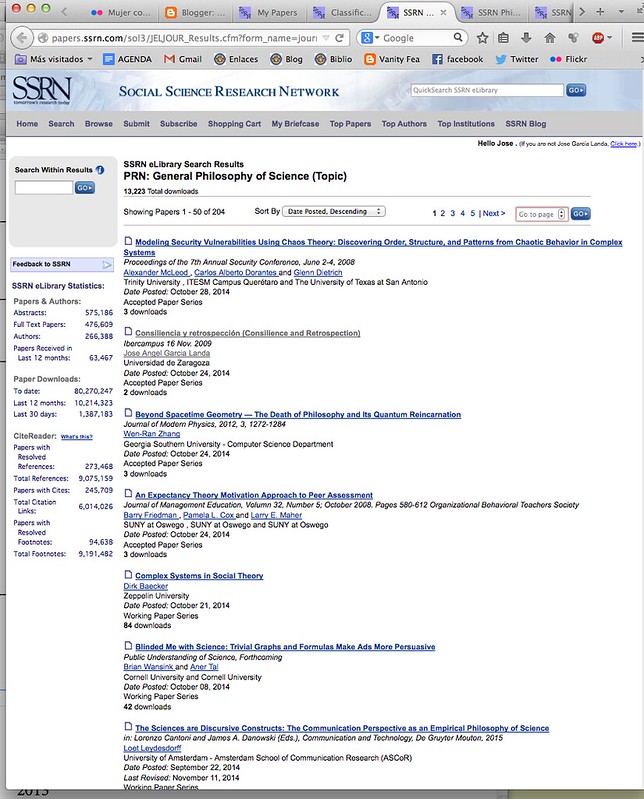
Este artículo reexamina la crítica de Stephen Jay Gould al concepto de consiliencia propuesto por E. O. Wilson, remontándose a la formulación original del concepto por parte de William Whewell. Aquí clarificamos el componente de retrospección hermenéutica inherente al proceso efectual de la consiliencia, una cuestión que puede enfocarse desde la perspectiva de una narratología cognitiva.
Reference Info: Ibercampus 16 Nov. 2009
Reference Info: Ibercampus 16 Nov. 2009
Se encuentra ahora, en español, en estas revistas temáticas de la SSRN (Date posted: October 24, 2014)
| eJournal Classifications |
AARN Subject Matter eJournals |
| AARN Subject Matter eJournals |
| CSN Subject Matter eJournals |
| PRN Subject Matter eJournals |
(Consilience and Retrospection) - aquí el texto revisado en inglés.
y en Academia, Consilience and Retrospection: https://www.academia.edu/20088095/
—oOo—
Consiliencia y Retrospección
II Seminario HERAF
(Oct. 2014)
Ya ha salido el programa del II seminario del Grupo de investigación sobre Hermenéutica y Antropología Fenomenológica (HERAF). Este segundo seminario versa sobre "Corporalidad, Temporalidad y Espacialidad", y yo hablaré sobre la complejidad del tiempo humano en G. H. Mead.
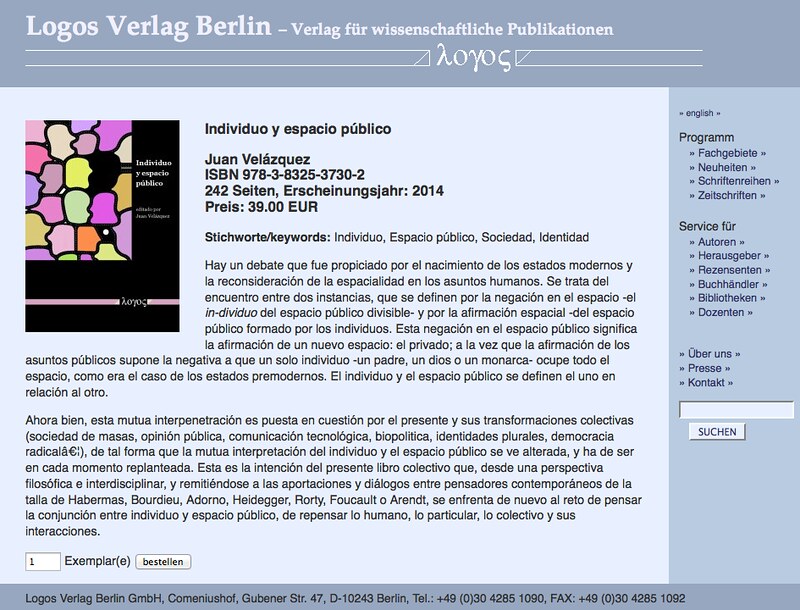
Acaba de publicarse un libro basado en el primer seminario terminado este año, Individuo y espacio público, editado por Juan Velázquez (Berlín: Logos Verlag, 2014).
Individuo y espacio público
viernes, 17 de octubre de 2014
Individuo y espacio público
Aparece en Alemania, o aquí, este libro del grupo HERAF, un volumen colectivo con un capítulo mío,
"4. El dividuo social: roles, marcos interaccionales y (nuevos) medios." En Individuo y espacio público. Ed. Juan Velázquez. Berlín: Logos Verlag, 2014. 99-116.
http://www.logos-verlag.de/cgi-bin/buch/isbn/3730
Y ya está en marcha el segundo seminario HERAF, sobre cuerpo, espacio y temporalidad.