
Literatura y crítica
The Poetry of Spenser
lunes, 3 de octubre de 2016
The Poetry of Spenser
From The Short Cambridge History of English Literature, by George Sampson (1972 ed.).
After a lapse of almost two centuries we reach the first English major poet since Chaucer. Edmund Spenser (1552-99) was born in London, and was related to the great family of his name. At Cambridge he not only wrote his earliest sonnets, but came under three profound influences. The first was his frienship with Gabriel Harvey, a powerful and controversial scholar, to whom justice has yet to be done. The second was the refined and cultured "Puritanism", which, like that of Milton, was a revolt from coarseness and materialism in life and in religion. The third was the study of Platonic philosophy—not the Christianized neo-Platonism of the Reformers, but the pure Platonism of the Timaeus and the Symposium. To the imagination of Spenser this proved exceedingly congenial, and confirmed him in his allegorical habit of conception and expression. His early Hymnes, the first in honour of Love, the second in honour of Beautie, though not published till 1596 (Foure Hymnes made by Edm. Spenser), were inspired by his first experience of love, and written in the spirit of Plato.
He was brought by Harvey into the service of the Earl of Leicester, and met Philip Sidney, whose ardent imagination and lofty spirit greatly stimulated him. After toying, under Harvey's influence, with the possibilities of using in English a system of quantitative prosody (that ignis fatuus of English poets) he began to consider the forms in which he could express himself most naturally, and he turned instinctively to the pastoral and the romance, with their stock figures, the shepherd and the knight. The pastoral, as we have seen, was a popular form, offering an abundance of models. The extent of Spenser's debt to any of these is not really important. All that matters in a poem is what it is, not what it may have come from. Upon the "XII Aeglogues proportioned to. . . the XII monethes" forming The Shepheards Calendar (1579) the impress of a creative, originating poetic genius is clearly discernible. The book was dedicated to Sidney, who praised it highly, but objected, rather pedantically, to one of its greatest charms, namely "the olde rusticke language". Sidney, a typical figure of the Renascence, disliked Spenser's archaism, not in itself, but because it was unwarranted by classical originals. This kind of criticism was to have a long run. A more serious objection would have been that the pastoral, as Spenser wrote it, was a literary exercise with little hold on life. Spenser uses all varieties of the form, amatory, moral, religious, courtly, rustic, lyric, elegiac, and shows himself at once master of an old convention and herald of a new spirit in poetry. His language was deliberately archaic. Ben Jonson said that Spenser, in affecting the obsolete, "writ no language". The answer is that Spenser used the language in which Spenser could write. Every true poet creates his own idiom. What The Shepheards Calendar clearly reveals is the arrival of a great poet-musician, who excelled all his predecessors in a sense of the capacity of the English language for harmonious combinations of sound. To turn from the flatness of [George Gascoigne's] The Steele Glas to The Shepheardes Calendar is to pass from honest and well-meant effort into a new world of absolute mastery.
From the pastoral Spenser proceeded naturally to romance. In 1580 he went to Ireland as secretary to the Lord Deputy, and there at Kilcolman Castle he continued his Faerie Queene, the first three books of which were published in 1590 on his return to England. As, in any creative sense, the poem shows no progress, but is at the end what it was in the beginning, some consideration of it may be given at once. The poem, as planned in twelve books, was never completed. Spenser himself has clearly stated his own intentions in the prefatory letter addressed to Ralegh, and to this the reader is referred. Like other great poets he felt himself called to teach; and desiring to set forth a picture of a perfect knight, he chose King Arthur as hero, rather than any person of his own time. Further, he desired to glorify his own dear country and its "most royal Queen". In much of his intention he was successful, but he was not completely successful. Spenser failed because he refused to follow his natural instinct for allegory and romance, the forms that most readily released his creative powers—in The Allegory of Love (1936) C. S. Lewis traced their history from Le Roman de la Rose—but turned aside to be instructive, and, in seeking to make the allegory edifying, forgot to tell the story. But if an allegory does not survive as a story, it does not survive as an allegory. The Pilgrim's Progress [by John Bunyan] is, first of all, an excellent story; The Faerie Queene is not. Like every great poem, The Faerie Queene is entitled to its own imaginative life; but it must continue to be true to that life. Spenser, to use a common phrase, lets us down, when we are left wondering whether the false Duessa is a poetical character, or Theological Falsehood, or Mary Queen of Scots. He tried to do too many things at once; and, in elaborating intellectually the allegorical plot he has confused the imaginative substance of the poetic narrative. Homer, says Aristotle, tells lies as he ought; that is, he makes us believe his stories. Spenser tried to tell his lies while clingling to a disabling kind of truth; and so he does not convince his readers. Thus it is neither as an allegorist not as a narrator that the author of The Faeire Queene holds his place. He lives us an exquisite word-painter of widely differing scenes, and as supreme poet-musician using with unrivalled skill a noble stanza of his own invention, unparalleled in any other language.
As the years advanced, Spenser seems to have felt that his conception of chivalry had little correspondence with the facts of life. Sidnay was dead, and his own hopes of preferment were frustrated. In 1591 a volume of his collected poems was published with the significant title Complaints, including such works as The Rines of Time, The Teares of the Muses and Prosopopoia or Mother Hubberd's Tale, in which the Ape and the Fox serve to satirize the customs of the court. In 1591 he returned to his exile in Ireland, and there, in the form of an allegorical pastoral, called Colin Clouts Come Home Againe (1595), he gave expression to his views about the general state of manners and poetry. In his Prothalamion, and still more, in his Epithalamion, he carries his lyrical style, first attempted in The Shepheards Calendar, to an unequalled height of harmony, splendour and enthusiasm. In 1595, he again came over to England, bringing with him the second part of The Farie Queene, which was licensed for publication in January 1595-6. Finding still no place at court, he returned to Ireland in 1597; but, in a rising, Kilcolman Castle was taken and burned, and Spenser barely escaped with his life. His spirit was broken, and after suffering the afflictions of poverty, he died in January 1599. His posthumous prose dialogue, A Veue of the Present State of Ireland, written in 1596, is discussed in a later chapter. Spenser is the poets' poet, and his greatness cannot be diminished by the jeers of the tough-minded who find his poetic music and his poetic virtue too delicate for their manly taste.
....
Spenser is the true father of the Elizabethan sonnet. He first appeared as a poet with the twenty-six youthful sonnets of 1569. His indebtedness to Du Bellay is declared in the title of one group of sonnets, The Visions of Bellay. Another set, The Visions of Petrarch, he translates from Marot. These and the other sonnets of Spenser in Amoretti (1595) have his characteristic sweetness of versification. Spenser, it should be noted, uses the English and not the Italian form of the sonnet. Two of the sonnets in the Amoretti refer to the Platonic "Idea" of beauty which outshines any mortal embodiment. The "Idea", found also in numerous French writers, became a theme of later English sonnets, especially those of Drayton (...).

—oOo—
Sir/St Thomas More
Sir / St Thomas More
From The Concise Cambridge History of English Literature, by George Sampson (1972 ed.):
...
John Fisher (1459-1535), Bishop of Rochester, deserves brief mention in this place, not because he took high rank himself as a humanist, but because he was the means of bringing Erasmus to lecture on Greek in Cambridge (1511-14) at the very time when the university was changing from an ancient to a modern seat of learning.
Sir Thomas More (1478-1535), the associate with Fisher in his tragic death—and canonized with him in 1935—was the pupil of Linacre and Grocyn, the disciple of Colet, the beloved friend of Erasmus, and was the one member of the band of English literary humanists who had a distinct gift of literary genius. At Oxford he became a good Latinist and a fair scholar in Greek. Even when he was a highly successful lawyer with a lucrative commercial practice he lectured on the philosophy nad history of Augustine's City of God. As a member of Parliament he resisted the royal exactions, and was reluctantly drawn into the royal service, in which, however, he rose rapidly, becoming in the end Lord Chancellor in succession to Wolsey. He was the first layman to hold that office. More had no illusions about his royal master, and the end came also as he had foreseen. Having refused to take any oath which denied the Pope's supremacy in matters of faith he was confined in the Tower amid circumstances of spiteful and gratuitous hardship. The humorous serenity characteristic of his life never forsook him, and displays itself in the moving letters to his daughter, Margaret Roper, scribbled on scraps of paper with a piece of charcoal because writing materials had been taken from him. He went to his death in July 1535, jesting with the exexutioner in the act of mounting the scaffold. English history can show few baser acts than the judicial murder of this great and good man. More's literary fame rests on his history of Richard III (see p. 133) and his book universally known as Utopia ("Nowhere"), though he gave it a lengthy Latin title that actually does not include that famous name. It discusses in its few pages many of the problems, interests and activities of its time—political speculation, voyages of discovery, the iniquitous wars and leagues of rulers scrambling for extensions of dominion in Europe, royal indifference to social injustice, the growth of crime caused by lack of employment, and the possibilities of a polity in which health and well-being for all are deliberately sought, in which national service is applied to construction instead of to destruction, and in which a liberal existence is made possible by good-will and toleration. It is interesting to detect anticipations of modern social development in More's imaginary island, but the longest and most valuable part of the book is that which describes, not Utopia, but England. The brief account of Utopia itself is little more than an appended parable. In other words the book is that which describes, not Utopia, but England. In other words the book (like all its later progeny from Swift's Gulliver to Butler's Erewhon and Orwell's Nineteen Eighty-Four) is mainly a picture of its own time—a criticism of the present rather than a construction of the future. The force of its appeal is attested by the fact that it has added an indispensable word to the world's vocabulary. The book itself illustrates the pleasing internationalism of scholarship, for it was written by the Englishman More in the universal Latin, it received additions from the Flemish Peter Giles, it was revised by the Dutch Erasmus, it was first printed (1516) at Louvain, then at Paris, and then later at Basle, where it was illustrated by two woodcuts from the hand of the German Holbein. No edition appeared in Enalnd or in English until after More's death. Ralph Robynson's translation (1551) has the flavour of the time, but is less exact than later ones made in the seventeenth (Burnet), the nineteenth (Cayley) and the twentieth centuries (Paget, Richards). Utopia is bes read in its own Latin, with a modern English translation. More's other works can be briefly summarized. His verses, English and Latin, are, for the most part, mediocre, but contain some pieces of great merit. They are interesting as revelations of a character at once humorous and serious, prepared foor the best and the worst that life could offer. His translation into English of the Lyfe of Johan Picus, Erle of Myrandula, a greate Lorde of Italy (1510) is a treasury of ideals if not of facts. His controversial tracts, often unpleasing in tone, include A Dyaloge . . . touchynge the pestylent Sect of Luther and Tyndale, the Supplycacyon of Soulys, two parts of A Confutacyon of Tyndales Answere, a long Apology and A Letter against Frith (all c. 1530). More's English writings, first collected by W. Rastell in 1557, with their vivid idiomatic words, their carefully constructed well-balanced sentences, and their modulated cadences exhibit the scholar and the imitator of the Latin classics. Though Utopia was written in Latin, its author was one of the makers of English prose. The sketches of More's life by William Roper and Nicholas Harpsfield set the man before us. The best modern biography is Thomas More (1935) by R. W. Chambers.
__________
[...there are three writers, Sir Thomas More, George Cavendish (1500-61?) and Sir John Hayward (1564-1627), who are scholars and historians rather than mere chroniclers. The History of King Richard the thirde (first printed in Harding's Chronicle, 1543) is properly attributed to More, who no doubt derived his information from the first-hand knowledge of his early patron Cardinal Morton. Its high quality is attested by the fact that the dark and sinister portrait of Richard III drawn in its pages has endured ever since, in spite of vigorous challenge. (....) With [these writers] begins in England the art of history.]
—oOo—
The 'Pearl' Poet
lunes, 26 de septiembre de 2016
The 'Pearl' Poet
From A Literary History of England (ed. A. C. Baugh), ch. XIV, "The Alliterative Revival", by Kemp Malone and A. C. Baugh.
In the last few chapters—on the romance, the religious omnibus, the lyric, and the writings of the mystics—we have become increasingly aware of the intense literary activity that marks the whole fourteenth century, and activity that reaches its culmination for most readers today in the great narrative poetry of Chaucer. It is an activity that extends from one end of England to the other, an activity in which London and the court participate to no overwhelming extent but rather share along with many other sections of the country. The widespread distribution of the ferment that was at work is indicated perhaps nowhere more plainly than in the emergence about 1350 of the Old English alliterative tradition after it had lain hidden for nearly two hundred years.
Alliterative verse
Roughly between the years 1350 and 1400 there appeared a score of poems, ranging from a few hundred lines to several thousand, in a metre which had clearly evolved in an unbroken development from the old four-beat alliterative measure of Beowulf and Cynewulf. It is not an antiquarian revival, but the reappearance of a metrical pattern which has undergone considerable change. The line has become in most cases the unit of thought, and the alliteration is therefore not so much structural as decorative. With some poets hunting the letter becomes a passion, and the alliteration falls on three syllables in a half-line or is carried through several consecutive lines. Verse of this sort was obviously associated in Chaucer's mind with the north, as is indicated by the well-known words of the Parson:
But trusteth well, I am a Southern man,
I can not geste—rum, ram, ruf—by lettre.
And most of the poems in the alliterative revival belong to the north and to the northwest Midlands. While one of the most important—Piers Plowman—has its origin in the west Midlands, we may think of the alliterative revival as occurring in the north and more particularly the northwest of England.
Three of the earliest poems in the revival, Alexander A, Alexander B, and William of Palerne, have already been discussed in the chapters on the romance. There we have likewise treated other later romances in alliterative verse, such as The Wars of Alexander, The Destruction of Troy, the Morte Arthure, and the religious romance The Destruction of Jerusalem. It is not practicable to include them again here, where as part of the alliterative movement they would be fully entitled to a place. (NOTE 1) We shall have to be content with this brief reference, and confine ourselves in this and the following chapter to the other classes of alliterative poetry. In the present chapter we shall treat the works of the Pearl poet and one or two poems in some ways related to his. In the chapter which follows we shall consider a group of poems concerned with social and ethical questions, of which the most important is the great social document Piers Plowman.
NOTE 1: See above, pp. 182 ff. On the later alliterative movement in Scotland see Sir William Craigie, "The Scottish Alliterative Poems," Proc. Brit. Acad. xxviii (1942): 217-236.
The Pearl Poet
Of the many unique manuscripts gathered together in the seventeenth century by the famous antiquary Sir Robert Cotton, among which are the Beowulf codex, the two texts of Layamon's Brut, the Ludus Coventriae and others less famous, one is a modest quarto volume known as Nero A. X. (NOTE 2). The contents consist of four alliterative poems in a hand of the end of the fourteenth century. Acoompanying the text are twelve illustrations of quite crude workmanship depicing episodes in some of the poems. None of the texts is accompanied by any title, but they have been named, in the order of their occurrence in the manuscript, the Pearl, Purity (or Cleanness), Patience, and Sir Gawain and the Green Knight.
NOTE 2. It is reproduced in facsimile in EETS, 162 [Early English Text Society series].
The Pearl (NOTE 3) is not only first in the manuscript but shares with the Gawain the first place in the interest of modern readers. In a hundred stanzas of twelve lines each (NOTE 4), ingeniously linked in groups of five by repetition and a refrain, the poet tells how a lovely pearl, smooth and white, slipped from his hands into the grass and was lost in the ground. In his grief he often visits the spot which covers his pearl, and one August day, lulled by the fragance of herbs and flowers, he falls asleep on the little mound. There as he slumbers he dreams that he is in another world, a world of crystal cliffs, bright woods, and strands pebbled with precious stones. Such sights make him forget his grief, and he wanders about in sheer delight. Finally he comes upon a stream, clear and sparkling, beyond which he thinks must be Paradise. It is backed by a crystal cliff, at the foot of which sits a child—
A gracious maiden full debonaire;
Glistening white was her robe:
I knew her well; I had seen her before.
NOTE 3. Edited by Richard Morris (2ed, 1869; EETS, I). Sir Israel Gollancz (1891; 1921) and Charles C. Osgood (1906; Belles-Lettres Ser.). A translation is included in Gollancz's edition, and there are modern renderings by G. G. Coulton (1907), Osgood (1907), Sophe Jewett (1908), and Stanley P. Chase (1932).
NOTE 4. The rime scheme is abababab bcbc. There are 101 stanzas, but one is considered spurious or was canceled by the author.
The longer he looks at her the better he knows her. He has an impulse to call her, but seeing her in so strange a place deters him. She is spotless, and her dress is trimmed profusely with pearls. She wears a crown, from beneath which her hair falls loosely on her shoulders. No tongue could fittingly describe the sight:
So clean was it and clear and pure,
That precious pearl where it was set.
Thus arrayed she comes down to the brink. She was nearer to me, he says, than aunt or niece. Finally she speaks to him and he then addresses her:
O Pearl, quoth I, in pearls bedight,
Art thou my pearl that I have 'plain'd,
Regretted when all alone at night?
Much longing for thee have I restrained
Since into the grass thou didst from me glide.
Grown in stature and in wisdom, she reveals to him her life as spouse of the Heavenly Bridegroom. The dreamer's pearl was not lost when it was put in a coffer so comely as is this gracious garden. Along with thousands of others she shares a most happy lot. When the poet objects that she did nothing to deserve so great a reward, since she "lived not two years in our land" and knew neither her Paternoster nor Creed, she enters upon an elaborate discourse on the part played by merit and grace in salvation and the equality of the saved before God (NOTE 5), illustrating her views at length by biblical parables. The poet is finally granted a view of her abode—the New Jerusalem—vividly adapted from the Apocalypse. His effort in trying to cross the stream and reach the heavenly city wakens him from his dream, and he rises from the mound on which he had slumbered, filled with a new spiritual strength.
NOTE 5. The orthodoxy of the poet's views was questioned by Carleton F. Brown, "The Author of The Pearl Considered in the Light of His Theological Opinions," PMLA, XIX (1904), 115-53, and defended by James Sledd, MLN, LV (1940), 381. While his attitude toward grace has been shown to be good doctrine, equality of reward appears to be stressed beyond medieval orthodoxy.
The Allegory
This beautiful and seemingly transparent allegory has been interpreted in various ways and has led to considerable controversy. The traditional view sees in the poem an elegy in which the poet grieves for the death of a two-year-old daughter and is consoled by her in a vision of a common medieval type. This view was challenged by Schofield in 1904, who denied the autobiographical interpretation and suggested that the poet was merely upholding the virtue of purity under the symbolism of a pearl, with appropriate personification (NOTE 6). While his view has not found much favor (NOTE 7) his example has led others to attempt new explanations and various modifications of the original interpretation. The Pearl has been taken as symbolizing the Eucharist (NOTE 8) and more recently as recording a state of "spiritual dryness" experienced by the poet and not unknown to religious and to mystics (NOTE 9). Still others have sought to reconcile the elegiacal and symbolical interpretations (NOTE 10). There is symbolism, to be sure, in incidental ways in the poem, and the problems of divine grace and the equality of heavenly rewards constitute the major theme for discussion, but there are too many features which are meaningless on any other assumption than that the poet mourns the loss of a real child (NOTE 11). The poem treats certain aspects of salvation in the framework of a personal elegy, employing the medieval conventions of vision and debate.
NOTE 6. W. H. Schofield, "The Nature and Fabric of The Pearl," PMLA, xix (1904). 154-215; "Symbolism, Allegory, and Autobiography in The Pearl," PMLA, xxiv (1909). 585-675.
NOTE 7. Schofield's interpretation was opposed by Coulton in MLR, ii (1907). 39-43.
NOTE 8. R. M. Garrett, The Pearl—An Interpretation (Seattle, 1918; Univ. of Wash. Pub. in English, (Vol. iv., No. 1).
NOTE 9. Sister M. Madeleva, Pearl: A Study in Spiritual Dryness (1925).
NOTE 10. Jefferson B. Fletcher, "The Allegory of the Pearl," JEGP, xx (1921). 1-21., and René Wellek, "The Pearl: An Interpretation of the Middle-English Poem," Studies in English (Charles Univ., Prague), iv (1933). 1-33. Both these papers stress the complex character of the symbolism.
NOTE 11. For an attempt to identify the child, see Oscar Cargill and Margaret Schlauch, "The Pearl and Its Jeweler," PMLA, xliii (1928), 105-123.
A personal elegy
Viewed as a personal elegy the Pearl is a poem of deep feeling, the poet's grief yielding gradually to resignation and spiritual reconciliation. In its sensuous beauty, its artistic restraint, its skilful manipulation of a complex and difficult metrical pattern, and its imaginatively beautiful descriptions of the garden, the pearl-maiden, and the New Jerusalem, it is in its best parts unsurpassed by anything in Middle English poetry.
Purity
In two respects Purity (NOTE 12), the second poem in the manuscript, resembles the Pearl—in its preoccupation with an ethical question and in its predilection for extended paraphrases of biblical incident. For here we have a discourse on purity, showing how impossible it is for one who is unclean to approach God's pure presence, and enforcing the point by the parable of the man without a wedding garment. This and other episodes such as the fall of Lucifer and the Expulsion from Paradise are merely preliminary, however, to the main purpose, which is to tell the stories of the Flood, the Destruction of Sodom and Gomorrah, and the profanation of the holy vessels in Belshazzar's Feast. The homiletic purpose is plain, and at the end the poet not only reminds us that "upon thrynne wyses" he has showed the sorrow that uncleanness causes our Lord but he closes with a prayer for grace. The stories are vividly told, but the poem suffers by comparison with the Pearl through the lack of any framework or artistic motivation.
NOTE 12. Edited by Richard Morris (2ed., 1869; EETS, i)., Robert J. Menner (1920; Yale Stud. in English, 61), and Sir Israel Gollancz (1921).
Patience
This is also true of its companion piece, Patience (NOTE 13), which devotes all but the first sixty of its 531 lines to the story of Jonah and the whale. But concentration upon a single subjet gives greater unity to the piece, and the poet has allowed his imagination freer rein in embellishing his theme. He shows us the activity in getting under sail, describes vividly the storm at sea, pictures with realistic detail the slimy insides of the whale, and reports dramatically Jonah's conversations with God. God's rebuke of Jonah for his impatinece leads the poet to his closing reflection. He who is too hasty in tearing his clothes will often sit sewing them up. Even poverty must be borne with patience, which "is a noble point, though it displease oft." In both Purity and Patience the poet's principal indebtedness is to the Bible, and the Pearl not only draws its parables from the same source but derives its description of the New Jerusalem from the Apocalypse. Other sources in Tertullian, an eclogue of Boccassio, and even the Book of the Knight of La Tour Landry have been suggested but with the possible exception of Boccaccio's eclogue, must be described as very doubtful. The poet refers once to Jean de Meun and his part of the Roman de la Rose, and he has drawn scattered details in Purity from Mandeville's Travels in their French form. But while the author of these poems was apparently well read, we have not been very successful in tracking down the sources of his inspiration outside of the Scriptures.
NOTE 13. Edited by Richard Morris (as above), Hartley Bateson (Manchester, 191; 2ed., 1918), and Israel Gollancz (1913).
Sir Gawain and the Green Knight
There seems to be no reason to doubt that the three poems the Pearl, Purity, and Patience are the work of one man. The fourth poem in the transcript is of such a different kind that if it were not found in association with the others we might well hesitate to attribute it to the same authorship, in spite of obvious stylistic resemblancs (NOTE 14). Sir Gawain and the Green Knight (NOTE 15) is a courtly romance, the finest Arthurian romance in English. Though it exemplifies the knightly virtues of courage and truth, it is in no sense a stroy told to enforce a moral. It is quite in the spirit of French romance, told for its own sake.
NOTE 14. Apart from the stylistic features common to all four poems, there are noteworthy parallels between Sir Gawain and the Green Knight and Purity. It should be remembered, however, that the romance also shows many striking parallels in phrases and lines with the Wars of Alexander.
NOTE 15. There are older editions by Sir Frederic Madden for the Bannatyne Club (1839) and Richard Morris (1864; EETS, 4); revised by I. Gollancz (1897 and 1912), but the romance is best studied in the edition of J. R. R. Tolkien and E. V. Gordon (1925) or the new edition of Sir Israel Gollancz with introductory essays by Mabel Day and Mary S. Serjeantson (1940; EETS, 210). Modern renderings by Jessie L. Weston (1898), often reprinted, T. H. Banks (1929), G. H. Gerould (1934), etc. are available separately or in anthologies.
Subject Matter and Treatment
The plot itself is so well known as to need no retelling. The main adventure is the challenge, which Gawain accepts of an exchange of blows with the Green Knight, in which he beheads the challenger but must submit to the same hazard a year later. With this is combined the adventure at Bertilak's castle, in which Gawain is tempted on three successive mornings by his host's wife and in which his only fault is concealing the magic girdle which she gives him. Both of these stories are found separately either in Celtic or in Old French romances (NOTE 16). They are first found combined in the English poem (NOTE 17), and whether we owe the combination to the English poet or to hes source we must grant that it was a happy inspiration which tied the three temptations to the three blows offered Gawain at the Green Chapel and made the wound received from the third blow the result of his concealing the girdle. Accepting the supernatural as a prerogative of medieval story, we have a skilfully contrived plot (NOTE 18), a feature always worthy of remark in medieval romance. But it is only one, and that perhaps the least, of the qualities which give this remarkable poem its high place among English romances. From the beginning almost to the end it proceeds by a succession of scenes and situations full of color and movement and vivid detail. We begin with the New Year's feast, the guests exchanging greetings and gifts, the maidens laughing and making mirth till it is time to eat, then washing and seating themselves at tables. Just as the music ceases and the first course has been served the Gren Knight enters. He is fully described—stature, appearance, dress, armor, horse, trappings—as he rides straight up to the daïs. And so it goes from episode to episode like a succession of tapestries or medieval illuminations. The descriptions of the seasons as they mark the passing of the year and bring Gawain to the time when he must set out to keep his pledge are no mere literary exercises, and the hunting scenes have all the excitement and lifelikeness of first-hand experience or observation. Striking, too, is the poet's mastery of dialogue, always easy and natural, but particularly skilful in the extended conversations between Gawain and the lady of the castle, as she seeks an opening and he adroitly evades and parries each thrust. Finally, one should remark the dexterous way in which the poet keeps the various actions moving forward simultaneously, passing from the dalliance of the lady to the husband's adventures in the chase and back again to the bed chamber until all parties are brought together naturally at the end of the day. But there is no end of things to exclaim over and we can only hint at the enjoyment to be had from reading and rereading this fine romance (NOTE 19).
NOTE 16. The fullest study of the sources of the romance is George L. Kittredge, A Study of Gawain and the Green Knight (Cambridge, Mass., 1916). The challenge or beheading game is found in an episode inown as The Champion's Bargain which closes the Irish romance (at least as old as the eleventh century) of Fled Bricrend, or Bricriu's Feast. From there it passed into French where it was embodied independently into four separate romances (the Livre de Caradoc, incorporated in the first continuation of Chrétien's Perceval, the short thirteenth-century romance La Mule sanz Frain, the prose Grail romance known as the Perlesvaus in which the adventure is attributed to Lancelot, and another thirteenth-century romance entitled Gawain et Humbaut in which the ending has been completely changed). Parallels to the temptation motif are not so clsoe, but in one form or another it is found in the Old French Ider, in the late English Carl of Carlisle, and elsewhere.
NOTE 17. There are many theories accounting for this combination. Kittredge believed that Sir Gawain and the Green Knight was based on a lost French romance in which the adventures were combined. J. R. Hulbert, "Syr Gawayn and the Grene Knygt," MP, XIII (1915-16). 433-462, 689-730, believes they were originally joined in a Fairy Mistress story as the conditions which the hero must fulfill. Else von Schaubert, "Der englische Ursprung von Syr Gawayn and the Grene Knygt," ESt, LVII (1923). 330-446, maintains that they were first combined by the English poet. This is also the view of Miss Day in the essay noted above. O. Löhmann, Die Sage von Gawain und dem grünen Ritter (Königsberg, 1938), likewise believes in the English origin of the romance, but argues that a Fairy Mistress story has been changed into a test of the hero.
NOTE 18. The idea that Sir Gawain and the Green Knight is connected in some way with the Order of the Garter is most fully advocated in Isaac Jackson, "Sir Gawain and the Green Knight considered as a 'Garter' Poem," Anglia, XXXVII (1913). 393-423, and opposed by J. R. Hulbert in the article already referred to (MP. XIII, especially pp. 710 ff.).
NOTE 19. In the absence of any objective evidence for determining the order of composition it has seemed best to treat the poems in the order in which they occur in the manuscript. Patience and Purity probably belong together, and since Purity has a number of parallels with the Gawain, it probably stands closer to the latter. On artistic grounds the Pearl and Gawain should follow the homiletic pieces, though this is not a safe criterion for pieces unlike in kind. One could argue for an order which would put the Gawain first, followed by the Pearl, the bereavement in which led the poet to the moral concerns of Purity and Patience. Such an order would have the advantage of putting Patience after Purity, to which it is superior in structure and unity.

The Author
All that we know about the author of these four poems is what can be cautiously inferred from his work, and all attempts to identify him with Huchown, Strode, or any other individual have failed. The dialect of the manuscrip, which there is no reason to think differs essentially from that of the author, would indicate that he belonged to the northwest Midlands, probably south Lancashire, and this general locality is supported by the landscape and local allusions in the poems. He need not have been a priest in spite of his preoccupation with theological and moral questions, though a position as chaplain in some nobleman's household would make such an interest natural and account for his familiarity with the ways of courtly life. Naturally, however, such knowledge could be otherwise accounted for. His vocabulary contains a large French element which might result from his social status or his acquaintance with French literature. This was certainly considerable. He impresses us as a man of cosmopolitan taste whose horizon was not bounded by the limits of a provincial neighborhood. That he was at once observant and imaginative is apparent. His literary activity coincides roughly with the earlier part of Chaucer's career, and in the absernce of more precise information we cannot do better than to date his work c. 1375.
St Erkenwald
Various other alliterative poems have from time to time been atrributed to the Pearl poet. Among them the one that has found most supporters is St. Erkenwald (NOTE 20), which attributes to the Old English bishop of this name a miracle not otherwise recorded. When St. Paul's in London was being rebuilt a tomb was uncovered in which was the body of a pagan judge. Since he had always been just in his awards, his body and clothing were still as fresh as at the time of his death. At Erkenwald's bidding the corpse reveals its identity, whereupon the bishop's tears fall on the body, constituting baptism and releasing the soul. Bodily decay at once sets in. The story is told in 352 clear and straightforward verses, but the present writer at least cannot accept the attribution to the Pearl poet.
NOTE 20. Edited by Horstmann, Altengliche Legenden (1881), Gollancz (1922), and Henry L. Savage (1926; Yale Stud. in English, 72).
Pistel of Swete Susan
Associated with the poems previously discussed is a short piece of twenty-eight tail-rime stanzas, each with thirteen alliterative lines, called the Pistel of Swete Susan (NOTE 21). It tells the story of Susanna and the Elders from the thirteenth chapter of Daniel (in the Vulgate), with the description of the garden embellished with details drawn from the Roman de la Rose. It is told simply and effectively, at times with the deft touches of an artist. When Susanna, allowed to speak to her husband, has avowed her innocence and fidelity to him,
Thei toke the feteres of hire feete,
And evere he kyssed that swete;
"In other world schal we mete."
Seide he no mare. (lines 257-60)
A passage in Wyntoun's Orygynale Cronykil (c. 1420) asserts that the author was Huchown of the Awle Ryale (Royal Court), who is therre credited also with the Gret Gest off Arthure and the Awyntyre off Gawane (NOTE 22). The attribution cannot be accepted, but the passage has led some to believe that Huchown was not only the Pearl poet but the author of most of the poems in the alliterative revival (NOTE 23). Naturally such extravagant claims have not met with much favor. While the six poems discussed in the present chapter are linked together by certain features of subject matter and treatment it seems best to hold to the conservative view which limites the work of the Pearl poet to the poems preserved in the famous Cotton manuscript.
NOTE 21. Edited by Hans Köster, Huchown's Pistel of Swete Susan (Strassburg, 1895; Quellen und Forschungen, LXXVI).
NOTE 22.
He made the Gret Gest off ArthureThe Gret Gest off Arthure is believed to be the alliterative Morte Arthure, presumably in its fuller form (see ch. X, above). The Awyntyre off Gawane is identified by those who believe Huchown to be the Pearl poet with Sir Gawain and the Green Knight, by others with the Awyntyrs of Arthur (see p. 190, note 22).
And the Awyntyre off Gawane
The Pystill als off Swete Swsane....
NOTE 23. George Neilson, 'Huchown of the Awle Ryale', the Alliterative Poet (Glasgow, 1902), who argues that Huchown is to be identified with the "gude Sir Hew of Eglintoun" mentioned by Dunbar in his Lament for the Makaris. In spite of the extravagance of his thesis Neilson's book contains much interesting matter.
—oOo—
The Middle English Period
lunes, 26 de septiembre de 2016
The Middle English Period
A couple of introductory videos on the historical context of the Middle Ages and on Middle English.
The medieval historical context and the Crusades:
The Middle English period:
At War with Gertrude Stein (Rosalind Morris)
Retropost (2006): Gilgamesh y la escritura (II)
Gilgamesh y la escritura (II)
Publicado en Literatura y crítica. com. José Ángel García Landa
Me comprado una nueva traducción del poema de Gilgamesh, hecha por Jorge Silva Castillo, y en esta versión he encontrado el poema todavía más interesante (y disfrutable) como obra literaria. Es una versión un tanto "interpretativa": hasta le añade a la traducción un subtítulo que refuerza su interpretación de la obra: Gilgamesh, o la angustia por la muerte. Poema babilonio. Traducción directa del acadio, introducción y notas de Jorge Silva Castillo (3ª ed.; Barcelona: Kairós, 2006; primera edición en 1994). Es una interpretación que hace girar todo el poema alrededor de la tristeza de la mortalidad en contraste con la grandeza por la vida, una idea presente de modo memorable en un poema donde se dice que "la humanidad, su nombre es ’como una caña de cañaveral se quiebra’" (222, n. 130). Así resume el traductor su interpretación del poema en relación al tema de la inmortalidad. El ser humano es intrascendente, frente a la trascendencia de los dioses, recuerda Gilgamesh a su amigo Enkidú.
Gilgamesh entonces le propone lanzarse a la gran aventura de la expedición al bosque de los Cedros y, ante las objeciones de su amigo, que trata de disuadirlo, fundamenta su decisión en trascender por la fama de sus proezas. Trascender de la única manera posible para un mortal, puesto que sólo los dioses poseen la vida... los hombres están destinados a la muerte: "La humanidad tiene sus días contados. . . todo cuanto hace es viento" (Tablilla III, col. iv, versos 142-143). Enkidú, creatura salvaje, semihombre, semianimal, se había humanizado por los ritos del amor de una hieródula. Gilgamesh, rey tiránico y en este sentido deshumanizado, inicia un proceso de humanización por la amistad de Enkidú, pero deberá sufrir l muerte de su amigo para tomar conciencia de su intrascendencia humana, y sufrir el fracaso de su intento por lograr la inmortalidad pra llegar al fin de ese proceso: sólo cuando vuelve a Uruk resignado y asume su condición humana alcanza Gilgamesh una humanización completa" (p. 29)
Disiento, sin embargo, de lo que a continuación dice Silva: "... y, de ese modo, se convierte en el antihéroe, prototipo del hombre-mujer mesopotámico". Gilgamesh es siempre un héroe, el héroe del poema, y sus hazañas son sobrehumanas aunque no consiga alcanzar la inmortalidad. Descendiendo a las profundidades en busca de la planta que da la inmortalidad, Gilgamesh cumple el recorrido arquetípico del héroe: viaja a los infiernos, y regresa, si bien con una inmortalidad imperfecta. La culpable es (como en el Génesis) la serpiente, que se lleva la planta mientras Gilgamesh duerme. Como dice el editor, "sucumbir al sueño no sólo es prueba de la debilidad de la naturaleza humana, cuya máxima consecuencia es la mortalidad, sino, más aún, el sueño es en sí una pequeña muerte" (225, n. 149). A su vez, la serpiente deja su muda, lo cual parece aludir a su propio poder de regeneración.
El pukku y el mekku que pierde Gilgamesh en un fragmento aislado o quizá en otra versión de la historia quizá sean el equivalente de la planta de la juventud en la versión estándar que sirve de base a esta traducción. Como señala el editor, "Ciertamente son símbolos de poder y probablemente, por ser don de Ishtar, la diosa del amor, su simbolismo tenía alguna connotación sexual, puesto que el rey estaba investido para regenerar año con año a la sociedad humana" (226, n. 154). La forma que a veces se atribuye a estos símbolos reales, un aro y una vara, ciertamente hace pensar en un símbolo vaginal y uno fálico, respectivamente. No olvidemos que como rey, se atribuye a Gilgamesh el derecho de pernada que sin duda tiene también un sentido simbólico (y supongo que a veces literal) de fecundación.
En el mundo de los muertos, al que Gilgamesh llega acompañado de la versión babilónica de Caronte, "Los etimmu, los muertos mismos en su estado semi-inmaterial, son comparados con las sombras y con el viento, pero tienen necesidades báscias (comer y beber), que satisfacen gracias a las ofrendas funerarias que les proveen sus descendientes vivos" (226 n. 157). Los muertos sólo viven su precaria existencia mientras son recordados. El relato que hace Enkidú de las leyes del infierno sí parece dar a los muertos un puesto y vida mejor según el número de descendientes. No iban desencaminados los babilonios, al considerar que son los descendientes quienes con sus ofrendas mantienen al muerto alimentado en la medida de lo posible en su vida de sombras. El destino último de los vivos es un buen puesto en el infierno, pero más importante es gozar de la vida mientras la tenemos, como le aconsejan a Gilgamesh:
Gilgamesh, ¿hacia dónde corres?
La vida que persigues, no la encontrarás.
Cuando los dioses crearon a la humanidad,
le impusieron la muerte;
la vida, la retuvieron en sus manos.
¡Tú, Gilgamesh, llena tu vientre;
día y noche vive alegre;
haza de cada día un día de fiesta;
diviértete y baila noche y día!
Que tus vestidos estén inmaculados,
lavada tu cabeza, tú mismo estés siempre bañado.
Mira al niño que te tiene de la mano.
Que tu esposa goce siempre en tu seno.
¡Tal es el destino de la humanidad! (p. 29)
(O, como decía Bob Dylan, "have a bunch of kids that call me pa — That must be what it’s all about"). Enkidú había sido una simple bestia, y como tal desconocía la muerte: de ello parece acordarse cuando maldice al cazador que lo encontro, y a Shamhát, la prostituta sagrada que lo hizo humano haciéndole el amor (120-21). Hasta a su nombre inscrito (que le ha de trascender) maldice Enkidú cuando sabe que va a morir (118). Pero sí que se consuela, en cambio, sabiendo que tendrá bonitos ritos funerarios... Gilgamesh manda hacer una efigie de Enkidú en lapislázuli (135).
Los hombres de piedra del mundo infernal a los cuales ataca Gilgamesh parecen tener algo en común con la pervivencia de las imágenes tras la muerte en efigie: son similares a "una estatua funeraria, supremo honor que un difunto podía tener y por el cual sería recordado siempre y, por lo tanto, habría de gozar de mejor vida en el inframundo" (219, n. 110).
Pero el tema de la rememoración funeraria y de la inmortalidad se trata de la manera más memorable en la propia estructura narrativa de la obra y en su textualidad. Recordemos el principio de Gilgamesh, (estandarizo el texto y unifico los hemistiquios, a veces modifico ligeramente la traducción de Silva Castillo).
Quien vio el Abismo, fundamento de la tierra,
quien conoció los mares, fue quien todo lo supo;
quien, a la vez, investigó lo oculto:
dotado de sabiduría, comprendió todo,
descubrió el misterio, abrió la vía
de las profundidades ignoradas
y trajo la historia de tiempos del Diluvio.
Tras viaje lejano, volvió exhausto, resignado,
y grabó en estela de piedra sus tribulaciones.
Al comienzo del poema no sabemos de quién se nos habla; luego comprenderemos que quien ha hecho esos viajes y obtenido ese conocimiento es Gilgamesh. El inicio del poema nos habla así no sólo de algo que ha pasado, como toda narración, sino también, prolépticamente, de algo que va a pasar en el poema; es una especie de abstract o trailer que resume lo esencial de la aventura de Gilgamesh: no su fracaso a la hora de alcanzar la inmortalidad, sino su éxito en la obtención del conocimiento. El viaje no es sólo una aventura que termina mal, también es un viaje a la experiencia, y nos anuncia desde el principio la culminación de esa experiencia: la enseñanza, la memoria, la escritura: "grabó en estela de piedra sus tribulaciones". Así pues, Gilgamesh no obtiene la inmortalidad, pero sus hazañas sí que serán inmortales: también él se convierte en "hombre de piedra", de material imperecedero, capaz de resistir las aguas del olvido, una figura grabada en la roca, una inscripción que perdura. El hombre no puede trascender la muerte, pero su experiencia, a través de la escritura, sí puede. Tal parece ser un importante descubrimiento de Gilgamesh: la narración puede ser grabada en piedra, no se ve limitada a la transmisión oral (que sin duda fue la primera forma del poema). La escritura cuneiforme se destinó primero al parecer a llevar contabilidad (está ligada a la ciudad, al mercado, al registro de excedentes agrícolas que posibilitan las poblaciones). Con Gilgamesh, da la escritura un salto cualitativo, y recoge ya no medidas de grano, sino la historia modélica de un héroe. El principio del poema superpone dos obras imperecederas de Gilgamesh: las murallas de la ciudad de Uruk, antes de sus viajes, y la (hipotética) estela de piedra con esta narración, tras ellos. Hay una cierta analogía o parentesco entre estas dos obras duraderas que hablarán de su memoria.
El erigió los baluartes de Uruk la amurallada,
el del Eanna, sagrario santo.
Mira sus muros... ¡Como de bronce...!
Observa sus fundamentos. ¡No tiene par!
Toca el umbral de vieja hechura.
Acércate al Eanna, morada de Ishtar.
Ningún rey en el pasado, ningún hombre lo igualará.
sube y pasea sobre sus muros.
Mira sus cimientos. Considera su estructura.
¿No son acaso cocidos sus ladrillos?
¿No habrán echado sus fundamentos los Siete Sabios?
Un sar mide la ciudad, un sar sus huertos, un sar el templo de Ishtar.
En total... ¡tres sar abarca Uruk!
Considerando la estructura del poema, vemos que es lo que Steven G. Kellman llamaría una self-begetting narrative (aunque él habla de novelas), una historia que es, entre otras cosas, la historia de cómo llegó a ser escrita la historia que tenemos. Hay en esta estructura un asomo de circularidad (y por tanto de inmortalidad), un renacer de la narración a manera de ouroboros, cuando el final se junta con el principio. Es una estructura temporal a la que tienden de por sí las narraciones en primera persona, y también esta aunque esté en tercera persona, pues Gilgamesh es, supuestamente, su autor, aunque no sea su narrador. Encontramos así que esta descripción de Uruk aparece de modo casi literal en la conclusión del poema (si exceptuamos el fragmento inconexo en el que Enkidu describe el mundo de los muertos). Gilgamesh vuelve tras su fracaso a Uruk, acompañado por el barquero de los muertos, Urshanabí:
Gilgamesh se dirigió a Urshanabí:
"Sube y pasea sobre los muros de Uruk la amurallada.
Mira sus cimientos. Considera su estructura. ¿No son acaso cocidos sus ladrillos?
¿No habrán echado sus fundamentos los Siete Sabios?
Un sar mide la ciudad; un sar, sus huertos, un sar, el solar del templo de Ishtar.
¡Tres sar abarca el dominio de Uruk!
La historia de Gilgamesh nos ha llegado en tablillas de barro cocido, semejantes a las murallas de Uruk hace poco desenterradas. El traductor/editor nos recuerda, inoportuno, que lo muros de Uruk no son sino de adobe (201, n. 10). El poema dignifica tanto las murallas como el poema, comparando las primeras al bronce y, en cuanto al segundo, mencionando una hipotética versión grabada en lapislázuli y guardada en un cofre de bronce. Símbolos, en todo caso, de la pervivencia de los materiales construidos o grabados frente al hombre en sí. Es quizá la visión de la permanente Uruk a su vuelta lo que sugiere a Gilgamesh fijar su historia en una inscripción permanente. Antes ha existido en versión oral: en el propio poema se conserva una huella de esa oralidad anterior a la fijación por escrito, cuando el propio Gilgamesh, y su amigo Enkidú antes de morir, evocan una y otra vez sus hazañas anteriores, a modo de carta de presentación y explicación de por qué continúan sus aventuras:
¡... mi amigo, Enkidú, mulo errante, onagro del monte, pantera de la estepa,
—con quien, uniendo nuestras fuerzas, juntos, escalamos la montaña,
nos apoderamos del Toro y lo matamos,
derrotamos a Humbaba, que moraba en el Bosque de los Cedros,
y en los pasos de montaña matamos a los leones—;
mi amigo, a quien tanto amé, quien conmigo pasó tantas pruebas,
Enkidú, a quien tanto amé, quien conmigo pasó tantas pruebas,
llegó a su fin, destino de la humanidad!
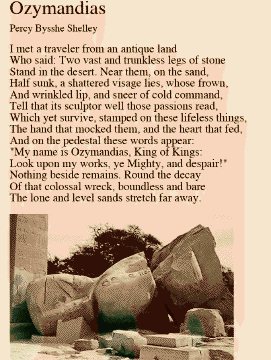
En última instancia, el destino de la humanidad es morir y ser olvidados; los más afortunados logran que sus descendientes los recuerden y hagan ritos funerarios; los héroes pueden aspirar a una estatua, y a que sus historias pasen a grabarse en material duradero. La escritura es, frente a la palabra, como la estatua frente a la persona: imperecedera, al menos de momento. Gilgamesh, el poema, murió, pero ha renacido; y si bien ha de morir, tiene más posibilidades de pervivir que cualquiera de nosotros. El principio de Gilgamesh recuerda al poema Ozymandias de Shelley. Quizá la vida humana quede empequeñecida en ambos, y las ambiciones de los reyes, pero nos transmiten de modo muy vívido, desde luego, la pervivencia inhumana de estatuas e inscripciones como voces que nos llegan desde lo más profundo de los tiempos, voces e imágenes de alguien que quería seguir viviendo aunque fuese sólo con la poca vida que prestamos a una figura de piedra en la que reconocemos una forma humana, o a una inscripción que pronunciamos, las palabras aún vivas de alguien que existe ya sólo como una voz grabada en piedra. En el fundamento de la escritura está el epitafio, una mezcla de voz, piedra, ausencia, y aspiraciones inmortales.
—oOo—
The Pretender
The Pretender
(from ’Andrew’s Brain’, by E. L. Doctorow)
I didn’t know opera singers owned their costumes —they don’t, do the? Yet there he was in that heavy tapestry robe and that knitted crown they affected with the jeweled trimming and the little cross on top. He lifted his glass: To The Pretender, he said, looking at me, and then because he hiccuped his arm jerked back and the contents of his glass made a lovely arc through the air and hit his portrait on the wall behind him, splashing over his face made up as Boris Godunov so that the painting seemed to be shedding tears.
Did this really happen?
What?
Your impulsively going to New Rochelle because you’d heard ’Boris Godunov’ on the radio and then finding this czarist simulacrum lying around drunk?
I’m not angry at you for asking that question because I hardly believed it myself standing there in that dark living room, which incidentally was unheated, which may have been the reason Martha’s large husband had put on that heavy regalia complete with that watch cap of a crown. And, after all, might he not have been listening with some bitterness to the same Saturday broadcast? I stood over him as he looked at me with bleary half-focused eyes. He had lost weight and was no longer the intimidating figure he’d been. He’d been a big humpy manatee of a man, huge and sleek. No more. The double chin, the wide face, the big head, it was all thinned out no, the physiognomy, with his jawline like a wishbone and the hollow cheeks with eeys staring up at me that belonged to a very sick man. I found myself furious, totally unsympathetic, and spoke to him as one speaks to a drunk.
Where is she, Martha, goddamn you, where’s my child?
He staggered to his feet and began to sing the dying scene in his raspy bass, holding his arms out to me.
I ran upstairs, looking in all the rooms. An empty crib, open empty drawers, empty coloset. In the master bedroom a rumpled bed, one closet with just the hangers hanging there. On the floor, some scraps of paper. A folded-up bus schedule. ’Ras-chee-chev. Ras-chee-chev’. [THINKING] Listen, I want to correct the wrong impression I may have given you about my feelings for Briony.
Wait a minute. What did you do then?
What?
After you found Martha gone.
I caught the last train back to Washington. That poor drunk had no more idea where she was than I did. He couldn’t even tell me how long she’d been gone. I had the feeling looking around that it had been quite a while. Of course the kid would be safe with her. She’d left her piano. It was still there in the study. That meant to me Willa was now her life. But there was no rush, this was not an emergency, if I hadn’t impulsively taken that trip I would really have been in the dark. So relatively speaking I was up on things.
And there was a little bit of relief there too, do you suppose?
Well, why not? I’m not ashamed to say it. What is more daunting than a judgment in the eyes of a child? It would come eventually, inevitably. It just wouldn’t be now. But I was trying to tell you something.
Yes?
See, the door was open and there I stood. So to a man, an opera singer costumed as Boris, and seriously drunk, singing the role there in his living room—what could be more reasonable than for Boris to see the fellow standing at the door as the Pretender Grigoriy, with his Polish-Lithuanian army, arrived to take the crown. I had thought he was talking about me, and maybe he was but somehow now also putting me in the opera. I was the false claimant to the throne, you see?
Was he that drunk?
Drunk or not, he was in the play, casting me as the enemy. Some basis for that in my being Martha’s ex. And yes he found just the term, plucked it out of Russian operatic history maybe by way of a deeper recognition. At the root, Andrew is The Pretender, OK? Is that what you want to hear? You’ve interrupted my train of thought. You guys aren’t supposed to do that.
But this is important, don’t you think? Didn’t he make you mad?
Listen, he knew I did cog science. He was not unintelligent. when I left he was singing his heart out to me, following me to the door. So don’t jump to conclusions. I felt sorry for him, to tell you the truth. He kissed me on the top of my head. And then he got down on his knees and begged for my blessing. That’s what Boris does in the opera, he begs for the blessing of the Holy Fool who stands in his mind for all of Russia. So I was no longer the Pretender to the throne. I had been recast as the Holy Fool. Or he might have been acknowledging me as one Pretender to another. After all he couldn’t exclude himself pretending to be the rightful czar. You weren’t there. We were brothers under the skin.
So it was a reprieve, is that what you’re saying? You were absolved of being Andrew the Pretender?
We’re all Pretenders, Doctor, even you. Especially you. Why are you smiling? Pretending is the brain’s work. It’s what it does. The brain can even pretend not to be itself.
Oh? What can it pretend to be, just by way of example?
Well, for the longest time, and until just recently, the soul.
—oOo—
(E. L. Doctorow, ’Andrew’s Brain’, London: Little, Brown, 2014; 98-102)