
John Bunyan
John Bunyan
From The Oxford Companion to English Literature, ed. Margaret Drabble.
BUNYAN, John (1628-1688), born at Elstow, near Bedford, the son of a brazier. He learned to read and write at the village school and was early set to his father's trade. He was drafted into the parliamentary army and was stationed at Newport Pagnell, 1644-6, an experience perhaps reflected in The Holy War. In 1659 he married his first wife, who introduced him to two religious works, Dent's Plain Man's Pathway to Heaven and Bayly's Practice of Piety; these, the Bible, the Prayer Book, and Foxe's *Actes and Monuments were his principal reading matter. In 1653 he joined a Non-conformist church in Bedford, preached there, and came into conflict with the Quakers (see under FRIENDS, SOCIETY OF), against whom he published his first writings, Some Gospel Truths Opened (1656) and A Vindication (1657). He married his second wife Elizabeth c. 1659, his first having died c. 1656 leaving four children. As an itinerant tinker who presented his Puritan mission as apostolic and placed the poor and simple above the mighty and learned, Bunyan was viewed by the Restoration authorities as a militant subversive. Arrested in Nov. 1660 for preaching without a licence, he was derided at his trial as 'a pestilent fellow', to which his wife riposted, 'Beacause he is a tinker, and a poor man, therefore he is despised and cannot have justice.' Bunyan spent most of the next 12 years in Bedford Jail. During the first half of this period he wrote nine books, including his spiritual autobiography, *Grace Abounding to the Chief of Sinners (1666). In 1665 appeared The Holy City, or The New Jerusalem, inspired by a passage in the Book of Revelation. In 1672 he published A Confession of my Faith, and a Reason of My Practice. After his release in 1672 he was appointed pastor at the same church, but was imprisoned again for a short period in 1677 during which he probably finished the first part of *The Pilgrim's Progress, which had been written during the latter years of the first imprisonment. The first part was published in 1678, and the second, together with the whole work, in 1684. His other principal works are The Life and Death of Mr *Badman (1680) and The Holy War (1682). Bunyan preached in many parts, his down-to-earth, humorous, and impassioned style drawing crowds of hundreds, but was not further molested. Theree are recent editions of his more important works by R. Sharrock, who also wrote a biography. See also A Turbulent, Seditious and Factious People: John Bunyan and His Church by C. *Hill (1988).
Grace Abounding to the Chief of Sinners, or The Brief Relation of the Exceeding Mercy of God in Christ to his Poor Servant John Bunyan (1666), a Puritan conversion narrative by *Bunyan, testifying to the focal events in his journey to assurance of salvation. Its pastoral purpose was to comfort his flock at Bedford during his imprisonment. The author bound himself to the Puritan 'plain style', for 'God did not play in convincing of me . . . I may not play in relating'. The document chronicles anguished oscillation between spiritual despair and contrite reassurance and bears witness to the inner struggle of moods ('up and down twenty times in an hour') which typified Puritan experience. External events (military service in the Civil War, marriage, etc.) are subordinate to inner and spiritual events, as Bunyan struggles against the lure of church bells, the doctrines of the *Ranters, Sabbath recreations, dancing, swearing and blaspheming—even against envy of toads and dogs as being exempt from God's wrath. It details his joining of the Bedford church, call to the ministry, and trials.
The Pilgrim's Progress, from This World to That Which Is to Come, a prose allegory by *Bunyan. Part I published 1678 (a second edition with additions appeared in the same year, and a third in 1679), Part II 1684.
The allegory takes the form of a dream by the author. In this he sees *Christian, with a burden on his back and reading in a book, from which he learns that the city in which he and his family dwell will be burned with fire. On the advice of Evangelist, Christian flees from the *City of Destruction, having failed to persuade his wife and children to accompany him. Pt I describes his pilgrimage through the *Slough of Despond, the Interpreter's House, the House Beautiful, the *Valley of Humiliation, the *Valley of the Shadow of Death, *Vanity Fair, *Doubting Casxtle, the *Delectable Mountains, the Country of *Beulah, to the *Celestial City. On the way he encounters various allegorical personages, among them Mr *Worldly Wiseman, *Faithful (who accompanies Christian on his way but is put to death in Vanity Fair), Hopeful (who next joins Christian), Giant *Despair, the foul fiend *Apollyon, and many others.
Pt II relates how Christian's wife Christiana, moved by a vision, sets out with her children on the same pilgrimage, accompanied by her neighbour Mercy, despite the objections of Mrs Timorous and others. They are escorted by *Great-heart, who overcomes Giant Despair and other monsters and brings them to their destination. The work is a development of the Puritan conversion narrative (see GRACE ABOUNDING), drawing on popular literature such as *emblem books and *chapbooks, as well as *Foxe's Book of Martyrs and the Bible. It is remarkable for the beauty and simplicity of its language (Bunyan was permeated with the English of the Bible, though he was also a master of the colloquial English of his own time), the vividness and reality of the characterization, and the author's sense of humour and feeling for the world of nature. It circulated at first mainly in uneducated circles, and its wide appeal is shown by the fact that it has been translated into well over 100 languages. It became a children's classic, regarded by generations of parents as a manual of moral instruction and an aid to literacy, as well as a delightful tale. It was a seminal text in the development of the realistic novel, and Bunyan's humorously caustic development of the tradition of name symbolism influenced *Dickens, *Trollope, and *Thackeray.
The Life and Death of Mr Badman, an allegory by *Bunyan, published 1680.
The allegory takes the form of a dialogue, in which Mr Wiseman relates the life of Mr Badman, recently deceased, and Mr. Attentive comments on it. The youthful Badman shows early signs of his vicious disposition. He beguiles a rich damsel into marriage and ruins her; sets up in trade and swindles his creditors by fraudulent bankruptcies and his customers by false weights; breaks his leg when coming home drunk; and displays a short-lived sickbed repentance. His wife dies of despair and Badman marries again, but his second wife is as wicked as he is and they part 'as poor as Howlets'. Finally Badman dies of a complication of diseases. The story is entertaining as well as edifying and has a place in the evolution of the English novel.
Soy el autor más leído en LINGÜÍSTICA
martes, 10 de noviembre de 2015
Soy el autor más leído en LINGÜÍSTICA
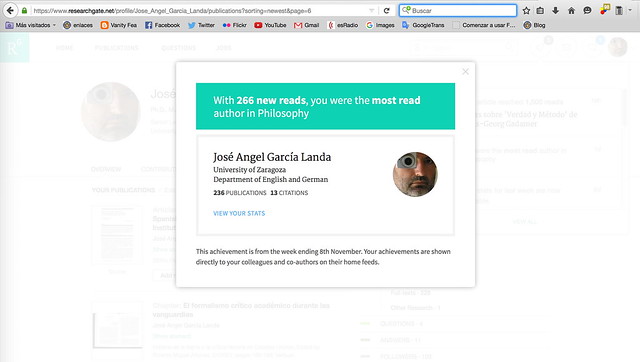
Esta semana pasada, en ResearchGate, he sido el autor más leído en Lingüística. No en mi universidad, sino en el mundo.

La semana que viene, posiblemente no. Pero quién sabe algo de la semana que viene.
—oOo—
El más leído en Filosofía
Keren Ann (live 2002)
André Glucksmann "Une rage d'enfant devenu adulte" | Archive INA
André Glucksmann "Une rage d'enfant devenu adulte" | Archive INA
Acaba de morir André Glucksmann. Aquí repasa ese libro suyo donde repasa el libro de su vida.
Tout le monde en parle : [émission du 25 mars 2006] Le dernier livre d'André GLUCKSMANN s'intitule "Une rage d'enfant". Assis aux côtés de Sandrine BONNAIRE, le philosophe raconte son enfance, ses parents juifs immigrés en Allemagne en 1930. En 1937, ils fuient l'Allemagne pour la France où né le petit André. Pendant l'occupation, les Glucksmann vivent dans la clandestinité. Il est raflé avec sa mère et ses soeurs, mais sauvé grâce à la rage de sa mère. Après la guerre, à 10 ans, il reste en France seul, sa mère étant retournée en Autriche. A 13 ans il adhère au PC qu'il quitte en 1956 pour devenir maoïste. Cette appartenance demeure une honte pour lui, la révolution chinoise étant la pire révolution du 20ème siècle. Dans son livre "La cuisinière et le mangeur d'homme", il comparera les totalitarismes nazi et communiste.Après un intermède musical repris par le public de l'émission, André GLUCKSMANN justifie son soutien à l'intervention américaine en Irak et son désaccord sur l'intervention russe en Tchétchénie.Il explique pourquoi il approuve la publication des caricatures de Mahomet (une opinion laissée à la liberté de chacun) mais contre les quolibets sur les chambres à gaz (un fait ayant existé). INTERVIEW RAGE :André GLUCKSMANN répond aux questions de Thierry ARDISSON sur :-sa rage de vivre ; de se coiffer; à propos de Jacques Chirac; de changer le monde; de vendre moins de livres que Bernard Henri Lévy; sur les jeunes filles "aux petits seins de bakélite" (il aime les petits et les gros seins); les SDF dans le métro; la place de la France dans le monde (la grande absente); Milosevic qui ne sera pas jugé; le fait qu'il doive mourir un jour, ses échecs auprès des femmes; qu'il soit considéré comme un vieux fou en colère.Il tire au hasard une carte qui lui demande de faire la promotion d'un autre livre que le sien. Il choisit "American Vertigo". Images d'archive INA Institut National de l'Audiovisuel
Handel's GIULIO CESARE
Handel's GIULIO CESARE
Handel. Giulio Cesare. Andreas Scholl (Giulio Cesare), Cecilia Bartoli (Cleopatra), Anne Sofie von Otter (Cornelia), Philippe Jaroussky (Sesto), Christophe Dumaux (Tolomeo), Ruben Drole (Achilla), Jochen Kowalsky (Nirena), Peter Kálman (Curio). Il Giardino Armonico / Giovanni Antonini. Stage dir. Moshe Leiser and Patrice Caurier. Live video from the Salzburger Pfingstfestspiele. YouTube 7 Oct. 2013.*
2015
Die Dreigroschenoper
martes, 10 de noviembre de 2015
Die Dreigroschenoper
Un musical de Bertolt Brecht y Kurt Weil, inspirado en The Beggar's Opera de John Gay. Aquí con los arreglos de la producción de 2004 dirigida por Ulrich Waller:
—oOo—