
Ciencia y tecnología
La Historia del Universo
martes, 6 de mayo de 2014
La Historia del Universo
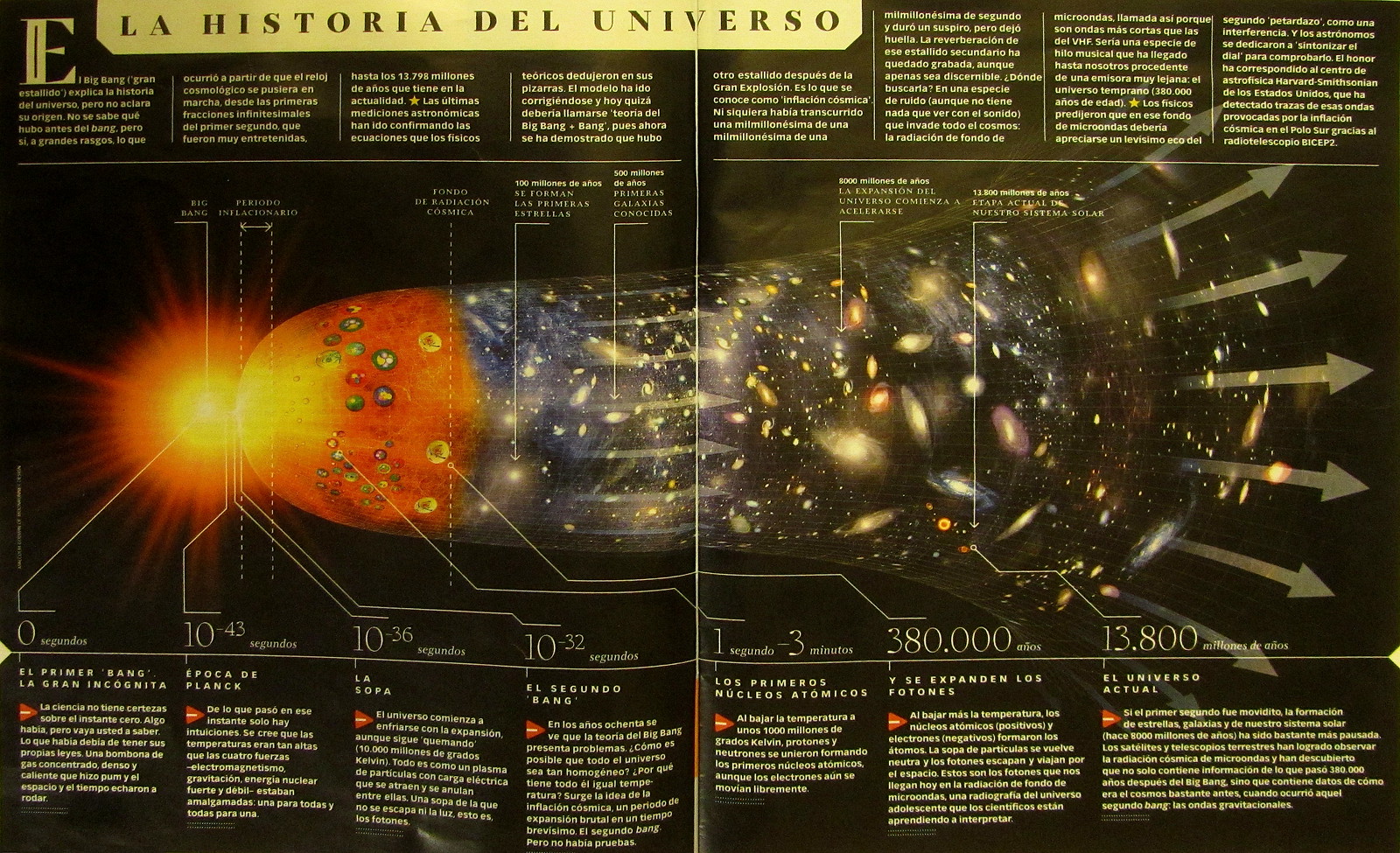
Ilustración del artículo de Ixone Díaz Landaluce, Ixone y Carlos Manuel Sánchez, "Andrei Linde: El hombre que descubrió cómo fue el Big Bang—y que va a ganar un Nobel." XL Semanal 1381 (13-19 abril 2014): 1, 14-22.
Pilar Zaragoza sobre la clonación
An Interview of Lord Martin Rees
Out of Oil Apocalypse
Para psicosomatizadores
jueves, 20 de febrero de 2014
Para psicosomatizadores
Y traumados. Nos pasan esto por PsyArt—un encuentro entre el psicoanálisis y la neuropsiquiatría:
Neural Correlates of Recall of Life Events in Conversion Disorder
Selma Aybek, MD1; Timothy R. Nicholson, MD, PhD1; Fernando Zelaya, PhD2; Owen G. O’Daly, PhD2; Tom J. Craig, MD, PhD3; Anthony S. David, MD1; Richard A. Kanaan, MD, PhD4
JAMA Psychiatry. 2014;71(1):52-60. doi:10.1001/jamapsychiatry.2013.2842.
Importance Freud argued that in conversion disorder (CD) the affect attached to stressful memories is “repressed” and “converted” into physical symptoms, although this has never been subject to scientific study to our knowledge.
Objective To examine the neural correlates of recall of life events judged to be of causal significance in CD.
Design, Setting, and Participants Case-control study. Academic research setting among 12 patients with motor CD and 13 healthy control subjects.
Main Outcomes and Measures Stressful life events were assessed using the Life Events and Difficulties Schedule and rated by a blinded panel for their likelihood to cause CD based on the threat posed and the extent to which subsequent illness might allow escape from some of their consequences (termed escape). Recall of those events (escape condition) was compared with recall of equally threatening control events from the same epoch (severe condition) in a functional magnetic resonance imaging task.
Results Relative to controls, patients showed significantly increased left dorsolateral prefrontal cortex and decreased left hippocampus activity during the escape vs severe condition, accompanied by increased right supplementary motor area and temporoparietal junction activity. Relative to controls, patients failed to activate the right inferior frontal cortex during both conditions, and connectivity between amygdala and motor areas (supplementary motor area and cerebellum) was enhanced.
Conclusions and Relevance These data offer support for the notion that the way adverse events are processed cognitively can be associated with physical symptoms in CD. Abnormal emotion (dorsolateral prefrontal cortex and right inferior frontal cortex) and memory control (hippocampus) are associated with alterations in symptom-related motor planning and body schema (supplementary motor area and temporoparietal junction).
The Thinking Ape: The Enigma of Human Consciousness
martes, 18 de febrero de 2014
The Thinking Ape: The Enigma of Human Consciousness
What is the origin and nature of consciousness? If consciousness is common to humans and animals alike, what are the defining traits of human consciousness?
Nobel laureate psychologist Daniel Kahneman (que es talmente como Dick Pilcher), philosopher David Chalmers, expert in primate cognition Laurie Santos, and physician-scientist Nicholas Schiff will discuss what it means to be "conscious" and examine the human capacities displayed in cognitive, aesthetic, and ethical behaviors, with a focus on the place and function of the mind within nature.
The New York Academy of Sciences Wednesday, October 10, 2012
This event is part of The Emerging Science of Consciousness Series, which brings together leading experts from various fields to discuss how the latest research is challenging our understanding of the very nature and function of consciousness in our daily life.