
Literatura y crítica
La Pocalipsis
viernes, 8 de noviembre de 2013
La Pocalipsis
Alguien ha cogido mi trabajillo de curso sobre Los Cuatro Jinetes del Apocalipsis, de Blasco Ibáñez, de hace casi (o sin casi) treinta años, y lo ha colocado de introducción a una edición electrónica del libro, en "Libros Tauro", y de ahí a Scribd... poniéndole mal el título. La Apocalipsis, la llaman, o la Apolacipsis.... En fin, yo ya ni protesto por estas cosas, además las protestas a Rita.
Mejor lo consideraré mi primera publicación argentina, y no es la menos indicada por cierto.
Memoirs of an English Officer
jueves, 7 de noviembre de 2013
Memoirs of an English Officer
From The Oxford Companion to English Literature, ed. Margaret Drabble.
Memoirs of Captain Carleton, a narrative published 1728 as The Memoirs of an English Officer, by Captain George Carleton. It was once thought to be by *Defoe, but is now known not to be by him or *Swift, to whom the work was sometimes groundlessly attributed. Captain Carleton, who unquestionably existed, is the subject of an attractive tale of soldierly adventure. Sir Walter *Scott, who regarded the Memoirs as Carleton's own work, brought out a new edition in 1808.
Carleton volunteers on board the London on the declaration of war with the Dutch in 1672. In 1674 he enters the service of the prince of Orange, remaining there until the peace of Nijmegen. Returning to England, he receives a commission from James II and serves in Scotland and then in Flanders until the peace of Ryswick. The most interesting part of the memoir follows. Carleton embarks with Lord Peterborough for Spain in 1705, and gives a stirring narrative of the siege, capture, and subsequent relief of Barcelona and of the campaign by which Peterborough, with scanty resources, temporarily placed the Archduke Charles on the throne of Spain. This is followed by some account of various parts of Spain visited by the author as a prisoner of war. See Steig Hargevick, The Disputed Assignment of 'Memoirs of an English Officer' to Daniel Defoe (2 vols; 1972, 1974).
What Is Narratology?
jueves, 7 de noviembre de 2013
What Is Narratology?
He aquí un libro, el primero de la serie "Narratologia: Contributions to Narrative Theory", en el que se me cita en diversas ocasiones. Al parecer lo ha scribdizado Iryna Holodiuk—no sé quién lo desescribdizará; ni siquiera sé si existen los desescribdizadores.
La pregunta "¿Qué es la narratología?" aparece como desamparada y solitaria, y casi parece desalentar una posible respuesta, aquí en primera página—pero no hay tal, porque recibe abundantes respuestas en el resto del libro.
Daniel Defoe
miércoles, 6 de noviembre de 2013
Daniel Defoe
From The Oxford Companion to English Literature, ed. Margaret Drabble.
 DEFOE, Daniel (1660-1731), born in London, the son of James Foe, a butcher. He changed his name to Defoe from c. 1695. He attended Morton's academy for Dissenters at Newington Green with a view to the ministry, but by the time he married Mary Tuffley in 1683/4 he was established as a hosiery merchant in Cornhill, having travelled in France, Spain, the Low Countries, and possibly Italy and Germany; he was absorbed by travel throughout his life. He took part in Monmouth's rebellion, and in 1688 joined the advancing forces of William III. His first important signed work was An Essay upon Projects (1697), followed by The True-Born Englishman (1701), an immensely popular satirical poem attacking the prejudice against a king of foreign birth and his Dutch friends. In 1702 appeared The Shortest Way with Dissenters, a notorious pamphlet in which Defoe, himself a Dissenter, ironically demanded the total and savage suppression of dissent; for this he was fined, imprisoned (May-Nov. 1703) and pilloried. While in prison he wrote his Hymn to the Pillory, a mock-Pindaric *ode which was sold in the streets to sympathetic crowds. Meanwhile various business projects (the breeding of civet cats, marine insurance, a brick works) had come to grief, and Defoe's fortunes were revived by Harley, the Tory politician, who arranged a pardon and employed him as a secret agent; between 1703 and 1714 Defoe travelled around the country for Harley and Godolphin gathering information and testing the political climate. Defoe wrote many pamphlets for Harley, and in 1704 began the Review; in the same year appeared his pamphlet Giving Alms No Charity and in 1706 True Relation of the Apparition of One Mrs Veal, a vivid report of a current ghost story, probably by Defoe. Certain anti-Jacobite pamphlets in 1712-13 led to his prosecution by the Whigs and to a brief imprisonment. He now started a new trade journal, Mercator, in place of the Review. In 1715 he was convicted of libelling Lord Annesley (by implying that he was a Jacobite); he escaped punishment through the intervention of Townshend, the Whig secretary of state.
Defoe was an extremely versatile and prolific writer, and produced some 250 books, pamphlets, and journals, many anonymously or pseudonymously, but the works for which he is best known belong to his later years. *Robinson Crusoe appeared in 1719, the Farther Adventures following a few months later. The next five years saw the appearance of his most important works of fiction: Captain *Singleton in 1720, *Moll Flanders, A Journal of the *Plague Year, and *Colonel Jack in 1722; *Roxana, the *Memoirs of a Cavalier (now considered to be certainly by Defoe), his tracts on Jack *Sheppard, and A New Voyage round the World in 1724; The Four Voyages of Capt. George Roberts in 1726. His Tour through the Whole Island of Great Britain, a guidebook in three volumes (1624-26), is a vivid first-hand account of the state of the country, gleaned from his many travels, the last of which he appears to have taken in 1722. His last principal works were The Complete English Tradesman (1726), Augusta Triumphans (1728), A Plan of the English Commerce (1728) and The Complete English Gentleman, not published until 1890. He died in his lodgings in Ropemaker's Alley, Moorfields, and was buried in what is now Bunhill Fields. Defoe's influence on the evolution of the English novel was enormous, and many regard him as the first true novelist. He was a master of plain prose and powerful narrative, with a journalist's curiosity and love of realistic detail; his peculiar gifts made him one of the greatest reporters of his time, as well as a great imaginative writer who in Robinson Crusoe created one of the most familiar and resonant myths of modern literature. Important work on the Defoe canon by P. N. Furbank and W. R. Owens includes The Canonisation of Defoe (1988), Defoe De-Attributions (1994) and A Critical Biography of Daniel Defoe (1998).
The Review, a periodical started by *Defoe in 1704, under the title of A Weekly Review of the Affairs of France, which after various transformations became A Review of the State of the British Nation in 1707, it lasted until 1713. It was a non-partisan paper, an organ of the commercial interests of the nation: it appeared thrice weekly and was written, practically in its entirety, by Defoe himself, who excpressed in it his opinions on all current political topics, thus initiating the political leading article. It also had lighter articles on love, marriage, gambling, etc.: Defoe's attitude to his readers was that he strove to 'wheedle them in (if it may be allowed that expression) to the knowledge of the world; who, rather than take more pains, would be content with their ignorance, and search into nothing'.
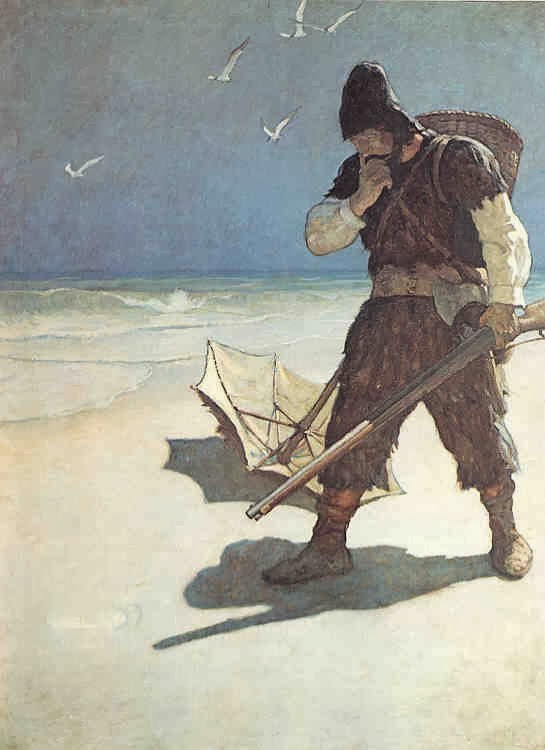
The Life and Strange and Surprising Adventures of Robinson Crusoe, a romance by *Defoe, published 1719.
In 1704 Alexander Selkirk, who had run away to sea and joined a privateering expedition under *Dampier, after a quarrel with his captain was put ashore on the uninhabited island of Juan Fernández. He was rescued in 1709 by Woodes *Rogers. Defoe was probably familiar with several versions of this tale, and added many incidents from his own imagination to his account of Crusoe, presenting it as a true story. The extraordinarily convincing account of the shipwrecked Crusoe's successful efforts to make himself a tolerable existence in his solitude first revealed Defoe's genius for vivid fiction; it has a claim to be the first English novel. Defoe was neraly 60 when he wrote it.
The author tells how, with the help of a few stores and utensils saved from the wreck and the exercise of infinite ingenuity, Crusoe built himself a house, domesticated goats, and made himself a boat. He describes his struggle to accept the workings of Providence, the perturbation of his mind caused by a visit of cannibals, his rescue from death of an indigenous native he later names Friday, and finally the coming of an English ship whose crew are in a state of mutiny, the subduing of the mutineers, and Crusoe's rescue.
The book had immediate and permanent success, was translated into many languages, and inspired many imitations, known generically as 'Robinsonades', including *Philip Quarll, *Peter Wilkins, and *The Swiss Family Robinson. Defoe followed it with The Farther Adventures of Robinson Crusoe (1719), in which with Friday he revisits his island, is attacked by a fleet of canoes on his departure, and loses Friday in the encounter. Serious Reflections . . . of Robinson Crusoe . . . with His Vision of the Angelick World, which is more a manual of piety than a work of fiction, appeared in 1720, and was never as popular. The influence of Robinson Crusoe has been very great. *Rousseau in Émile recommended it as the book that should be studied by a growing boy, *Coleridge praised its evocation of 'the universal man', and *Marx in Das Kapital used it to illustrate economic theory in action.
In recent years 'Man (later Girl) Friday' came to describe a lowly assistant performing a multiplicity of tasks.
In The Rise of the Novel (1957) and other essays ian Watt provides one of the most controversial modern interpretations, relating Crusoe's predicament to the rise of bourgeois individualism, division of labour, and social and spiritual alienation. See David Blewett, The Illustration of Robinson Crusoe, 1719-1920 (1995).
Adventures of Captain Singleton, a romance of adventure by Defoe, published 1720.
Singleton, the first-person narrator, having been kidnapped in his infancy is sent to sea. Having 'no sense of virtue or religion', he takes part in a mutiny and is put ashore in Madagascar with his comrades; he reaches the continent of Africa and crosses it from east to west, encountering many adventures and obtaining much gold, which he dissipates on his return to England. He takes once more to the sea, becomes a pirate, carrying on his depredations in the West Indies, Indian Ocean, and China Seas, acquires great wealth, which he brings home, and finally marries the sister of a shipmate.
The Fortunes and Misfortunes of the Famous Moll Flanders, a romance by *Defoe, published 1722.
This purports to be the autobiography of the daughter of a woman who had been transported to Virginia for theft soon after her child's birth. The child, abandoned in England, is brought up in the house of the compassionate mayor of Colchester. The story relates her seduction, her subsequent marriages and liaisons, and her visit to Virginia, where she finds her mother and discovers that she has unwittingly married her own brother. After leaving him and returning to England, she is presently reduced to destitution. She becomes an extremely successful pickpocket and thief, but is presently detected and transported to Virginia in company with one of her former husbands, a highwayman. With the funds that each has amassed they set up as planters, and Moll moreover finds that she has inherited a plantation from her mother. She and her husband spend their declining years in an atmosphere of prosperity and ostensible penitence.
A Journal of the Plague Year, a historical fiction by *Defoe, published 1722.
It purports to be the narrative of a resident in London during 1664-5, the year of the Great Plague; the initials 'H.F.' which conclude it have been taken to refer to Defoe's uncle Henry Foe, a saddler, from whom the author may have heard some of the details he describes. It tells of the gradual spread of the plague, the terror of the inhabitants, and the steps taken by the authorities, such as the shutting up of infected houses and the prohibition of public gatherings. The symptoms of the disease, the circulation of the dead-carts, the burials in mass graves, and the terrible sce
nes witnessed by the supposed narrator are described with extraordinary vividness. The general effects of the epidemic, notably in the closing down of trading and the flight from the city, are also related, and an estimate of the total number of deaths is made. The Journal embodied information from various sources, including official documents; some scenes appear to have been borrowed from *Dekker's The Wonderfull Yeare (1603). Defoe's subject was suggested by fears of another outbreak, following the one in Marseilles in 1721 which occasioned Sir Robert *Walpole's unpopular Quarantine Act. *Hazlitt ascribed to the work 'an epic grandeur, as well as heart-breaking familiarity'.
Colonel Jack, The History and Remarkable Life of Colonel Jacque, Commonly Call'd, a romance of adventure by *Defoe, published 1722.
The supposed narrator, abandoned by his parents in childhood, falls into bad company and becomes a pickpocket. His profession grows distasteful to him, he enlists, and presently deserts to avoid being sent to serve in Flanders. He is kidnapped, sent to Virginia, and sold to a planter. He is promoted to be an overseer, is given his liberty, becomes himself a planter, and acquires much wealth. He returns home and has a series of unfortunate matrimonial adventures, but finally ends in prosperity and repentenace.
Roxana, or The Fortunate Mistress, a novel by *Defoe, published 1724.
This purports to be the autobiography of Mlle Beleau, the beautiful daughter of Prench Protestant refugees, brought up in England and married to a London brewer, who, having squandered his property, deserts her and her five children. She enters upon a career of prosperous wickedness, passing from one protector to another in England, France, and Holland, amassing much wealth, and receiving the name Roxana by accident, in consequence of a dance that she performs. She is accompanied in her adventures by a faithful maid, Amy, a very human figure. She marries a respectable Dutch merchant in London and subsequently lives as a person of consequence in Holland. When one of her daughters appears on the scene in London, Roxana dares not acknowledge her, fearing that her past life will be revealed to her new spouse and her life of security will be ruined. When Amy says she will murder the girl, if necessary, to silence her inquiries about Roxana's identity, Roxana is filled with horror and relief. Both Amy and the girl disappear, and Roxana, miserable and apprehensive, is tormented by her conscience. Her husband discerns her iniquity and soon thereafter dies, leaving her only a small sum of money. In the company of her alter ego Amy, Roxana descends into debt, poverty, and remorseful penitence.
Memoirs of a Cavalier, a historical romance most probably by Defoe, published 1724.
The pretended author, 'Col. Andrew Newport', a young English gentleman born in 1608, travels on the Continent, starting in 1630 goes to Vienna, and accompanies the army of the emperor, being present at the siege and sack of Magdeburg, which is vividly presented. He then joins the army of Gustavus Adolphus, remaining with it until the death of that king and taking part in a number of engagements which he describes in detail. After his return to England he joins the king's army, first against the Scots, then against the forces of Parliament, being present at the battle of Edgehill, which he fully describes, the relief of York, and the battle of Naseby.
Twelfth Night - dir. Kenneth Branagh
The University Wits
miércoles, 6 de noviembre de 2013
The University Wits
From The Oxford Companion to English Literature, ed. Margaret Drabble.
John Lyly
Lyly, John (?1554-1606), the grandson of William *Lily. He was educated possibly at the King's School, Canterbury, then at Magdalen College, Oxford. He studied also at Cambridge. He was MP successively for Hindon, Aylesbury, and Appleby (1589-1601), and supported the cause of the bishops in the *Martin Marprelate controversy in a satirical pamphlet, *Pappe with an Hatchet (1589). The first part of his *Euphues, the Anatomy of Wit appeared in 1578, and the second part, Euphues and His England, in 1580. Its peculiar style came to be known as 'Euphuism'. Among Lyly's plays, all of which were written for performance by boy actors to courtly audiences, are Alexander, Campaspe and Diogenes (see under Campaspe, its later title); Sapho and Phao (1584); Endimion (1591); Midas (1592), Mother Bombie (1594, see under Bumby). The attractive songs in the plays, including such well-known lyrics as 'Cupid and my Campaspe played', were first printed in Blount's collected edition of 1632; it is doubtful to what extent theyh are the work of Lyly. Although Euphues was Lyly's most popular and influential work in the Elizabethan period, his plays are now admired for their flexible use of dramatic prose and the elegant patterning of their construction. R. W. Bond edited Lyly's works in 1902, and there is a good study of him by G. K. Hunter, John Lyly: The Humanist as Courtier (1962).
George Peele
Peele, George (1556-96), the son of James Peele, clerk of Christ's Hospital and author of city pageants and books on accountancy. He was educated at *Christ's Hospital, Broadgates Hall (Pembroke College), and Christ Church, Oxford. From about 1581 he was mainly resident in London, and puruing an active and varied literary career. He was an associate of many other writers of the period, such as Thomas *Watson and Robert *Greene. His works fall into three main categories: plays, pageants, and 'gratulatory' and miscellaneous verse. His surviving plays are *The Araygnement of Paris (1585), Edward I (1593), *The Battle of Alcazar (1594); *The Old Wives Tale (1595); and *David and Fair Bethsabe (1599). His miscellaneous verse includes *Polyhymnia (1590) and The Hounour of the Garter (1593), a gratulatory poem to the Earl of Northumberland. Peele's work is dominated by courtly and patriotic themes, and his technical achievements include extending the range of non-dramatic blank verse. The jest book The Merrie Conceited Jests of George Peele (1607) seems to bear little relation to Peele's actual personality. His Life and Works were edited by C. T. Prouty (3 vols, 1952-70).
Robert Greene
Greene, Robert (1558-92), born in Norwich, educated at St John's College and Clare Hall, Cambridge, from 1575 until 1583, and incorporated at Oxford in 1588. From about 1585 he lived mainly in London. Although he liked to stress his connections with both universities, his later literary persona was that of a feckless drunkard, who abandoned his wife and children to throw himself on the mercies of tavern hostesses and courtesans; writing pamphlets and plays was supposedly a last resort when his credit failed. He is said to have died of a surfeit of Rhenish wine and pickled herrings, though it may more likely have been plague, of which there was a severe outbreak in 1592. Greene was attacked at length by Gabriel *Harvey in Foure Letters (1592) as the 'Ape of Euphues' and 'Patriarch of shifters'; *Nashe defended him in Strange Newes in the same year, acknowledging Greene to have been a drunkard and a debtor, but claiming that 'Hee inherited more vertues than vices.' Greene's 37 publications, progressing from moral dialogues to prose romances, romantic plays, and finally realistic accounts of underworld life, bear out Nashe's assertion that printers were only too glad 'to pay him deare for the very dregs of his wit'. The sententious moral tone of his works suggests that his personal fecklessness and deathbed repentance may have been partly a pose.
Among the more attractive of his romances are the Lylyan sequel Euphues his Censure to Philautus (1587); *Pandosto: The Triumph of Time and Perimedes the Blacke-Smith (1588); *Menaphon (1589). Among his 'repentance' pamphlets are Greenes Mourning Garment and Greenes Never too Late (1590) and the work attributed to him *Greenes Groats-Worth of Witte (1592). Greenes Vision (1592) is a fictionalized acccount of his deathbed repentance in which he receives advice from *Chaucer, *Gower, and King Solomon. The low-life pamphlets include A Notable Discover of Coosenage (1591) and three 'conny-catching' pamphlets in the same years 1591-2. His eight plays were all published posthumously. The best known are Orlando furioso (1595), *Frier Bacon and Frier Bongay (1594) and *James the Fourth (1598), of which there are editions by J. A. Lavin and N. Sanders.
Greene is now best known for his connections with Shakespeare. The attack on him in the Groats-Worth of Witte (below) as an 'upstart Crow, beautified with our feathers' is the first reference to Shakespeare as a London dramatist, and his Pandosto provided Shakespare with the source for *The Winter's Tale. The voluminousness of Greene's works and the supposed profligacy of his life have caused him to be identified with the typical Elizabethan hack writer; he probably provided a name and a model for the swaggering Nick Greene in Virginia *Woolf's Orlando (1928) . Green's works were edited in 15 volumes by *Grosart (1881-6).
Greenes Groats-Worth of Witte, Bought with a Million of Repentance, a prose tract attributed to Robert *Greene, but edited and perhaps written by Henry *Chettle, published 1592.
It begins with the death of the miser Gorinius, who leaves the bulk of his large fortune to his elder son Lucanio, and only 'an old groat' to the younger, Roberto (i.e. the author), 'wherewith I wish him to buy a groatsworth of wit'. Roberto conspires with a courtesan to fleece his brother, but the courtesan betrays him, subsequently ruining Lucanio for her sole profit. The gradual degradation of Roberto is then narrated, and the tract ends with the curious 'Address' to his fellow playwrights *Marlowe, *Lodge, and *Peele, urging them to spend their wits to better purpose than the making of plays. It contains the well-known passage aobut the 'upstart Crow, beautified with our feathers', the *'Johannes fac totum¡, who 'is in his owne conceit the onely Shake-scene in a countrey', which probably refers to Shakespeare as a non-graduate dramatist newly arrived in London.
Thomas Lodge
Lodge, Thomas (1558-1625), son of Sir Thomas Lodge, lord mayor of London, educated at Merchant Taylors' School, London, and Trinity Colelge, Oxford. He was a student of Lincoln's Inn in 1578. In 1579 he pubished an anonymous Defence of Poetyr, Music, and Stage Plays, a reply to *Gosson's Schoole of Abuse, and in 1584 An Alarum against Usurers (dedicated to Sir Philip *Sidney), depicting the danger that moneylenders present to young spendthrifts. Appended to it was a prose romance Forbonius and Prisceria. *Scillaes Metamorphosis, an Ovidian verse fable, was published in 1589. In about 1586 Lodge sailed on a privateering expedition to the Terceras and the Canaries, and in 1591-3 to South America. On the earlier voyage he wrote his best-known romance *Rosalynde (1590), 'hatcht in the stormes of the Ocean, and feathered in the surges of many perillous seas'. After four more minor prose romances he published Phillis: Honoured with Pastorall Sonnets, Elegies, and Amorous Delights (1593), including many poems adapted from Italian and French models , to which was appended 'The Complaynt of Elstred', the story of the unhappy mistress of King *Locrine. His play The Wounds of Civill War (1594), about Marius and Sulla, had been performed by the Lord Admiral's Men; he also wrote A Looking Glasse for London and England (1594), in collaboration with Robert *Greene. It is not clear whether he wrote any other plays. A Fig for Momus (1595) was a miscellaneous collection of satirical poems including epistles addressed to Samuel *Daniel and Michael *Drayton. Wits Miserie, and the Worlds Madnesse: Discovering the Devils Incarnate of this Age was published in 1596, as was a remarkable romance, *A Margarite of America, written during his second voyage, under Thomas Cavendish, while they were near the Magellan Straits. Lodge soon after this became a Roman Catholic, and studied medicine at Avignon; he was incorporated MD at Oxford in 1602, and in the next year published A Treatise of the Plague. He completed two major works of translation: The Famous and Memorable Works of Josephus (1602), which was frequently reprinted, and The Workes of Lucius Annaeus Seneca (1614). His last work was a translation of Goulart's commentary on *Du Bartas (1621). Lodge is now mainly remembered for Rosalynde and for the lyrics scattered throughout his romances. His works were edited by E. *Gosse (4 vols, 1883).
Other "University Wits":
Thomas Nashe
Thomas Watson
Thomas Kyd
Christopher Marlowe
Sentiments and Spectators: Adam Smith's Moral Philosophy
lunes, 4 de noviembre de 2013
Sentiments and Spectators: Adam Smith's Moral Phiilosophy
A lecture by Geoffrey Sayre-McCord, "Sentiments and Spectators: Adam Smith's Moral Philosophy." (The Human Nature Tradition in Anglo-Scottish Philosophy: History and Future Prospects. The Shalem Center, Jerusalem, Dec. 14-17, 2009). YouTube (gsmunc)
2013