Blogia
Vanity Fea

Literatura y crítica

The Fates of Men

domingo, 16 de septiembre de 2012

The Fates of Men


Poema anónimo anglosajón. Aparece en el Project Gutenberg eBook of Old English Poems. Tiene un cierto toque a la canción  Who By Fire de Leonard Cohen.


Full often through the grace of God it happens
That man and wife to the world bring forth
A babe by birth; they brightly adorn it,
And tend it and teach it till the time comes on
With the passing of years when the young child’s limbs
Have grown in strength and sturdy grace.
It is fondled and fed by father and mother
And gladdened with gifts. God alone knows
What fate shall be his in the fast-moving years.
To one it chances in his childhood days
To be snatched away by sudden death
In woeful wise. The wolf shall devour him,
The hoary heath-dweller. Heart-sick with grief,
His mother shall mourn him; but man cannot change it.
One of hunger shall starve; one the storm shall drown.
One the spear shall pierce; one shall perish in war.
One shall lead his life without light in his eyes,
Shall feel his way fearing. Infirm in his step,
One his wounds shall bewail, his woeful pains—
Mournful in mind shall lament his fate.
One from the top of a tree in the woods
Without feathers shall fall, but he flies none the less,
Swoops in descent till he seems no longer
The forest tree’s fruit: at its foot on the ground
He sinks in silence, his soul departed—
On the roots now lies his lifeless body.
One shall fare afoot on far-away paths,
Shall bear on his back his burdensome load,
Tread the dewy track among tribes unfriendly
Amid foreign foemen. Few are alive
To welcome the wanderer. The woeful face
Of the hapless outcast is hateful to men.
One shall end life on the lofty gallows;
Dead shall he hang till the house of his soul,
His bloody body is broken and mangled:
His eyes shall be plucked by the plundering raven,
The sallow-hued spoiler, while soulless he lies,
And helpless to fight with his hands in defense
Against the grim thief. Gone is his life.
With his skin plucked off and his soul departed,
The body all bleached shall abide its fate;
The death-mist shall drown him— doomed to disgrace.
The body of one shall burn on the fire;
The flame shall feed on the fated man,
And death shall descend full sudden upon him
In the lurid glow. Loud weeps the mother
As her boy in the brands is burned to ashes.
One the sword shall slay as he sits in the mead-hall
Angry with ale; it shall end his life,
Wine-sated warrior: his words were too reckless!
One shall meet his death through the drinking of beer,
Maddened with mead, when no measure he sets
To the words of his mouth through wisdom of mind;
He shall lose his life in loathsome wise,
Shall shamefully suffer, shut off from joy,
And men shall know him by the name of self-slayer,
Shall deplore with their mouths the mead-drinker’s fall.
One his hardships of youth through the help of God
Overcomes and brings his burdens to naught,
And his age when it comes shall be crowned with joy;
He shall prosper in pleasure, in plenty and wealth,
With flourishing family and flowing mead—
For such worthy rewards may one well wish to live!
Thus many the fortunes the mighty Lord
All over the earth to everyone grants,
Dispenses powers as his pleasure shall lead him.
One is favored with fortune; one failure in life;
One pleasure in youth; one prowess in war,
The sternest of strife; one in striking and shooting
Earns his honors. And often in games
One is crafty and cunning. A clerk shall one be,
Weighted with wisdom. Wonderful skill
Is one granted to gain in the goldsmith’s art;
Full often he decks and adorns in glory
A great king’s noble, who gives him rewards,
Grants him broad lands, which he gladly receives.
One shall give pleasure to people assembled
On the benches at beer, shall bring to them mirth,
Where drinkers are draining their draughts of joy.
One holding his harp in his hands, at the feet
Of his lord shall sit and receive a reward;
Fast shall his fingers fly o’er the strings;
Daringly dancing and darting across,
With his nails he shall pluck them. His need is great.
One shall make tame the towering falcon,
The hawk on his hand, till the haughty bird
Grows quiet and gentle; jesses he makes him,
Feeds in fetters the feather-proud hawk,
The daring air-treader with daintiest morsels,
Till the falcon performs the feeder’s will:
Hooded and belled, he obeys his master,
Tamed and trained as his teacher desires.
Thus in wondrous wise the Warden of Glory
Through every land has allotted to men
Cunning and craft; his decrees go forth
To all men on earth of every race.
For the graces granted let us give him thanks—
For his manifold mercies to the men of earth.
El viento de tormenta

La rebelión de Satanás


La rebelión de Satanás


Del Génesis B, poema contenido en un manuscrito de hace mil años, el códice anglosajón Junius 11. Hay una edición en red en Project Gutenberg:


 V

(ll. 235-236) "...Eat freely of the fruit of every other tree. From that one tree refrain. Beware of its fruit. And ye shall know no dearth of pleasant things."

(ll. 237-245) Eagerly they bowed them down before the King of heaven, and gave Him thanks for all, for His teachings and counsels. And He gave them that land to dwell in. Then the Holy Lord, the Steadfast King, departed into heaven. And the creatures of His hand abode together on the earth. They had no whit of care to grieve them, but only to do the will of God for ever. Dear were they unto God as long as they would keep His holy word.

VI

(ll. 246-260) The Holy Lord, All-wielding God, with mighty hand had wrought ten angel-orders in whom He trusted well, that they would do Him service, and work His will. Therefore God gave them reason, with His own hands shaped them, and stablished them in bliss. But one He made so great and strong of heart, He let him wield such power in heaven next unto God, so radiant-hued He wrought him, so fair his form in heaven which God had given, that he was like unto the shining stars. He should have sung his Maker's praise, and prized his bliss in heaven. He should have thanked his Lord for the great boon He showered on him in the heavenly light, and let him long enjoy. But he turned him to a worse thing, and strove to stir up strife against the Highest Lord of heaven, who sitteth on the throne of glory.

(ll. 261-276) Dear was he to our Lord. Nor could it long be hid from God that pride was growing in His angel's heart. He set himself against his Leader, scoffed at God with boasting, and would not serve Him. He said his form was beautiful and bright, gleaming and fair of hue. Nor could he find it in his heart to serve the Lord God, or be subject to Him. It seemed to him that he had greater strength and larger following than Holy God might have. Many words the angel spake in his presumption. By his own power alone he thought to build a stronger throne and mightier in heaven. He said his heart was urging him to toil, to build a stately palace in the north and west. He said he doubted in his heart if he would still be subject unto God:

(ll. 277-291) "Why should I slave?" quoth he. "I need not serve a master. My hands are strong to work full many a wonder. Power enough have I to rear a goodlier throne, a higher in the heavens. Why should I fawn for His favour, or yield Him such submission? I may be God as well as He! Brave comrades stand about me; stout-hearted heroes who will not fail me in the fray. These valiant souls have chosen me their lord. With such peers one may ponder counsel, and gain a following. Devoted are these friends and faithful-hearted; and I may be their lord and rule this realm. It seemeth no wise right to me that I should cringe a whit to God for any good. I will not serve Him longer."

(ll. 292-298) Now when God had heard all this, how His angel was beginning to make presumptuous head against his Leader, speaking rash words of insolence against his Lord, needs must he make atonement for that deed, endure the woe of strife, and bear his punishment, most grievous of all deaths. And so doth every man who wickedly thinketh to strive with God, the Lord of might.

(ll. 299-319) Then Almighty God, High Lord of heaven, was filled with wrath, and hurled him from his lofty throne. He had gained his Master's hate, and lost His favour. God's heart was hardened against him. Wherefore he needs must sink into the pit of torment because he strove against the Lord of heaven. He banished him from grace and cast him into hell, into the deep abyss where he became a devil. The Fiend and all his followers fell from heaven; three nights and days the angels fell from heaven into hell. God changed them all to devils. Because they heeded not His deed and word, therefore Almighty God hurled them into darkness, deep under earth, crushed them and set them in the mirk of hell. There through the never-ending watches of the night the fiends endure an unremitting fire. Then at the dawn cometh an east wind, and bitter frost, ever a blast of fire or storm of frost. And each must have his share of suffering wrought for his punishment. Their world was changed when God filled full the pit of hell with His foes!

(ll. 320-322) But the angels who kept their faith with God dwelt in the heights of heaven.

VII

(ll. 322-336) The other fiends who waged so fierce a war with God lay wrapped in flames. They suffer torment, hot and surging flame in the midst of hell, broad-stretching blaze of fire and bitter smoke, darkness and gloom, because they broke allegiance unto God. Their folly and the angel's pride deceived them. They would not heed the word of God. Great was their punishment! They fell, through folly and through pride, to fiery depths of flame in hell. They sought another home devoid of light and filled with fire—a mighty flaming death. The fiends perceived that through the might of God, because of their presumptuous hearts and boundless insolence, they had won a measureless woe.

(ll. 337-355) Then spake their haughty king, who formerly was fairest of the angels, most radiant in heaven, beloved of his Leader and dear unto his Lord, until they turned to folly, and Almighty God was moved to anger at their wantonness, and hurled him down to depths of torment on that bed of death. He named him with a name, and said their leader should be called from thenceforth Satan. He bade him rule the black abyss of hell in place of striving against God. Satan spake—who now must needs have charge of hell and dwell in the abyss—in bitterness he spake who once had been God's angel, radiant-hued in heaven, until his pride and boundless arrogance betrayed him, so that he would not do the bidding of the Lord of hosts. Bitterness was welling in his heart; and round him blazed his cruel torment. These words he spake:

(ll. 355-367) "This narrow place is little like those other realms we knew, on high in heaven, allotted by my Lord, though the Almighty hath not granted us to hold our state, or rule our kingdom. He hath done us wrong to hurl us to the fiery depths of hell, and strip us of our heavenly realm. He hath ordained that human kind shall settle there. That is my greatest grief that Adam—wrought of earth—should hold my firm-set throne and live in joy, while we endure this bitter woe in hell.

(ll. 368-388) "Alas! could I but use my hands and have my freedom for an hour, one winter hour, then with this host I would— But bands of iron crush me down, the bondage of my chains is heavy. I am stripped of my dominion. Firmly are hell's fetters forged upon me. Above me and below a blaze of fire! Never have I seen a realm more fatal—flame unassuaged that surges over hell. Ensnaring links and heavy shackles hold me. My ways are trammelled up; my feet are bound; my hands are fastened. Closed are the doors of hell, the way cut off. I may not escape out of my bonds, but mighty gyves of tempered iron, hammered hot, press hard upon me. God hath set His foot upon my neck. So I know the Lord of hosts hath read the purpose of my heart, and knew full well that strife would grow between our host and Adam over the heavenly realm, had I the freedom of my hands.

VIII

(ll. 389-400) "But now we suffer throes of hell, fire and darkness, bottomless and grim. God hath thrust us out into the black mists. He cannot charge upon us any sin or evil wrought against Him in His realm! Yet hath He robbed us of the light and cast us into utter woe. Nor may we take revenge, nor do Him any evil because He stripped us of the light. He hath marked out the borders of the world, and there created man in His own image, with whom He hopes again to people heaven, with pure souls. We needs must ponder earnestly to wreak this grudge on Adam, if we may, and on his children, and thwart His will if so we may devise.

(ll. 401-407) "No longer have I any hope of light wherein He thinketh long to joy, in bliss among His angel hosts; nor may we ever bring this thing to pass, that we should change the purpose of Almighty God. Let us therefore turn the heavenly kingdom from the sons of men, since we may not possess it, cause them to lose His favour and turn aside from the command He laid upon them. Then shall His wrath be kindled, and He shall cast them out from grace. They shall seek out hell and its grim gulf, and in this heavy bondage we may have the sons of men to serve us.

(ll. 408-424) "Begin now and plan this enterprise. If ever in olden days, when happily we dwelt in that good kingdom, and held possession of our thrones, I dealt out princely treasure to any thane, he could not make requital for my gifts at any better time than now, if some one of my thanes would be my helper, escaping outward through these bolted gates, with strength to wing his way on high where, new-created, Adam and Eve, surrounded with abundance, dwell on earth—and we are cast out hither in this deep abyss. They are now much dearer unto God, and own the high estate and rightful realm which we should have in heaven! Good fortune is allotted to mankind.

(ll. 425-437) "My soul is sorrowful within me, my heart is sore, that they should hold the heavenly realm for ever. But if in any wise some one of you could bring them to forsake God's word and teaching, soon would they be less pleasing unto Him! If they break His commandment, then will His wrath be kindled. Their high estate shall vanish; their sin shall have requital, and some grim penalty. Take thought now how ye may ensnare them. I shall rest softly in these chains if they lose heaven. Whoso shall bring this thing to pass shall have reward for ever, of all that we may win to our advantage, amid these flames.


Sigue la tentación de Eva, y la escena de la manzana. El origen del símbolo de Apple. El Satanás del poema anglosajón es un cabecilla rebelde que se ha alzado contra su señor feudal. Pueden compararse los versos del más famoso monólogo de Satanás en el Paríso Perdido de Milton, donde el tono es más subjetivo y existencial, con más énfasis en la interioridad:


Hadst thou the same free will and power to stand?
Thou hadst. Whom has thou then, or what, to accuse,
But Heaven's free love dealt equally to all?
Be then his love accursed, since, love or hate,
To me alike it deals eternal woe.
Nay, cursed be thou; since against his thy will
Chose freely what it now so justly rues.
Me miserable! which way shall I fly
Infinite wrath and infinite despair?
Which way I fly is Hell; myself am Hell;
And, in the lowest deep, a lower deep
Still threatening to devour me opens wide,
To which the Hell I suffer seems a Heaven.
O, then, at last relent! Is there no place
Left for repentence, none for pardon left?
None left but by submission; and that word
Disdain forbids me, and my dread of shame
Among the Spirits beneath, whom I seduced
With other promises and other vaunts
Than to submit, boasting I could subdue
The Omnipotent. Aye me! they little know
How dearly I abide that boast so vain,
Under what torments inwardly I groan.

Y de ahí a James Joyce: "Non serviam!"

Según Michael Alexander, no es imposible que Milton conociese este texto del Génesis B, pues estudió anglosajón y conocía a Junius, el primer editor del manuscrito.


Whoever You Are Holding Me Now in Hand

viernes, 14 de septiembre de 2012

Whoever You Are Holding Me Now In Hand

Walt Whitman


Whoever you are holding me now in hand,  
Without one thing all will be useless,  
I give you fair warning before you attempt me further,  
I am not what you supposed, but far different.   

Who is he that would become my follower?  
Who would sign himself a candidate for my affections?   

The way is suspicious, the result uncertain, perhaps destructive,  
You would have to give up all else, I alone would expect to be your sole and exclusive standard,  
Your novitiate would even then be long and exhausting,  
The whole past theory of your life and all conformity to the lives around you would have to be abandon'd,  
Therefore release me now before troubling yourself any further, let go your hand from my shoulders,  
Put me down and depart on your way.   

Or else by stealth in some wood for trial,  
Or back of a rock in the open air,  
(For in any roof'd room of a house I emerge not, nor in company,  
And in libraries I lie as one dumb, a gawk, or unborn, or dead,)  
But just possibly with you on a high hill, first watching lest any person for miles around approach unawares,  
Or possibly with you sailing at sea, or on the beach of the sea or some quiet island,  
Here to put your lips upon mine I permit you,  
With the comrade's long-dwelling kiss or the new husband's kiss,  
For I am the new husband and I am the comrade.  

Or if you will, thrusting me beneath your clothing,  
Where I may feel the throbs of your heart or rest upon your hip,  
Carry me when you go forth over land or sea;  
For thus merely touching you is enough, is best,  
And thus touching you would I silently sleep and be carried eternally.   

But these leaves conning you con at peril,  
For these leaves and me you will not understand,  
They will elude you at first and still more afterward, I will certainly elude you.  
Even while you should think you had unquestionably caught me, behold!  
Already you see I have escaped from you.

For it is not for what I have put into it that I have written this book,  
Nor is it by reading it you will acquire it,  
Nor do those know me best who admire me and vauntingly praise me,  
Nor will the candidates for my love (unless at most a very few)  prove victorious,  
Nor will my poems do good only, they will do just as much evil,  perhaps more, 
For all is useless without that which you may guess at many times and not hit, that which I hinted at;  
Therefore release me and depart on your way.


______


Este poema viene de Leaves of Grass. Aquí estoy seleccionando las lecturas para literatura inglesa y americana... y visitando mucho Project Gutenberg.

Jane Eyre Videobook

Del muy recomendable canal CCProse:
 

Darkness

miércoles, 12 de septiembre de 2012


Darkness


—a poem by George Gordon, Lord Byron


I had a dream, which was not all a dream.
The bright sun was extinguish'd, and the stars
Did wander darkling in the eternal space,
Rayless, and pathless, and the icy earth
Swung blind and blackening in the moonless air;
Morn came and went--and came, and brought no day,
And men forgot their passions in the dread
Of this their desolation; and all hearts
Were chill'd into a selfish prayer for light:
And they did live by watchfires--and the thrones,
The palaces of crowned kings--the huts,
The habitations of all things which dwell,
Were burnt for beacons; cities were consum'd,
And men were gather'd round their blazing homes
To look once more into each other's face;
Happy were those who dwelt within the eye
Of the volcanos, and their mountain-torch:
A fearful hope was all the world contain'd;
Forests were set on fire--but hour by hour
They fell and faded--and the crackling trunks
Extinguish'd with a crash--and all was black.
The brows of men by the despairing light
Wore an unearthly aspect, as by fits
The flashes fell upon them; some lay down
And hid their eyes and wept; and some did rest
Their chins upon their clenched hands, and smil'd;
And others hurried to and fro, and fed
Their funeral piles with fuel, and look'd up
With mad disquietude on the dull sky,
The pall of a past world; and then again
With curses cast them down upon the dust,
And gnash'd their teeth and howl'd: the wild birds shriek'd
And, terrified, did flutter on the ground,
And flap their useless wings; the wildest brutes
Came tame and tremulous; and vipers crawl'd
And twin'd themselves among the multitude,
Hissing, but stingless--they were slain for food.
And War, which for a moment was no more,
Did glut himself again: a meal was bought
With blood, and each sate sullenly apart
Gorging himself in gloom: no love was left;
All earth was but one thought--and that was death
Immediate and inglorious; and the pang
Of famine fed upon all entrails--men
Died, and their bones were tombless as their flesh;
The meagre by the meagre were devour'd,
Even dogs assail'd their masters, all save one,
And he was faithful to a corse, and kept
The birds and beasts and famish'd men at bay,
Till hunger clung them, or the dropping dead
Lur'd their lank jaws; himself sought out no food,
But with a piteous and perpetual moan,
And a quick desolate cry, licking the hand
Which answer'd not with a caress--he died.
The crowd was famish'd by degrees; but two
Of an enormous city did survive,
And they were enemies: they met beside
The dying embers of an altar-place
Where had been heap'd a mass of holy things
For an unholy usage; they rak'd up,
And shivering scrap'd with their cold skeleton hands
The feeble ashes, and their feeble breath
Blew for a little life, and made a flame
Which was a mockery; then they lifted up
Their eyes as it grew lighter, and beheld
Each other's aspects--saw, and shriek'd, and died--
Even of their mutual hideousness they died,
Unknowing who he was upon whose brow
Famine had written Fiend. The world was void,
The populous and the powerful was a lump,
Seasonless, herbless, treeless, manless, lifeless--
A lump of death--a chaos of hard clay.
The rivers, lakes and ocean all stood still,
And nothing stirr'd within their silent depths;
Ships sailorless lay rotting on the sea,
And their masts fell down piecemeal: as they dropp'd
They slept on the abyss without a surge--
The waves were dead; the tides were in their grave,
The moon, their mistress, had expir'd before;
The winds were wither'd in the stagnant air,
And the clouds perish'd; Darkness had no need
Of aid from them--She was the Universe. 


libertine
The Road, and Company


Metaphysical Wit

miércoles, 12 de septiembre de 2012

Metaphysical Wit

From Samuel Johnson's Lives of the English Poets (Life of Cowley):

Wit, like all other things subject by their nature to the choice of man, has its changes and fashions, and at different times takes different forms. About the beginning of the seventeenth century appeared a race of writers that may be termed the metaphysical poets, of whom in a criticism on the works of Cowley it is not improper to give some account. 

    The metaphysical poets were men of learning, and to show their learning was their whole endeavour; but, unluckily resolving to show it in rhyme, instead of writing poetry they only wrote verses, and very often such verses as stood the trial of the finger better than of the ear; for the modulation was so imperfect, that they were only found to be verses by counting the syllables.

     If the father of criticism has rightly denominated poetry tekhné mimetiké,  an imitative art, these writers will, without great wrong, lose their right to the name of poets, for they cannot be said to have imitated anything; they neither copied nature for life, neither painted the forms of matter, nor represented the operations of intellect. 

     Those, however, who deny them to be poets, allow them to be wits. Dryden confesses of himself and his contemporaries, that they fall below Donne in wit, but maintains that they surpass him in poetry.

     If wit be well described by Pope, as being "that which has been often thought, but was never before so well expressed," they certainly never attained, nor ever sought it; for they endeavoured to be singular in their thoughts, and were careless of their diction.  But Pope's account of wit is undoubtedly erroneous: he depresses it below its natural dignity, and reduces it from strength of thought to happiness of language.  

     If by a more noble and more adequate conception that be considered as wit which is at once natural and new, that which, though not obvious, is, upon its first production, acknowledged to be just; if it be that which he that never found it wonders how he missed, to wit of this kind the metaphysical poets have seldom risen.  Their thoughts are often new, but seldom natural; they are not obvious, but neither are they just; and the reader, far from wondering that he missed them, wonders more frequently by what perverseness of industry they were found.  

     But wit, abstracted from its effects upon the hearer, may be more rigorously and philosophically considered as a kind of discordia concors;  a combination of dissimilar images, or discovery of occult resemblances in things apparently unlike.  Of wit, thus defined, they have more than enough.  The most heterogeneous ideas are yoked by violence together; nature and art are ransacked for illustrations, comparisons, and allusions; their learning instructs, and their subtlety surprises; but the reader commonly thinks his improvement dearly bought, and, though he sometimes admires, is seldom pleased.  

     From this account of their compositions it will be readily inferred that they were not successful in representing or moving the affections. As they were wholly employed on something unexpected and surprising, they had no regard to that uniformity of sentiment which enables us to conceive and to excite the pains and the pleasure of other minds: they never inquired what on any occasion they should have said or done; but wrote rather as beholders than partakers of human nature; as beings looking upon good and evil, impassive and at leisure; as Epicurean deities making remarks on the actions of men and the vicissitudes of life, without interest and without emotion. Their courtship was void of fondness and their lamentation of sorrow. Their wish was only to say what they hoped had never been said before.

     Nor was the sublime more within their reach than the pathetic; for they never attempted that comprehension and expanse of thought which at once fills the whole mind, and of which the first effect is sudden astonishment, and the second rational admiration. Sublimity is produced by aggregation, and littleness by dispersion. Great thoughts are always general, and consist in positions not limited by exceptions and in descriptions not descending to minuteness. It is with great propriety that subtlety, which in its original import means exility of particles, is taken in its metaphorical meaning for nicety of distinction. Those writers who lay on the watch for novelty could have little hope of greatness; for great things cannot have escaped former observation. Their attempts were always analytic; they broke every image into fragments; and could no more represent, by their slender conceits and laboured particularities, the prospects of nature, or the scenes of life, than he who dissects a sunbeam with a prism can exhibit the wide effulgence of a summer moon. 

     What they wanted however of the sublime they endeavored to supply by hyperbole; their amplification had no limits: they left not only reason but fancy behind them, and produced combinations of confused magnificence that not only could not be credited, but could not be imagined.
     Yet great labour directed by great abilities is never wholly lost: if they frequently threw away their wit upon false conceits, they likewise sometimes struck out unexpected truth: if their conceits were farfetched, they were often worth the carriage. To write on their plan it was at least necessary to read and to think. No man could be born a metaphysical poet, nor assume the dignity of a writer by descriptions copied from descriptions, by imitations borrowed from imitations, by traditional imagery and hereditary similes, by readiness of rhyme and volubility of syllables. 

(...)


Hills Like White Elephants

martes, 11 de septiembre de 2012

Hills Like White Elephants

by Ernest Hemingway
 

The hills across the valley of the Ebro were long and white. On this side there was no shade and no trees and the station was between two lines of rails in the sun. Close against the side of the station there was the warm shadow of the building and a curtain, made of strings of bamboo beads, hung across the open door into the bar, to keep out flies. The American and the girl with him sat at a table in the shade, outside the building. It was very hot and the express from Barcelona would come in forty minutes. It stopped at this junction for two minutes and went on to Madrid. 
    "What should we drink?"  the girl asked. She had taken off her hat and put it on the table. 
     "It's pretty hot," the man said. "Let's drink beer." 
   "Dos cervezas," the man said into the curtain. 
     "Big ones?" a woman asked from the doorway. 
     "Yes. Two big ones." 
     The woman brought two glasses of beer and two felt pads. She put the felt pads and the beer glasses on the table and looked at the man and the girl.  The girl was looking off at the line of hills.  They were white in the sun and the country was brown and dry. 
     "They look like white elephants," she said. 
     "I've never seen one," the man drank his beer. "No, you wouldn't have." 
     "I might have," the man said. 'just because you say I wouldn't have doesn't prove anything." 
     The girl looked at the bead curtain.  "They've painted something on it," she said." What does it say?"  
     "Anis del Toro. It's a drink." 
     "Could we try it?"  
     The man called "Listen" through the curtain.  The woman came out from the bar. 
     "Four reales." 
     "We want two Anis del Toro." 
     "With water? " 
     "Do you want it with water?" 
     "I don't know," the girl said. "Is it good with water?" 
     "It's all right." 
     "You want them with water?" asked the woman. 
     "Yes, with water." 
     "It tastes like licorice," the girl said and put the glass down. 
     "That's the way with everything." 
     "Yes," said the girl. "Everything tastes of licorice. Especially all the things you've waited so long for, like absinthe." 
     "Oh, cut it out." 
     "You started it," the girl said. "I was being amused. I was having a fine time." 
     "Well, let's try and have a fine time." 
     "All right. I was trying. I said the mountains looked like white elephants. Wasn't that bright?"  
     "That was bright." 
     "I wanted to try this new drink. That's all we do, isn't it--look at things and try new drinks?"  
     "I guess so." 
     The girl looked across at the hills.  
     "They're lovely hills," she said. "They don't really look like white elephants. I just meant the coloring of their skin through the trees." 
     "Should we have another drink?" 
     "All right." 
     The warm wind blew the bead curtain against the table. 
     "The beer's nice and cool," the man said. 
     "It's lovely," the girl said. 
     "It's really an awfully simple operation, Jig," the man said. "It's not really an operation at all." 
     The girl looked at the ground the table legs rested on. 
     "I know you wouldn't mind it, Jig. It's really not anything. It's just to let the air in." 
     The girl did not say anything. 
     "I'll go with you and I'll stay with you all the time. They just let the air in and then it's all perfectly natural." 
     "Then what will we do afterward?"  
     "We'll be fine afterward. Just like we were before." 
     "What makes you think so?"  
     "That's the only thing that bothers us. It's the only thing that's made us unhappy." 
     The girl looked at the bead curtain,  put her hand out and took hold of two of the strings of beads. 
     "And you think then we'll be all right and be happy." 
     "I know we will. You don't have to be afraid. I've known lots of people that have done it."
     "So have I," said the girl. "And afterward they were all so happy." 
     "Well," the man said, "if you don't want to you don't have to. I wouldn't have you do it if you didn't want to. But I know it's perfectly simple." 
     "And you really want to?"  
     "I think it's the best thing to do. But I don't want you to do it if you don't really want to."
     "And if I do it you'll be happy and things will be like they were and you'll love me?"  
     "I love you now. You know I love you." 
     "I know. But if I do it, then it will be nice again if I say things are like white elephants, and you'll like it?"  
     "I'll love it. I love it now but I just can't think about it. You know how I get when I worry."
     "If I do it you won't ever worry?"  
     "I won't worry about that because it's perfectly simple." 
     "Then I'll do it. Because I don't care about me." 
     "What do you mean?" "I don't care about me." 
     "Well, I care about you." 
     "Oh, yes. But I don't care about me. And I'll do it and then everything will be fine." 
     "I don't want you to do it if you feel that way." 
     The girl stood up and walked to the end of the station. Across, on the other side, were fields of grain and trees along the banks of the Ebro. Far away, beyond the river, were mountains. The shadow of a cloud moved across the field of grain and she saw the river through the trees. 
     "And we could have all this," she said. "And we could have everything and every day we make it more impossible." 
     "What did you say?" 
     "I said we could have everything." 
     "We can have everything." 
     "No, we can't." 
     "We can have the whole world." 
     "No, we can't." "We can go everywhere." 
     "No, we can't. It isn't ours any more." 
     "It's ours." 
     "No, it isn't. And once they take it away, you never get it back." 
     "But they haven't taken it away." 
     "We'll wait and see." 
     "Come on back in the shade," he said. "You mustn't feel that way." 
     "I don't feel any way," the girl said. "I just know things." 
     "I don't want you to do anything that you don't want to do " 
     "Nor that isn't good for me," she said. "I know. Could we have another beer?"  
     "All right. But you've got to realize " 
     "I realize," the girl said. "Can't we maybe stop talking?"  
     They sat down at the table and the girl looked across at the hills on the dry side of the valley and the man looked at her and at the table. 
     "You've got to realize," he said, "that I don't want you to do it if you don't want to. I'm perfectly willing to go through with it if it means anything to you." 
     "Doesn't it mean anything to you? We could get along." 
     "Of course it does. But I don't want anybody but you. I don't want any one else. And I know it's perfectly simple." 
     "Yes, you know it's perfectly simple." "It's all right for you to say that, but I do know it." 
     "Would you do something for me now?' 
     "I'd do anything for you.' 
     "Would you please please please please please please please Stop talking." 
     He did not say anything but looked at the bags against the wall of the station. There were labels on them from all the hotels where they had spent nights. 
     "But I don't want you to," he said, "I don't care anything about it." 
     "I'll scream," the girl said. 
     The woman came out through the curtains with two glasses of beer and put them down on the damp felt pads. 
     "The train comes in five minutes," she said. 
     "What did she say?" asked the girl. 
     "That the train is coming in five minutes." 
     The girl smiled brightly at the woman, to thank her. 
     "I'd better take the bags over to the other side of the station," the man said. She smiled at him. 
     "All right. Then come back and we'll finish the beer." 
     He picked up the two heavy bags and carried them around the station to the other tracks. He looked up the tracks but could not see the train. Coming back, he walked through the barroom, where people waiting for the train were drinking. He drank an Anis at the bar and looked at the people. They were all waiting reasonably for the train. He went out through the bead curtain.  She was sitting at the table and smiled at him. 
     "Do you feel better?" he asked. 
     "I feel fine," she said. "There's nothing wrong with me. I feel fine."


Mary as the Monster

viernes, 7 de septiembre de 2012

Mary as the Monster

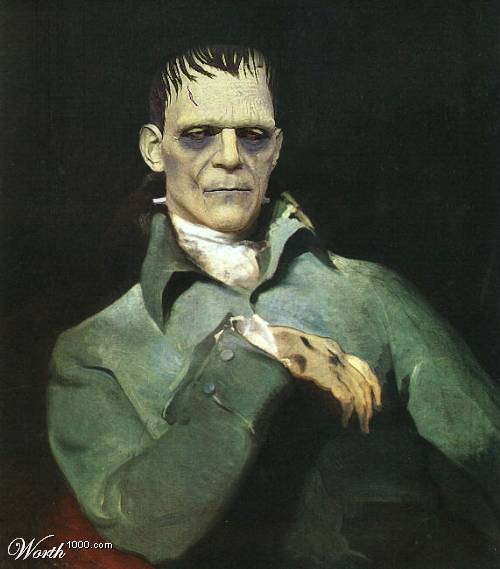
Ayer echaron por una de las cadenas de televisión que siguen los chavales, NeoMax, un documental presentado por Ridley Scott, Profetas de la ciencia-ficción, dedicado sobre todo al origen de la ciencia ficción en Mary Shelley, y cómo su idea de la creación artificial de vida se está viendo en algunos sentidos vindicated por las actuales investigaciones en genética, los experimentos de diseño de seres vivos de Craig Venter, las tecnologías de selección de embriones... Entrevistando a algunos biógrafos de Shelley, enfatizaban éstos el paralelismo entre la propia Mary y el monstruo: Mary huérfana de madre, con frecuentes visitas a la tumba de Mary Wollstonecraft y leyendo sus obras, y huérfana de padre en el sentido de no hallar acomodo en la familia de Godwin, con su nuevo matrimonio. Se sentía descuidada y abandonada y proyecta parte de ese abandono al monstruo. frankenstein portraitEs una perspectiva muy interesante y que complementa las observaciones también hechas sobre la relación entre la idea de dar vida a un cuerpo muerto y los sueños que tenía Mary Shelley tras la muerte de su bebé (acabaron muriendo todos sus hijos, y ella tampoco llegó a vieja). Algunas de estas cuestiones las traté en un comentario al prólogo de Frankenstein escrito por la autora; también el paralelismo entre el libro y el monstruo que notó alguno de los entrevistados. Los escritores de ciencia-ficción también crean sus propias "vidas artificiales", imaginativamente, se decía. Claro que en un cierto sentido todo escritor es creador de vida artificial, y tiene una relación ambivalente de paternidad monstruosa con los libros que inventa. Y una problemática relación hay en la propia figura de los padres, que dan vida y ocupan así de modo quizá indebido la figura de Dios, son dioses insuficientes; por allí se apunta tal vez otra crítica a Godwin, padre irresponsable como Frankenstein, y también a su modo generador de monstruos dada la desubicación social de Mary. Frankenstein es, por tanto, a un determinado nivel, la proyección de un trauma, quizá su cicatriz, o su forma visible. No en vano se lo dedicó Mary a Godwin, en un gesto ambivalente de admiración, desafío y reproche.

Otra cosa: quizá un término insuficientemente enfatizado en el prólogo de Shelley es el de la fabricación, la manufacture de partes corporales. Se ve allí la influencia imaginativa del primer industrialismo: partes, piezas que se fabrican separadamente y luego se montan juntas, un fenómeno relativamente nuevo y creciente en influencia. En ese sentido el monstruo es también el primer robot de la era industrial.

¡Ay, robot!