Blogia
Vanity Fea

Literatura y crítica

Criticism Top Ten

sábado, 12 de abril de 2014

Criticism Top Ten


Dear Jose Angel Garcia Landa:

Your paper, "AUTHORIAL INTENTION IN LITERARY HERMENEUTICS: ON TWO AMERICAN THEORIES", was recently listed on SSRN's Top Ten download list for: CSN: Criticism (Sub-Topic).

As of 12 April 2014, your paper has been downloaded 45 times. You may view the abstract and download statistics at: http://ssrn.com/abstract=1737206.

Top Ten Lists are updated on a daily basis. Click the following link(s) to view the Top Ten list for:

CSN: Criticism (Sub-Topic) Top Ten.

Click the following link(s) to view all the papers in:

CSN: Criticism (Sub-Topic) All Papers.

To view SSRN's Top Ten lists for any network, subnetwork, eJournal or topic on the Browse list (reachable through the following link: http://www.ssrn.com/Browse), click the "i" button to the right of the name, and then select the "Top Downloaded" link in the popup window.

(....)


Sincerely,

Michael C. Jensen
Chairman
Social Science Research Network

Lamentablemente, hay otro artículo empatado con el mío y no salgo de hecho en esta lista... pero bueno, ya iré subiendo, ya...



Ranking Web of World Repositories 

Literary Theory: introduction and Greek Origins

viernes, 11 de abril de 2014

Literary Theory: Introduction and Greek origins


Literary Theory: Introduction and Greek Origins

http://papers.ssrn.com/abstract=2419920

This paper defines the concepts of literary theory and literary criticism as dialectically related activities, puts forward a semiotic classification of literary theories, and sketches out the origins of literary theorizing and critical practice in pre-philosophical thought and in the Greek writers and philosophers before Plato and Aristotle’s foundational works.


These lecture notes used to be the beginning of my course on the history of literary theory and criticism back in the early 1990s. Now it’s to be found in the following thematic journals of the Social Science Research Network (Date posted: April 04, 2014)

eJournal Classifications
AARN Subject Matter eJournals
    
        
Political Theory eJournals
    
        
CRN Subject Matter eJournals
    
        
LIT Subject Matter eJournals


_____


—@ Academia:

https://www.academia.edu/8991370/


— @ ResearchGate:

https://www.researchgate.net/publication/267417606


Plato’s Poetics


Periodistas y blogueros

miércoles, 9 de abril de 2014

Periodistas y blogueros

Aquí mi bibliografía o listado de periodistas y blogueros, tal como la extraen de mi Bibliografía de Teoría Literaria, Crítica y Filología (http://bit.ly/abiblio) en un sitio llamado PlanningDoc:

 Periodistas y Blogueros / Journalists and Bloggers


Cierto es que no me he incluido a mí mismo, discúlpenme. Es que tampoco están todos los periodistas y blogueros del mundo. Pero enseguida añado uno más.


En la Bibliothèque Nationale

A photo on Flickr

Medieval Criticism

miércoles, 9 de abril de 2014

Medieval Criticism


Yet another paper with some notes from my course on the history of literary criticism, far back in ye olde 20th century....

book&glassesMedieval Criticism:

Poetics, Aesthetics, and Hermeneutics 

http://papers.ssrn.com/abstract=2417263

This paper offers an overview of the main figures and subjects in medieval criticism in the Western tradition, covering both secular poetics and those topics in theological reflection and Biblical commentary which have some relevance for literary theory. The first section deals with medieval poetics, discussing literature theory with reference to the trivium and the quadrivium, with a special focus on the poetics of Geoffrey de Vinsauf. This is followed by a short section on aesthetics and a more detailed treatment of medieval hermeneutics. The main figures and topics in this section include Augustine, pseudo-Dionysius, Aquinas, Dante, and Boccaccio, with a discussion of the theological dimension of literature, of symbolism, allegory, and of the modes of hermeneutical interpretation.


It has been accepted in the following area journals of the Social Science Research Network, in the fields of philosophy, literary theory, and anthropology. To be found in the following websites  (Date posted: March 30, 2014):  

eJournal Classifications
Anthropology and Archaeology Research Network Subject Matter eJournals
    
        
Anthropology and Archaeology Research Network Subject Matter eJournals
    
        
Literature Subject Matter eJournals
    
  Philosophy Research Network Subject Matter eJournals
    
        
Philosophy Research Network Subject Matter eJournals
    
        
Philosophy Research Network Subject Matter eJournals


—oOo— 


La Enorme Bibliografía

martes, 8 de abril de 2014

La Enorme Bibliografía

La Bibliografía II


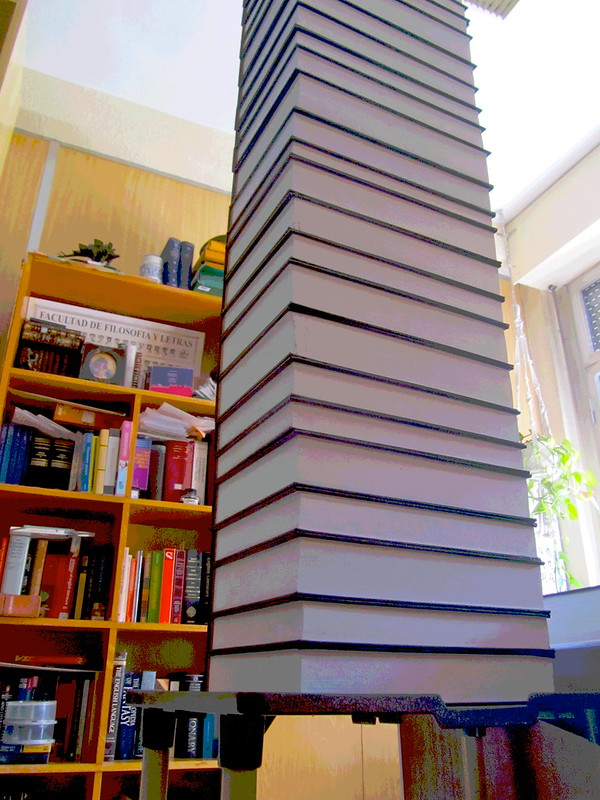
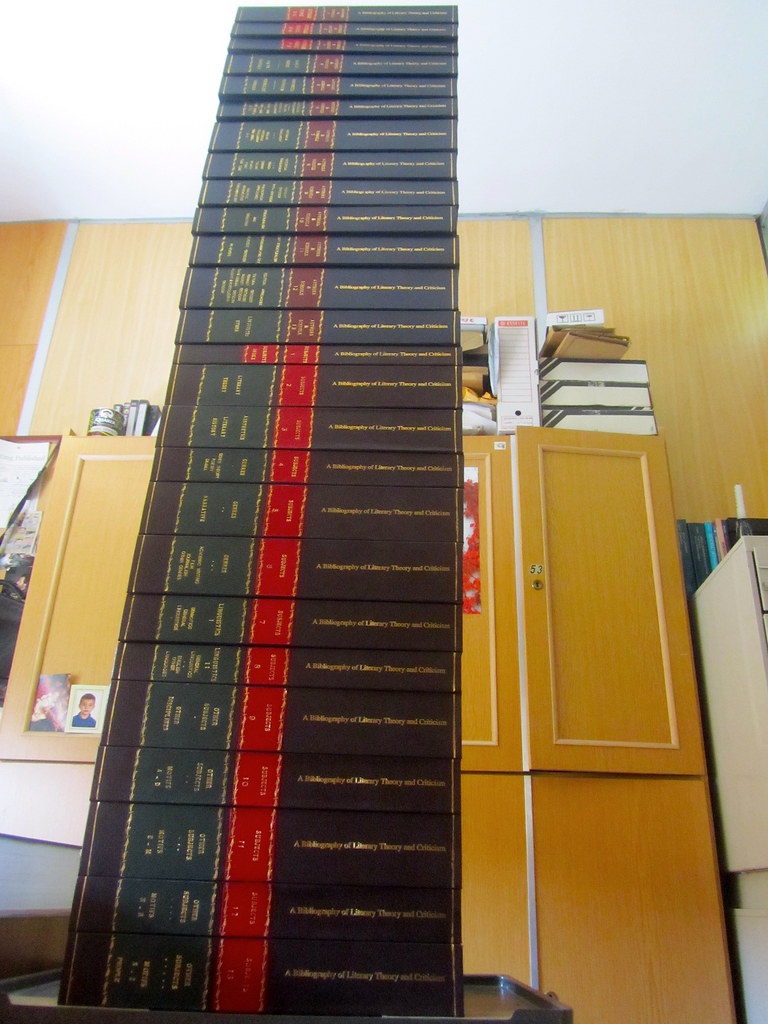
A veces presumo de que mi bibliografía es EL LIBRO MÁS GORDO escrito por persona humana. Algunos dirán que no, que no es un libro siquiera, o que no está escrito, o que no está impreso, o que no soy yo tan humano, etc. etc. Tenía un ejemplar traspapelado por el despacho, y le he hecho un reportaje fotográfico para que se aprecien mejor sus dimensiones descomunales. Cada cual presume de lo que puede, ya lo decía Thorstein Veblen en su Teoría de la Clase Ociosa. La encuadernación me costó un huevo, un auténtico derroche ostentoso.

De acuerdo, la Enciclopedia Espasa es más gorda—pero que yo sepa la hicieron entre cientos de autores.  Lo mismo la famosa bibliografía ABES de Robert Clark, que luego se interrumpió y fue a parar a una Literary Encyclopedia; tenía cientos de colaboradores. O la bibliografía enorme de la MLA y sus miles de editores. Dividan y verán en qué se les queda. Hombre, también está el Patrologiae Cursus Completus de Jacques Paul Migne, pero es una colección de libros de otros, no un libro propiamente dicho. Y él era monje.

PalauAlgunos creen que el célebre Manual del Librero Hispano-Americano de Antonio Palau y Dulcet (aquí a la izquierda) es más importante y celebrado que mi bibliografía. No los culpo—pero yerran si creen que es más voluminoso. Dicen que registra el Palau 381.897 libros—yo digo vagamente que mi bibliografía incluye "más de 300.000" entradas, bien pueden ser 500.000. La primera edición de Palau y Dulcet eran siete volúmenes (1923-1945); en la segunda edición constaba de 28 volúmenes publicados entre 1948 y 1977 y siete volúmenes de índices entre 1981 y 1987 añadidos por su continuador Agustín Palau Claveras, total 35 volúmenes. Ya son, ya—pero la hicieron entre dos, y contra dos, ni Hércules.


Puesta así, en pila india, mi bibliografía ocupa lo suyo, como la de Palau, o más. Pero les he de confesar una cosa: esta es una edición de hace diez años, y desde entonces se ha duplicado más o menos en volumen.

Y otra cosa: de esta edición de hace diez años sólo llegué a imprimir 26 de los 40 volúmenes de que constaba. Veintiséis que son la pila ésta que ven. Así que la pila completa no está visible, lo siento, pero sería unas tres veces ésta de abajo, o más. Ahora, no cuenten conmigo para imprimirla—sáquenle dos copias a la foto, y a correr.


La Bibliografía VII

Otra cosa, se lo crean o no—no es muy completa, mi bibliografía. У меня еще куча недоделанных документов...

Excelhonour

Deconstruction (Paul H. Fry)


Deconstruction (Paul H. Fry) - Videos from Yale Courses.

Plato's Poetics

viernes, 4 de abril de 2014

Plato's Poetics


I used to teach a course in the history of literary criticism in the late 80s and early 90s. And I began, well, before Plato—but Plato was the first major author, before the pièce de résistance of Unit 1, i.e. Aristotle's Poetics. But this is Plato's poetics—not that it's bound to exist as a bound volume.

Plato's Poetics

 http://ssrn.com/abstract=2414535

This paper presents an introductory overview of Plato's poetics, aesthetics, and literary theory, with particular reference to his notion of mimesis, and grounding the discussion on his Theory of Ideas. It is part of a lecture series on the history of literary criticism, partly available online as Hypercritica: A Hypertextual History of Literary Criticism.

And it's also been issued now in the following eJournalsDate posted: March 26, 2014  


eJournal Classifications
AARN Subject Matter eJournals
             
CRN Subject Matter eJournals
             
LIT Subject Matter eJournals
    
PRN Subject Matter eJournals


_____


Elsewhere:

_____. "Plato's Poetics." Academia.edu 10 May 2014.*
    https://www.academia.edu/7004120/
    2014
_____. "Plato's Poetics." ResearchGate 10 May 2014.*
    https://www.researchgate.net/publication/262183965
    2014


Aristotle and After


Congreso Tolkien

miércoles, 2 de abril de 2014

Congreso Tolkien

Worlds made of Heroes

On the 60th anniversary of the publication of J. R. R. Tolkien's The Fellowship of the Ring
6-7 November 2014

Faculdade de Letras da Universidade do Porto
CETAPS – Centre for English, Translation and Anglo-Portuguese Studies
ILCML – Instituto de Literatura Comparada Margarida Losa


J. R. R. Tolkien's The Lord of the Rings has been read and transformed in multiple ways, its narrative meticulously examined, its symbols analysed, its text regarded as configuring different allegories. Indeed, the novels became the best-known and most celebrated epic fantasy trilogy in the 20th century preserving their preponderance throughout more recent times. Whether in literature, cinema or music, countless works have been produced in their shadow, both as mere derivative pieces and as original fictions with an active and distinctive voice. As clearly shown by numerous studies in wide areas of literary theory and criticism as well as in comparative literature, Tolkien's legacy is both literary and cultural, and its influence pours out in many postmodern representations of man and nature, thus recreating the old traditional paths of epic fantasy and fantastic literature overall.
Derived as they were from the absorption and transformation of a sizeable body of mythological works in a number of languages, Tolkien’s mythopoetic compositions have themselves spawned a wealth of intermedial adaptations, from illustrations and radio plays to films, comic books, heavy metal and folk songs, operas, videogames, role playing games (RPG), spoofs... Peter Jackson's cinematic adaptation of The Lord of the Rings (2001-2003) is perhaps the greatest example of all, having contributed so far to further popularize Tolkien’s work and to awake a global epic fantasy euphoria. Literary and cultural questionings will be discussed alongside with intermedial dynamics within
the context of Tolkien’s work and its multiple versions and expansions. Ultimately, at a narratological level, a particular interest will be given to textual analyses around rhetorical/ stylistic features and devices that further reveal important ideological layers.

In order to celebrate the 60th anniversary of the publication of the trilogy's first volume – The Fellowship of the Ring –, the Porto Tolkien’s Conference “Worlds made of Heroes” invites submissions of 20-minute papers in English (preferably) or Portuguese in any of the above mentioned themes. Suggested topics include:
1 - J. R. R. Tolkien's works and their adaptations: intermedial dynamics
2 - Theorizing epic fantasy
3 - The hero’s role in epic fantasy and culture
4 - Travel literature and the construction of identity
5 - Ancient-classical origins of epic narratives
6 - The influence of epic fantasy on other genres
7 - Epic fantasy and mythology
8 - Epic fantasy and national identities
9 - Epic fantasy and social concerns
10 - Allegory vs reality: is this an issue or a false issue?

Submissions should be sent by e-mail to:
tolkien@letras.up.pt

Proposals must include:
- Paper's full title
- Abstract (max. 250 words)
- Name and e-mail address (other contacts if relevant)
- Institutional affiliation
- Short bionote

Deadline for proposals: 31st May 2014
Notification of acceptance: 30th June 2014
Deadline for registration: 1 October 2014

Registration fee: 80 Euros
Student fee: 40 Euros

Confirmed keynote speakers:
Edward F. James (University College Dublin, Ireland)
Maria do Rosário Monteiro (FCSH – Universidade Nova de Lisboa, Portugal)
Carl Phelpstead (University of Cardiff, UK)
Nicholas Parker-Groom (University of Exeter, UK)

Organizing Committee
Filomena Vasconcelos (Universidade do Porto, Portugal / CETAPS)
Maria Luísa Malato (Universidade do Porto, Portugal /ILC)
Inês Botelho (Universidade do Porto, Portugal / CETAPS)
Miguel Ramalhete Gomes (Universidade do Porto, Portugal / CETAPS)


Tolkien talking