Blogia
Vanity Fea

Semiótica

Storytime and Narrative Anchoring

Storytime and Narrative Anchoring

A short passage from Stephen Crites' article "Storytime: Recollecting the Past and anticipating the future", in which he puts forward a narrative psychology of the self. In this passage Crites differentiates between the self who remembers and the remembered self:

[S]tory-like narrative establishes a particularly strong sense of personal continuity, because it can link an indefinite number of remembered episodes from the single point of view of the one who recounts or merely recalls the story. This single point of view is the "I" who now speaks or recalls, and this "I" which situates my story and distinguishes it from others also anchors what I call my self in its identity over time. This story-like remembrance of things past is of at least Proustian length in its full extent, though what I can recollect at a sitting is mercifully some shorter sequence of the whole. The whole story generally remains vague and merely implicit. What I own as my self is always present as the character in the story from whose perspective its episodes are recalled, claimed as its own self by this "I" who recalls. By telling the story from the perspective of this self, as in a first person narrative, usually told in the past tense, I distance this self from the intersubjective matrix of experience in order to claim it as my own, as that personal past with which I claim identity. Still there is always some hiatus between the "I" who recollects and the self who appears as a character in a succession of episodes, a hiatus that I artfully bridge by owning this self, claiming it as my own. Still there remains a point of tension where the hiatus has been bridged, a tension that I express linguistically as a differentiation of tense between past and present. (Crites, "Storytime", In Narrative Psychology, ed. T. R. Sarbin, p. 159).


This is a distinction which is familiar to narratologists, from the German tradition of Spitzer and Gunther Müller, retaken by Genette, in the form of the opposition between the "narrating I" and the "narrated I" (Erzählendes Ich / Erzähltes Ich), i. e. the first-person narrator considered either as a narrator or as a character who is and is not himself, due to the distance in time, experience, knowledge, and narratorial function. The narrated I, the character, acts as a guiding thread and usually as a focalizer, though his perspective may be often qualified by the retrospective knowledge of the narrator.

Note the qualification "recounts or merely recalls"—narrative continuity and structuration is activated in the act of representation which takes place in memory alone, although it is questionable to what extent this constitutes "a narrative" before it is actually transmitted as one. Narrativeness is stronger in actual spoken or written narratives, but there is a degree of narrativity in the process described by Crites.

Note also the use of the term "anchoring". Here it refers to the act o situating episodes or events within a personal life-story, but it is clear that it is one aspect of what we call more generally "narrative anchoring", a term which refers to all kinds of anchoring of narrative sequences within larger sequences, whether personal, collective, or universal in scope.

El anclaje narrativo

Bibliografía de Umberto Eco

Bibliografía de Umberto Eco

Bibliografía de Umberto Eco, procedente de mi Bibliografía de Teoría Literaria, Crítica y Filología del año pasado. A la que hay que sumar ahora su última novela, Número Cero (Bompiani, 2015; traducción española de Helena Lozano miralles en Lumen, Penguin Random House).


Eco.U by anahialejandrare

Redes, Regiones y Público (Networks, Regions, and Audiences)

martes, 30 de junio de 2015

Redes, Regiones y Público (Networks, Regions, and Audiences)

En ’La presentación de la persona en la vida cotidiana’ Erving Goffman propone una teoria dramatística del espacio público, definido interaccionalmente en relación a actividades y grupos sociales específicos, y redefine desde esta perspectiva conceptos tales como la identidad personal y los roles, el trabajo en equipo y la cooperación, o la relación entre los roles y las regiones del espacio interaccional. En este artículo desarrollamos el análisis interaccional de Goffman y lo extendemos al espacio virtual de Internet y a la presentación de las identidades sociales en los blogs y en las redes sociales cibernéticas, concentrándonos en las implicaciones que se siguen para los conceptos de regiones, participantes en la interacción, y públicos.  
http://ssrn.com/abstract=2623861  
December 21, 2009


English abstract:
 

Networks, Regions, and Audiences

 
In ’The Presentation of the Self in Everyday Life’ Erving Goffman puts forward a dramatistic theory of public space, defined interactionally in relation to specific groups and social activities, and redefines from this standpoint such concepts as personal identity and roles, teamwork and cooperation, or the relation between roles and regions of interactional space. This paper further develops Goffman’s interactional analysis and extends it to the virtual space of the Internet and to the presentation of social identities in blogs and online social networking sites, concentrating on the implications for the concepts of regions, interactional participants, and audiences.

 
Note: Downloadable document is in Spanish.
Number of Pages in PDF File: 18
Keywords: Erving Goffman, Self, Computer-mediated communication, Social networks, Blogs, Internet, Symbolic interaction, Teams, Teamwork, Roles, Self, Internet identites


A photo on Flickr

Retropost #31: 15 de noviembre de 2004

sábado, 27 de junio de 2015

Retropost #31: 15 de noviembre de 2004


15 de noviembre

Hoy he colgado entre otras cosillas mi primera publicación académica, si descontamos la tesina: "El modo del género narrativo: diversas interpretaciones", escrita en 1985, rechazada por el congreso de AEDEAN de Murcia, publicada en la Miscelánea en 1986 y luego reaparecida, como otras, incorporada al libro sobre Acción, relato, discurso. Es curioso como releyéndola no cambiaría hoy muchas cosas – ­­será que me falta madurez y tengo que mirarla otra vez dentro de otros veinte años. Significar sí que significa ya otras cosas con el paso del tiempo, claro.


Retroposts


—oOo—

FOCALIZATION

miércoles, 24 de junio de 2015

Focalization


We're being quoted in the definition of "Focalization" at Omnilexica. I cut and paste that section of the page:


Definition of the noun focalization

What does focalization mean as a name of something?

noun - plural: focalizations

  1. the confinement of an infection to a limited area
  2. the act of bringing into focus
    • lexical domain: Acts - nouns denoting acts or actions
    • alternative spelling: focalisation
    • synonym of focalization: focusing
    • more generic word: intensification = action that makes something stronger or more extreme
    • more specific word: refocusing = focusing again

Alternative definition of the noun focalization

noun

  1. [context: literature] The perspective through which a narrative is presented
  2. [optics] Putting into focus

Explanation

Focalization is a term coined by the French narrative theorist Gerard Genette. It refers to the perspective through which a narrative is presented. For example, a narrative where all information presented reflects the subjective perception of a certain character is said to be internally focalized. An omniscient narrator corresponds to zero focalization. External focalization - camera eye. A novel in which no simple rules restrict the transition between different focalizations could be said to be unfocalized, but specific relationships between basic types of focalization constitute more complex focalization strategies; for example, a novel could provide external focalization alternating with internal focalizations through three different characters, where the second character is never focalized except after the first, and three other characters are never focalized at all. The specific domain of literary theory which deals with focalization is narratology, and it concerns not only distinctions between subjective and objective focalizations but various gradations between them, such as free indirect discourse, style indirect libre, or quasi-direct discourse.

Printed dictionaries and other books with definitions for Focalization

 Click on a title to look inside that book (if available):

Google previewNarratology (2014)

An Introduction by Jose Angel Garcia Landa, Susanna Onega
Focalization is the relationship between the 'vision,' the agent that sees, and that which is seen.
Modeling Mediation in Narrative by Peter Hühn, Wolf Schmid, Jörg Schönert
And Bal also says: “ Focalization is the relationship between the 'vision', the agent that sees, and that which is ...
Minority Identities, Multicultural Struggles by Paula M. L. Moya
Focalization refers to the mediation (the prism, perspective, or angle of vision) through which a story is presented by a narrator in the text. As such, it describes a relationship between the " 'vision,' the agent that sees, and that which is seen" ...
Focalization is a consistent exercise of the will. It fulfills opportunities and refuses to yield to adverse impressions, although the necessity appears inevitable. Thus, when the lights grow dim, the aged imagine that it is necessary to use glasses ...
Google previewStylistics (1997)
by Richard Bradford
Focalization is the literary-critical version of the general linguistic concept of ideational meaning: the mental image generated by the words (Jakobson uses the term 'referential' to account for the same process). Open any novel at random, ...
by Bernard Walliser
Focalization is a switch in the behavior of agents who tend to respond to ...
Psychoanalytic Psychotherapy with Children and Adolescents by John Tsiantis
The focus Focalization is a main feature in all forms of brief therapies. While it generally refers to an active search for a central constellation that the therapist tries to capture, one can say that a focus is always the result of joint forces, where the ...
A Practical System for Developing Self-confidence, Memory, Mental Concentration and Character by Victor Gabriel Rocine
Focalization is the act of a trained mind.
An Introduction by James L. Resseguie
Focalization is a useful concept in modern literature that uses the “free indirect style” of narration where a narrative represents a character's thoughts and feelings without the usage of quotation marks. See H. Porter Abbott, The Cambridge ...
The Subject of Cultural Analysis by Mieke Bal
Focalization is the relation between the vision narrated and the object represented.“ It is the inflection the telling or showing subject brings to the perception of the object. This could appear to be a reversal ofthe narrative strategy that obscures ...
by David Herman, Manfred Jahn, Marie-Laure Ryan
Conceived of as a primary trigger for *authors, narrators, and readers alike, focalization is here seen as a foundational process both in storytelling and in storyunderstanding, not, as in itsclassical conception, asasecondary filter restricting the ...
by Chris Baldick
focalization The term used in modern *narratology for '*point of view'; that is, for the kind of perspective from which the events of a story are witnessed. Events observed by a traditional * omniscient ...
by Katie Wales
focalization is used in the study of literary NARRATIVE and DISCOURS(E) for what is also known, in similar metaphorical terms, as PERSPECTIVE or POINT OF VIEW. As Shlomith Rimmon- Kenan ...
by Joseph Childers, Gary Hentzi
DOUBLE FOCALIZATION. Double focalization occurs when an event or situation is presented in a narrative through ...
Terms, Concepts, and Analysis by Patrice Pavis, Christine Shantz
See HAMARTIA FOCALIZATION Fr.: focalisation; Ger.: Fokalisierung, Fokuslenkung; Sp.: focalizacion. Stress placed by the author on an action according to a particular point of view, in order to underscore its relevance. This essentially epic ...
by Paul Schellinger
Focalization is also crucial tofirstperson (homodiegetic) narrative since thenarrator, as a character, has similarly limited access to information. Another manipulation of ...
by David Edward Aune
Focalization Continuum Individual -> Group -> City-state —> Nation —> Group of nations -> Known world Chronological Continuum Origins —> Early history —> Recent history —> Present day. city-states, did not yet exist in the mid-5th cent.
by William H. New
and 'focalization' ( the strategy that suggests whose perspective is actually being transmitted).
by Casey Albert Wood
Focalization. The art or process of bringing ...


 

When Your Paper (Barely) Makes SSRN Top Ten List

martes, 23 de junio de 2015

When Your Paper (Barely) Makes SSRN Top Ten List


Dear Jose Angel Garcia Landa:

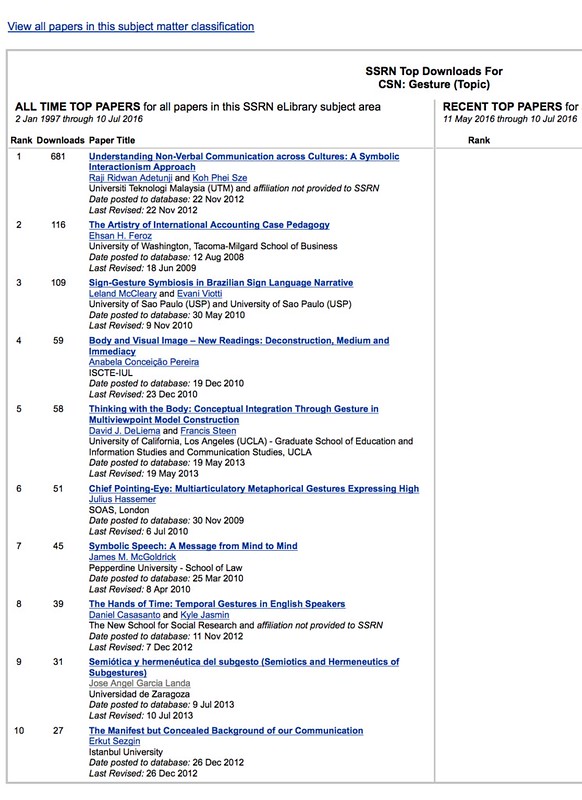
Your paper, "SEMIÓTICA Y HERMENÉUTICA DEL SUBGESTO (SEMIOTICS AND HERMENEUTICS OF SUBGESTURES)", was recently listed on SSRN’s Top Ten download list for: CSN: Gesture (Topic).

As of 23 June 2015, your paper has been downloaded 20 times. You may view the abstract and download statistics at: http://ssrn.com/abstract=2291374.

Top Ten Lists are updated on a daily basis. Click the following link(s) to view the Top Ten list for:

CSN: Gesture (Topic) Top Ten.

Click the following link(s) to view all the papers in:

CSN: Gesture (Topic) All Papers.

To view SSRN’s Top Ten lists for any network, subnetwork, eJournal or topic on the Browse list (reachable through the following link: http://www.ssrn.com/Browse), click the "i" button to the right of the name, and then select the "Top Downloaded" link in the popup window.


Gesto y Subgesto

Tiempo congelado: Vivimos en una máquina del tiempo

miércoles, 17 de junio de 2015

Tiempo congelado: Vivimos en una máquina del tiempo


El tiempo no se ha detenido desde el Big Bang hasta ahora. La única manera de congelarlo es parando el vídeo, o haciendo una foto, o utilizando algún otro artefacto de representación. La narración es uno de los instrumentos más eficaces para congelar el tiempo, y descongelarlo a gusto cuando se vaya a consumir, y empaquetarlo y organizarlo y transportarlo fácilmente. Comentamos en este artículo algunos aspectos representacionales y especialmente retrospectivos del tiempo narrativo, por vía de respuesta al artículo de Lidia Vianu "The After Mode."


Frozen Time: We Live in a Time Machine

Time has never stopped from the Big Bang until now. The only way to freeze it is stopping the video, or taking a photograph, or using some other representational device. Narrative is one of the most effective instruments to freeze time, and unfreeze it at will for consumption, and packaging it and organizing it and transporting it in an efficient way. This paper comments on some representational aspects, particularly retrospective aspects, of narrative time, by way of a response to Lidia Vianu's article "The After Mode."

 
Number of Pages in PDF File: 11


Reference Info: Ibercampus (March 4, 2010)


Date posted: June 05, 2015 ; Last revised: June 08, 2015

http://papers.ssrn.com/abstract=2614032

eJournal ClassificationsMessage
AARN Subject Matter eJournals
    
        
Added to eLibrary 


CSN Subject Matter eJournals


Added to eLibrary 


A photo on Flickr


Tiempo congelado

Cuádruple superveniencia (Fourfold Supervenience)

lunes, 1 de junio de 2015

Cuádruple superveniencia (Fourfold Supervenience)

Reflexionamos sobre las implicaciones del concepto de superveniencia evolutiva para una teoría del anclaje narrativo y para una hermenéutica historicista evolutiva. Aun siendo las interpretaciones inherentemente contingentes como resultado de la historia intelectual del intérprete, del utillaje conceptual aplicado al objeto, y de la situación o perspectiva interpretativa, en última instancia han de poder referirse a una cartografía conceptual global que proporciona un anclaje histórico para tales conceptos, objetos, perspectivas, situaciones, e historias personales. Hay por tanto, desde el punto de vista evolucionista, una dialéctica inherente entre los aspectos supervinientes por un lado y una situacionalidad coherente del acto de interpretación por otro. Para explorar nuestra comprensión de esta dialéctica, distinguimos cuatro niveles de contingencia que condicionan la interpretación: los relativos a la evolución cósmica, a la evolución biológica y cognitivo-neurológica, la evolución cultural, y la trayectoria vital personal.

Cuádruple superveniencia

http://ssrn.com/abstract=2609447


finetouch

Fourfold Supervenience

A reflection on the implications of the concept of evolutionary supervenience for a theory of narrative anchoring and evolutionary historicist hermeneutics. While interpretations are inherently contingent as a result of the interpreter's intellectual history, the conceptual toolkit brought to bear on the object, and the interpretive situation or perspective, they must ultimately be referrable to a global conceptual mapping which provides an historical anchoring for such concepts, objects, perspectives, situations, and personal histories. There is therefore an inherent dialectic between the contingent and supervenient aspects and the coherent situatedness of the interpretive act from an evolutionary perspective. In order to explore our understanding of this dialectic, four levels of contingency bearing on interpretation are distinguished, relative to cosmic evolution, biological evolution, neural-cognitive evolution, cultural evolution, and personal life history.


Note: Downloadable document is in Spanish.
 

Number of Pages in PDF File: 9
Keywords: Evolution, Narratology, Hermeneutics, Interpretation, Supervenience, Contingency, Emergence, Anthropology


Also to be found in the following electronic journals and thematic sections of the Anthropology Research Network, the Cognitive Science Research Network, and the Philosophy Research Network:


http://papers.ssrn.com/abstract=2609447

eJournal Classifications Date posted: May 24, 2015  
AARN Subject Matter eJournals
             
AARN Subject Matter eJournals
                          
AARN Subject Matter eJournals
             
CSN Subject Matter eJournals
                          
PRN Subject Matter eJournals


Cuádruple superveniencia


—oOo—