Blogia
Vanity Fea

Semiótica

Retropost: Narrative Dreams - Dream Narratives

martes, 24 de mayo de 2016

Retropost #944 (24 de mayo de 2016): Narrative Dreams / Dream Narratives

En la lista de distribución Narrative-L nos dice Michael Kimmer que va a estudiar los sueños desde el punto de vista narratológico, junto con "un colega vienés", y busca sugerencias...

Hello everybody, 
A Viennese colleague and I are working on a research proposal for the empirical analysis of dream transcripts. We are interested in finding out whether dreams tend to have narrative structure or not, which is a debated issue due to the often bizarre, erratic, highly compressed, and associative way in which dreams seem to unfold.
I would be interested in learning about empirical work around this topic from you, (perhaps even a recent survey article?).
I’d also appreciate discussing different theoretical approaches to narrativity and how they can be transformed into a manageable qualitative code system for a fairly large corpus. After all, how we define the notion will very much influence the answer to our question.
Finally, I would like to raise an issue that might interest those of you conversant with cognitive linguistic theory: The fact that compression plays such an important role in dreams made me think that the conceptual integration framework by Fauconnier and Turner (2002), in which compression plays a major role, might be applicable. Turner in particular, in other publications, has also applied the framework to narrative, but specific ways of bringing it to bear on our topic still elude me.
looking forward to your comments & ideas,
Michael

Así que envío esta respuesta (mi primera intervención en la lista):

Dear Michael Kimmer (and fellow members of the list):

"some dreams are born narrative, some achieve narrativity, and some have narrativity thrust upon ’em"!

It seems to me that an analysis of dream narrativity is bound to face, sooner or later, the observer’s paradox, as well as other paradoxes. There is no way to access the content of a dream as opposed to the dream tale, other than to analyze one’s own dreams as compared to one’s (re)telling of them. But if your are both the subject and the object of your experiment, some Heisenbergian distortions may be inevitable: self-consciousness about the project may intervene as a narrativizing factor. Not to mention the problem of privacy, infinite regression, etc., once your dreams have been censored and rearranged in order to be narrated, they will still have to be censored and rearranged in order to be retold along with their previous retellings in your self-analysis. And we haven’t even mentioned the nature of that censorship: Freudian issues of repression, unconsciousness, etc. So that direction of analysis is fraught with self-evident difficulties. And yet an approach to dream narratives that does not address the issue of dream "in-itself" vs. dream narrative is bound to be limited and flawed in a number of ways. Which is not to say that there are not other potentially interesting directions for analysis, including conventional narratological analysis of dream texts (alone) or comparisons of different dream-texts while leaving aside the issue of the dream itself. As to Fauconnier and Turner, I don’t know whether they address anywhere the possible links between their conceptual integration framework and the Freudian concepts of condensation and displacement, the "dream-work", quoi, but that would seem to be a must for this line of analysis. I don’t think I can be much help there, but perhaps other people may offer useful suggestions on how (not) to approach the subject.

All the best,
JOSE ANGEL GARCIA LANDA
Universidad de Zaragoza


HERE FOLLOW SOME REJOINDERS: Hi, i’ll add some comments on Tony Jackson’s comments on my comments on dream narratives in capitals... but please don’t assume I’m shouting! this is for the sake of readability.

Tony Jackson:
>I’ve wondered about dreams as narratives too, and also wonder if they’ve been given any detailed treatment by literary narrative theory.
WELL I WOULDN’T BEGIN WITH LITERARY NARRATIVE THEORY BUT WITH FREUD ON DELIRIUM AND DREAMS IN JENSEN’S GRADIVA, OR BETTER STILL WITH HIS INTERPRETATION ON DREAMS, OR WITH ARTEMIDORUS... I’M ENCLOSING A SHORT BIBLIOGRAPHICAL LIST IN CASE SOMEONE FINDS IT HELPFUL.
With my understanding of Michael’s project, I don’t see the need to worry about Freud. Unless the project is to be an empirical study of Freud’s theories in particular, most of his ideas won’t matter because they’re not adequately based in scientific kinds of knowledge;
PSYCHOANALYSIS IS NOT A SCIENTIFIC DISCIPLINE, BUT AN INTERPRETIVE, HUMANISTIC AND SEMIOTIC ONE.
and also the theoretical understanding of narrative has come a long way since Freud’s time.
STILL, IF YOU REREAD FREUD YOU MAY BE IN FOR SOME FRESH INSIGHTS ALL THE TIME. BUT BY ALL MEANS, READ ALSO LACAN, DERRIDA, AND WHAT NOT.
For some kind of qualitative coding, I imagine older more structuralist work such as Todorov s or even Propp s would provide the kind of abstracted categories that could be cross-referenced and counted. I wonder, though, if this might tend to reveal only already-established archetypal plots and characters?
BEWARE OF READY-MADE CATEGORIES AND COUNTING. BEWARE OF THE ESPRIT DE GÉOMETRIE. (I LIKE NARRATOLOGY, THOUGH. BUT READ, ALSO, FEYERABEND, AGAINST METHOD.
>I disagree with Jose s worry about getting at the subject of study. If it’s an empirical study, then why wouldn’t you just take the written or spoken report of the dream as the narrative that matters? Just as you take a written story as the story that you’ll study?
BECAUSE A DREAM NARRATIVE IS AN ACCOUNT OF A REAL EVENT, IE THE DREAM. YOU ARE PRESUPPOSING SOME KIND OF AESTHETIC-LITERARY STUDY OF DREAMS AS IF THEY WERE FICTIONS. IT IS, AS I SAID, ONE POSSIBLE AVENUE, BUT A VERY LIMITED ONE. SURELY ONE SHOULD STUDY DREAMS AS DREAMS, NOT AS FICTIONS (WHICH IS NOT TO SAY NARRATOLOGY HAS NOTHING TO SAY ABOUT THEM, QUITE THE CONTRARY).
Then I imagine you could try to bring already established narratological ideas to bear in the examination. I assume with Jose that the subject-object problem would be a basic issue, though I might say narrator-narratee.
OK, THAT IS RELEVANT. BUT DON’T STOP AT THE NARRATOR’S LEVEL. CROSS THE BORDER TO THE AUTHOR’S LEVEL. THE UNCONSCIOUS AS AUTHOR, THE CONSCIOUS AS READER. FOR INSTANCE.
In what sense is the narrator of the dream apart from the audience? And how would you assess such audience distinctions as the kind Peter Rabinowitz has theorized? If there’s compression in plot and image, there’s likely compression of audiences as well.
I VERY MUCH AGREE WITH THE RELEVANCE OF THESE ISSUES. HOW DREAMS ARE TOLD TO A VARIETY OF AUDIENCES... FOR INSTANCE.
In fact I imagine that for this teller-listener issue, Rabinowitz might be a good place to start, though of course he’s arguing about written narrative. But of course this kind of thing would be preliminary. I’m not sure how it could rendered into a qualitative code system.
Maybe the largest conceptual problem would be establishing what narrative is to mean in the first place.
IF WE GO BACK TO BASICS, A DEFINITION I LIKE IS: "NARRATIVE IS A RETROSPECTIVE REPRESENTATION OF A SEQUENCE OF INTERPRETED AND EVALUATED EVENTS" - WITH LOTS OF LEEWAY FOR FUZZY BORDERS AND PARTIAL NARRATIVITY IN CASES WHICH DON’T WHOLLY FIT THE DEFINITION.
Most dreams, I take it, won’t look so good by Aristotle’s standards.
I DARE SAY THEY WON’T!!
Dreams seem to take on much of their basic interest precisely because they wildly violate not just everyday storytelling norms, but also in some ways postmodern norms. Yet they must be taken as they are. They automatically carry a unique[?] kind of authenticity, precisely because they have been, originally, unconsciously ’told ’, and we have to take the report of that original telling as it is.
HERE PSYCHOANALYSIS DISAGREES. THENCE ITS RELEVANCE. I SHOULD SAY, NONETHELESS, THAT MOST OF MY DREAMS DON’T NEED A HEAVYWEIGHT LIKE FREUD TO COME AND INTEPRET THEM.
So dreams tend to fall outside the usual aesthetic and critical judgments. Would we ever have the notion of trying to get better at dreaming, as we do the notion of getting better at verbal or written storytelling?
THAT’S A GOOD ONE!
And if we did have that notion, what would it mean?
ENHANCED CENSORSHIP! MORE FODDER FOR FREUD!!!
Anyway, some thoughts & >Tony Jackson
SAME THING... ALL THE BEST, JOSE ANGEL

PS: I forgot to add, something which hasn’t been mentioned is that the usual narrative function of dreams is (apart as their "real-world" functions, or not quite apart) to act as a mise en abyme of the main narrative frame, or in any case as an interpretive device which helps organize, or problematize, the meaning of the main narrative sequence.

(PS: A narratological rereading of Freud’s Delirium and Dreams in Jensen’s "Gradiva" would seem to be in order).

La patata transgénica


Retroposts


—oOo—

Biographical fragments and narrative smoothing

Biographical fragments and narrative smoothing

From John Shotter's Conversational Realities (Sage, 1993), ch. 7, "In Search of a Past: Therapeutic Re-Authoring"—in which he comments Ronald Fraser's account of his coming to terms with his past through psychoanalyis (in In Search of the Past,  1984). The last section, on "Biographical fragments as a practical corpus", has interesting comments on retrospection and narrativization:

But who was Fraser's new way of being? How did he re-relation himself to his past, if he didn't get rid of it? Well, to grasp the nature of the difficulty he was in, let us return to the hermeneutical approach, but now, to bring out one of hits central dangers, what Donald Spence calls (1986) 'narrative smoothing': it is a danger because a nice coherent, well-organized narrative, with everything in its place, prevents the appearance of alternative circumstantial possibilities, amongst which, if we are to be the authors of our own lives, we must be free to judge. In other words, it diverts our attention away from the fact that in our parctical-moral activities, we are embedded in a context, and quite often our circumstances surround us with possibilities. Our attention is diverted, because, in a hermeneutical construction, all the fragments which have occurred are decontextualized, and made into an orderly or systematic whole —often with, as Freud put it, the insertion of the 'missing portions' which must have 'originally' been there if things are to be orderly. This is the 'finding' of a narrative, and Freud, as we all know, used the archaeological metaphor.   Once we have found this correct whole, people's past actions are thought of as taking on their proper meaning within its context.memories of

But this, I think, is absolutely wrong. What their actions take on there is not so much meaning as intelligibility; that is, they becoem capable of being grasped reflectively and intellectually. The order has been constructed and the missing portions supplied, by drawing upon a 'grammar' implicit in our life and language, by drawing upon features implicit in our 'accepted' ways of coordinating our actions with one another—and to the reational intellect, such a grammar gives the appearance of a proper meaning. but it is, I shall say, a 'counterfeit' version. It has been 'minted' wrongly; it has the wrong origins. For it has issued from a desire for a single, particular way of ordering social life—which for Freud, concerned as he was with psychoanalysis as a natural science ('What else can it be?') was in terms of individuals achieving mastery and possession of essentially socially produced resources. This is what it debases: its own proper minting and currency in the 'hurly-burly' or 'bustle' of practical, everyday life events (Wittgenstein), in which there is no order, no one single, complete, proper or true order. 'A faithful account of . . . the context of discovery will very likely have the appearance', says Spence (1986: 231), 'of a disconnected series of fragments strung together. Surprise, bewilderment, and faint glimmers of understanding probably all circle around one another during the average [analytic] hour in much the same way as they appear during a dream state . . .'

But if this is so, the true meanings of the events in the living of our lives cannot be properly understood within the confines of any order, narrative or otherwise. They are only to be found in the not wholly orderly, practical living of our lives. And this was Fraser's discovery: that if he was to be a 'maker' of narratives, the author of his own childhood, the historian of his past, he had to find a new 'position' for himself in relation to his own past. What he needed to do was not just to carry the narrative of his past into the future, as if it were the only proper one, but to be able to draw upon the fragments of his own past as and when he pleased, as a practical-moral resource, to re-colelct from them enablements (and constraints) of moment by moment relevance in judging how at present to best proceed in the realization of who he felt he should be in the future. This is why I emphasized his account of how he now felt about those he had known, that they were 'like people in books you can return to time and again'. No longer imprisoned within a single narrative, he realized he could treat his own biographical fragments as, to use a phrase of Alan Blum's (1971: 301-2), 'a practically conceived corpus of knowledge'.

Conclusions

In other words, to sum up, first for Fraser and then for the therapist: from Fraser's new position, as now the author of himself, his life becomes both a temporally developed and developing event, understood as such in a two-way, back-and-forth process of construction, oscillating in fact between the tasks of formulationg two interlinked narratives: one a retrospective, re-collective, hermeneutically constructed narrative, and the other a prospective, pro-jective, rhetorically formed narrative—two quite different narrative forms, each modifying the other. It is a mistake to think that the kind of understanding we seek is the 'proper' narrative of our past lives, or that we need a well-ordered script to carry us into the future. Each prevents us from being present at that moment of judgment when, in contact with the  circumstances around us, we must recollect those aspects of our past relevant for our future. If we are to continually reconstitute our past in terms of the 'lure' of our future projects, we must continually, at least to some extent, reconstitute ourselves (Crites, 1986). Thus the 'I', who at any one moment we are, is poised in that tense bridging position (the 'present' moment) , and must link an indefinite number of remembered episodes from that present point of view, while being oriented toward a future project, while—and it is this which we all forget—also noticing what is made available to us by way of the new opportunities in our current circumstances. Fraser's problem was that he could not live with what he himself had so far made of his biography; it did not make sense to him, or for him; he could not easily use it; it limited rather than liberated him; he did not feel at home in it; it did not enable him clearly to 'see' how to 'project' himself into the future.

This was Fraser's problem: but what was it like for the psychotherapist? If we ask, What practically happened in Fraser's analysis? I think we must reply along the following lines: (1) That first, the analyst discovered the central feeling of insecurity and lack of belongingness at the heart of Fraser's 'dis-ease' with his life, and discovered also the well-formed narrative, and the 'position' within it from which Fraser had tried to collect the fragments of his past together to form them into coherent biography, and how his wanting to be an 'I' for his mother, not only made that task impossible, but made the biography practically unusable. Up until this point, the analyst faced 'finding' the well-made narrative within which Fraser had entrapped himself. (2) Then, the analyst faced the task of finding the biographically engenderesd source feeling which that narrative, indeed accurately, but in fact inadequately, formulated. (3) At this point, his task changed from primarily a hermeneutical to a rhetorical one: he had to 'move' Fraser to a new 'position' from which to make sense of his own biographical data, by first leading him himself to discredit his old position, and by second, helping him to 'make' a new 'position' and thus a new biography for himself.

In all of these activities, narrative instruments are in use in one way or another; hermeneutically and rhetorically. However, because there is no principled way in which we can decide which should have priority over the other, I want to end by emphasizing again the importance of the rhetorical-poetic, the 'doing' rather than 'stating' aspect of language use—for it has not so far been given sufficient prominence in our theories of language. It provides us with the resources we need to 'see' the 'movements' invovlved in 'doing' communicating. It enables us to 'see' the movement between the retrospective and prospective aspects of the process of understanding at towk: the differences between attending to what has already been said and the context to which it gives rise, and attending to the activity of saying something further, in which one persona materilly 'moves' or 'affects' another by their utterances in that context. By 'moving' us to new 'positions' in relation to our own styorytelling, it has enabled us to 'see' how . . . we might 'move' ourselves to new positions by our own storytelling . . . which is, of course, one of the great powers, and one of the great dangers, of all storytelling.


Momentous Events and Turning Points


—oOo—

AUDIONARRATOLOGY

AUDIONARRATOLOGY (online at Google Books)

From a 2014 conference at Paderborn:
-->

Mildorf, Jarmila, and Till Kinzel, eds. Audionarratology: Interfaces of Sound and Narrative. (Narratologia, 52). Berlin and Boston: Walter de Gruyter, 2016.*
http://www.degruyter.com/view/product/468357
2016
(I'm being quoted, btw).

Ex post facto Facts & The Imaginary Construction of Reality

Ex post facto Facts & The Imaginary Construction of Reality

John Shotter’s account of the role of the imaginary in social life, and P.G. Ossorio’s notion of ’ex post facto facts’, can help us understand how our present cognitive perspective shapes our world and gives it a misleading solidity. These concepts are powerful tools for the analysis of ideology, especially when set in the context of a cognitive narratological perspective.

This is a section from John Shotter’s Conversational Realities (Sage, 1993), ch. 5, "Social Life and the Imaginary". It follows a discussion of how people create imaginary realities which allow social interaction, with an example from Samuel Beckett’s Waiting for Godot. Godot (or God, why not) may never appear but he plays a necessary function for Vladimir and Estragon:

"although they explain their activity to themselves by referring their supposed waiting to the supposed existence of a Godot, they actually get on in the meantime perfectly well without the existence of this Godot. It is an imagined Godot which plays a real part in their lives" (82); "But the one thing which alone seems clear to them—that they are waiting for Godot—is not a correct account of what they are in fact doing. It is a socially constructed and socially maintained illusion in terms of which they together make sense of their lives to themselves, to which they feel they must subordinate themselves" (82); "they are nevertheless, before our very eyes, living out a number of different, particular forms of life. Yet they cannot ’see’ that fact; they have imprisoned themselves within an account of themselves of their own devising. And they, as the individuals they are, prevent themselves from ’seeing’ its inadequacy: not just because it is the only ’currency’, so to speak, in terms of which they can conduct their joint endeavours, but because they owe their being who they are, their identity in relation to one another, to its continued use. Thus they feel, if they are to avoid a certain ontological disorientation, they must hold each other to its use" (83).


The ’ex post facto fact’ fallacy and the illusion of clarity

Yet clearly, in the middle of their confusion, the clarity they appeal to is illusory. And although they lack a sense of confusion, although they do not feel confused, to us, they are in fact still confused: for they have clearly mistaken features of their talk (about some ’thing’) for the features of the supposed ’thing’ itself. And the fact is, that no matter how clear (in certain special moments of reflection) the existence of Godot may seem to them—as a special and separate being beyond themselves who gives a meaning to their lives—not only need Godot not actually exist, they clearly in fact possess no actual knowledge of Godot at all. Indeed, they wonder at first if another wanderer in the wilds, Pozzo, is Godot. They can (and clealy do) live without an actual Godot or Godots. Yet if aked, that is how they explain their conduct: they are waiting for Godot. Without their waiting—false though it may be as an account of what they are actually doing—their life would seem at least to them to lack any sense of meaning. But the only Godot known to them is a Godot ’subsisting’ in their ways of talking about such a being between themselves.shaky bridge

And the lesson for us here is that we too are living like his down-and-outs: no matter how clear and definable the topics of our talk and discussions may seem to us to be, no matter how strongly we may possess a sense of their ’reality’, often, we are merely talking about and studying things which only subsist in the sppech we use for co-ordinating our activities with those of the others around us. We have ’given’ or ’lent’ the things we talk of a nature which—although that which grounds our talk may be such that it ’permits’ or ’allows’ such an account—they do not actually have. And when it comes to our talk about our own nature, then this issue becomes acute. We cannot ’give it up’ and simply turn to an alternative, without a great deal of existential disorientation; yet, we must try.

For it is not just that our means of warranting, justifying, or explaining our actions to those around us—by reference to our supposed ’inner’ mental states, to ’motives’ and ’feelings’ supposedly ’in’ us somewhere—is false and hides from us the proper relation of our actions to their context, to their surrounding circumstances. Neither is it just that it supports the illusion of an individualistic, ahistorical, decontextualized from of human agency which falsely ignores the role of our relations to others, especially those of our predecessors who fashioned the current ’organized setting’ into which we now act. The nature of the falsity involved is even deeper and more dangerous than that: it is to suppose that our essentially unknown and unknowable human nature, that all our meanings, can be captured within a circumscribed and well-defined, systematic discourse; it is to mistake the imaginary entities, that subsists only in our stories about ourselves, as actually being who we are. Thus, while the social constructionist approach suggests that our nature is such that it is always in the making, that it is never complete, that new aspects of our being are already emergin from the background to our lives, by contrast, our current attempsts to capture ourselves in a range of identifiable, well-defined ’images’ or ’models’ of our own making, in systematic discourses, suggests otherwise. Such images (or more properly ’we’) can create a sense of —an illusion of— fixity and completeness about ourselves; we can ’lend’ ourselves a nature which, although it is ’permitted’ or ’afforded’ by what we already are, only represents one small aspect of what in fact we are, and might next become.

But once we come to view the world from within the confines of an orderly, systematic discourse, the claim that something defined within that discourse essentially underlies all our action—seems undeniable; no one seems able to formulate a doubt about it within terms acceptable [to] followers of the system. What is at work here is a special kind of self-deceptive fallacy to which one becomes prone when one’s ideal is that of construc ting, and thinking within a formal system. It is [a] fallacy of a hermeneutical kind, to do with interpreting the meaning of statements, or states of affairs, retrospectively (5), from within such systems, and ignoring the socio-historical processes of argument and contest which are involved in their formulation as such. Following (Ossorio, 1981), I shall call it the ’ex post facto fact’ fallacy. The temporal sequence of events involved is as follows:

1. Firstly, a situation is described which, although we do not realize it at the time, is open to a number of possible interpretations.

2. We are, however, then tempted to accept one of these descriptive statements as true.

3. The statement then ’affords’ or ’permits’ the making of further statements, now of a better articulated nature, till a systematic account has been formulated.

4. The initial interpretation (already accepted as true, of course) now comes to be perceived, retrospectively, as owing its now quite definite character to its place within the now well- specified framework produced by the later statements.


In other words, the original situation has now been ’given’ or ’lent’ a determinate character, within the terms of the system, which it did not, in its original openness, actually possess.  This, I think, is a fallacy which operates on a grand scale in the social sciences, where we always attempt to make sense of social and psychological phenomena within well-defined systems of terms—that is, systematic discourses. It is what makes it seem that such systems can be detached from their origins in people’s social activities, and exist in some free-floating sense ’outside’ them. (6)

Someone who has studied its nature in relation to the genesis of the scientific fact is, as I have already mentioned, Ludwik Fleck (1979). As we saw earlier, in attempting retrospectively to understand the origins and development (and the current movement) of our thought, we describe their nature within our to an extent now finished and systematic schematisms. Thus, as he goes on to say:

Cognition modifies the knower so as to adapt him harmoniously to his acquired knowledge. The situation ensures harmony within the dominant view about the origin of knowledge. Whence arises the ’I came, I saw, I conquered’  epistemology, possibly supplemented by a mystical epistemology of intuition. (Fleck, 1979: 86-7)


But the trouble is, once ’inside’ such systems, it is extremely difficult to escape from them to recapture the nature of our original, open and indeterminate thoughts, the thought to do with the system’s development. We can become as Stolzenberg (1978) puts it, ’entrapped’. Where, the attitudes and habits of thought which prevent those within the system from recognizing its inadequacies arise out of them ignoring what Stolzenberg (1978: 224) calls ’those considerations of standpoint that have the effect of maintaining the system’. In other words, their plight arises, not just from them ignoring the fact that they have located themselves within a particular discursive or intralinguistic reality (sustained by a discourse couched within a particular idiom), but also from the fact within that their (self-contained, systematic) way of talking does not ’afford’ or ’permit’ the formulation of questions about its relations to its socio-historical surroundings. syntax masquerades as meaning to such an effect, that ’We predicate of the thing what lies in the method of representing it . . . ’ (Wittgenstein, 1953: no. 104).


NOTES

5. Much as in linguistics, one studies only patterns of already spoken words, and not the activity of words in their speaking.

6. This process is also discussed of course by Marx and Engels in their account in The German Ideology of how the ’ruling illusion’ of ’the hegemony of the spirit in history’ (Hegel) is produced.


(Works cited:)

Beckett, S. (1956). Waiting for Godot. London: Faber.
Fleck, L. (1979). The Genesis and Development of a Scientific Fact. Chicago: Chicago University Press.
Marx, K., and F. Engels. (1977). The German Ideology. London: Lawrence and Wishart, 1977.
Ossorio, P. G. (1981). ’Ex post facto’: The Source of Intractable Origin Problems and Their Resolution. Boulder, Colorado: Linguistic Research Institute Report no. 28.
Stolzenberg, G. (1978). "Can an Inquiry into the Foundations of Mathematics Tell Us Anything Interesting about Mind?" In Psychology and Biology of Language and Thought: Essays in Honour of Eric Lennberg. New York: Academic Press.
 
Wittgenstein, L. (1953). Philosophical Investigations. Oxford: Basil Blackwell.


This is a significant passage for the study of the cognitive value of retrospection and retroaction, especially when it is connected to a cognitive narratology, and to a perspectivist analysis of ideology. "The ex post facto fact fallacy" is another term for (or rather a subclass of) what has been called ’hindsight bias’, or what (in a narratological context) I call the narrative fallacy par excellence.

Concepts such as Morson and Bernstein’s sideshadowing  and backshadowing are also apposite to this analytic perspective. The present, in sum, changes the landscape of the past, which must be reopened and explored in order to fully understand it. (Although the imaginative reopening of the past is always effected from a virtual bracketing of hindsight, not an actual suppression of it. We cannot renounce the benefits of hindsight, even as we reinterpret the past in terms which are less univocally indebted to present priorities).

A perspective reorders the past and erases the process which generated it, or dispels and discredits the systems which preceded it. The cognitive coherence of a perspective is thus enhanced and reinforced, and its genesis and prehistory are dowplayed or obscured. The present or dominant cognitive perspective is thus naturalized as self-explaining; it is bootstrapped into its present position, and the representations it provides are interpreted as nature itself. Roland Barthes’s reflections on the naturalization of ideology come also to mind as a related topic for reflection. If our cognitive landscape structures and shapes the fabric of reality, it is reality itself which is cognitively remade through this narrative fallacy, this hindsight bias. Reality rests therefore, to some extent, on an illusion created by hindsight.


Retropost: En el retrovisor


—oOo—

Los circuitos neurales de la consciencia: Modo offline

viernes, 29 de abril de 2016

Los circuitos neurales de la consciencia: Modo offline (The Neural Circuits of Consciousness: Offline Mode)

Derek Bickerton propone una distinción entre modos de consciencia y actividad mental, ’en red’ y ’fuera de red’, desarrollada con vistas a comprender el origen del lenguaje. Aquí situamos esta noción en el contexto de las actuales teorías neurológicas sobre la consciencia. El modo ’fuera de red’ de la actividad mental lo relacionamos, además, al desarrollo y activación de estructuras simbólicas complejas, lo cual lo transforma también en un modo ’en red’ de actividad mental, en diferente sentido


English abstract:  
The Neural Circuits of Consciousness: Offline Mode

Derek Bickerton’s notion of an ’online’ and an ’offline’ mode of consciousness and mental activity, developed with a view to understanding the origin of language, is set in the context of contemporary neurological theories of consciousness. The ’offline’ mode of mental activity is here related, in addition, to the development and activation of complex networks of symbolism, which makes it an ’online’ mode of mental activity as well, in another sense.

Note: Downloadable document is in Spanish.

 
Number of Pages in PDF File: 7
Keywords: Interaction, Perception, Cognition, Neural circuits, Neurology, Frame theory, Symbolism, Semiosphere

Reference Info: Ibercampus (Oct. 13, 2015)


eJournal Classifications (Date posted: April 21, 2016)
AARN Subject Matter eJournals


 AARN Subject Matter eJournals
    
        
CSN Subject Matter eJournals


PRN Subject Matter eJournals


PRN Subject Matter eJournals


PRN Subject Matter eJournals


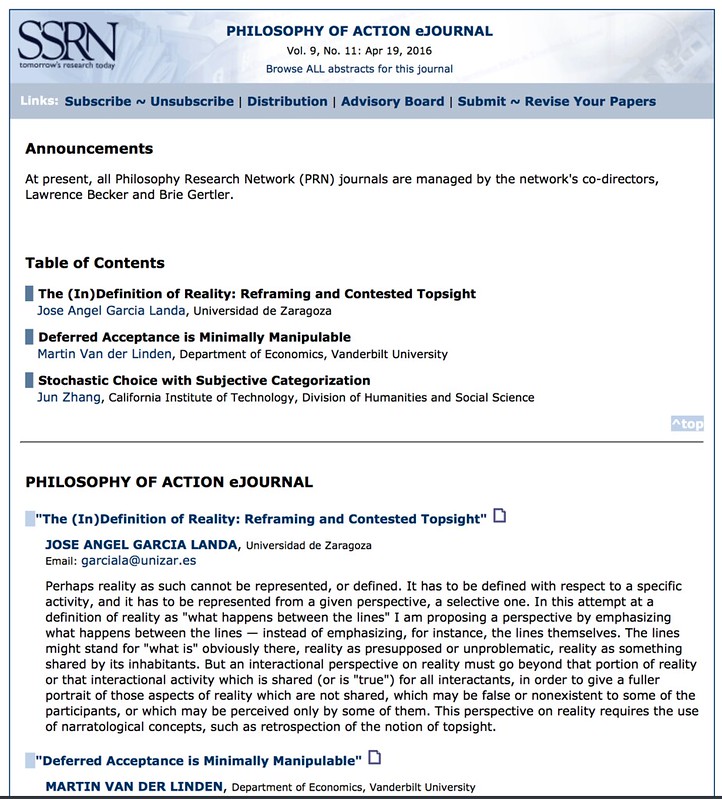
The (In)Definition of Reality: Reframing and Contested Topsight

miércoles, 27 de abril de 2016

The (In)Definition of Reality: Reframing and Contested Topsight

Abstract:

Perhaps reality as such cannot be represented, or defined. It has to be defined with respect to a specific activity, and it has to be represented from a given perspective, a selective one. In this attempt at a definition of reality as "what happens between the lines" I am proposing a perspective by emphasizing what happens between the lines — instead of emphasizing, for instance, the lines themselves. The lines might stand for "what is" obviously there, reality as presupposed or unproblematic, reality as something shared by its inhabitants. But an interactional perspective on reality must go beyond that portion of reality or that interactional activity which is shared (or is "true") for all interactants, in order to give a fuller portrait of those aspects of reality which are not shared, which may be false or nonexistent to some of the participants, or which may be perceived only by some of them. This perspective on reality requires the use of narratological concepts, such as retrospection or the notion of topsight.


The (In)Definition of Reality: 

Reframing and Contested Topsight

http://ssrn.com/abstract=2763243


Number of Pages in PDF File: 7

eJournal Classifications (Date posted: April 13, 2016)   Message
CSN Subject Matter eJournals
    
        
Distributed in Cognition & Culture: Culture, Communication, Design, Ethics, Morality, Religion, Rhetoric, & Semiotics eJournal
May 02, 2016
PRN Subject Matter eJournals
    
        
Distributed in Philosophy of Action eJournal
Vol 9, Issue 11, April 19, 2016
PRN Subject Matter eJournals
    
        
Distributed in Metaphysics eJournal
Vol 9, Issue 11, April 19, 2016


_____. "The (In)Definition of Reality: Reframing and Contested Topsight." Academia 9 April 2017.*
_____. ""The (In)Definition of Reality: Reframing and Contested Topsight." ResearchGate 10 April 2017.*


(Не)определение реальности


—oOo—

En el Philosophy of Action eJournal

En el Philosophy of Action eJournal

Aquí: http://www.ssrn.com/link/Philosophy-Action.html 

Philosophy of Action eJournal


—oOo—


Narrative: A Critical Linguistic Introduction

jueves, 31 de marzo de 2016

Narrative: A Critical Linguistic Introduction


No había caído en la cuenta de que me cita o nos cita Michael Toolan en las ediciones recientes de este libro, Narrative: A Critical Linguistic IntroductionCuya primera edición me compré yo en el año 88, en Providence. Estudiaba yo allí en esta bonita universidad.


—oOo—