
Ciencia y tecnología
The Quantum Internet
And teleporting information. One of the reports in this week's Nature podcast.
Preserved Self-Awareness
miércoles, 29 de agosto de 2012
Preserved Self-Awareness
Un abstract que nos pasan por PsyArt:
Preserved Self-Awareness following Extensive Bilateral Brain Damage to the Insula, Anterior Cingulate, and Medial Prefrontal Cortices.
Philippi CL, Feinstein JS, Khalsa SS, Damasio A, Tranel D, Landini G, Williford K, Rudrauf D.
Division of Behavioral Neurology and Cognitive Neuroscience, Department of Neurology, University of Iowa, Iowa City, Iowa, United States of America.
Source: PLoS One. 2012;7(8):e38413. Epub 2012 Aug 22.
Abstract
It has been proposed that self-awareness (SA), a multifaceted phenomenon central to human consciousness, depends critically on specific brain regions, namely the insular cortex, the anterior cingulate cortex (ACC), and the medial prefrontal cortex (mPFC). Such a proposal predicts that damage to these regions should disrupt or even abolish SA. We tested this prediction in a rare neurological patient with extensive bilateral brain damage encompassing the insula, ACC, mPFC, and the medial temporal lobes. In spite of severe amnesia, which partially affected his "autobiographical self", the patient's SA remained fundamentally intact. His Core SA, including basic self-recognition and sense of self-agency, was preserved. His Extended SA and Introspective SA were also largely intact, as he has a stable self-concept and intact higher-order metacognitive abilities. The results suggest that the insular cortex, ACC and mPFC are not required for most aspects of SA. Our findings are compatible with the hypothesis that SA is likely to emerge from more distributed interactions among brain networks including those in the brainstem, thalamus, and posteromedial cortices.
Conexionismo y combinaciones
jueves, 23 de agosto de 2012
Conexionismo y combinaciones
Leyendo "Avatares del paradigma conexionista" en Ciencia Cognitiva. La desvinculación establecida por el conexionismo entre los símbolos y sus representaciones cerebrales tiene un aire de familia, observo, con la mayor relativización que se ha impuesto en los estudios actuales sobre el genoma, donde ya no se sostiene que sea un gen el que codifica la información de por sí, sino un sistema de generación de información más complejo constituido por la interacción entre los genes, el momento de su activación, y la intensidad de su expresión. Como dice Beorlegui, en La singularidad de la especie humana,
"la genómica ya no se reduce al análisis de la secuencia de cada uno de los genes, sino que abarca también la combinación con otros elementos que los encienden, los frenan o los aceleran en su función. Por eso, si el ámbito del genoma es complicado, todavía lo es más el del proteoma." (426).
De ello surge un cierto paradigma también conexionista, o quizá mejor estructural-combinatorio, en el sentido de que es una combinatoria de factores la que rige el resultado, en lugar de una relación de uno a uno. Tanto la variabilidad semántica y cognitiva como la genética parecen requerir este instrumento combinatorio expandido, una especie de doble o triple articulación de signos como la que veían los estructuralistas en los planos del lenguaje.
A Commentary On the Origin of Technological Species
miércoles, 15 de agosto de 2012
A commentary On the origin of technological species
A commentary on Kevin Kelly's post On the Origin of Technological Species:
Astute readers should notice the origins of this famous passage, altered and paraphrased by Kirk Holden, and tweaked by me.
"If during the long course of ages and under varying conditions of instrumentation, technical tools vary at all in the several parts of their organization, and I think this cannot be disputed; if there be, owing to the high geometrical powers of increase of each kind of instrument, at some age, season, or year, a severe struggle for market share, and this certainly cannot be disputed; then, considering the infinite complexity of the relations of all instantiated artifacts of technology to each other and to their conditions of existence, causing an infinite diversity in structure, constitution, and habits, to be advantageous to them, I think it would be a most extraordinary fact if no variation ever had occurred useful to each technical artifact's own duration, in the same way as so many variations have occurred useful to nature. But if variations useful to any technical artifact do occur, assuredly individual tools thus characterized will have the best chance of being preserved in the struggle for product life; and from the strong principle of inheritance of specific technical solutions in hardware and software, they will tend to produce divergent forms similarly characterized. This principle of preservation, I have called, for the sake of brevity, Technological Progress. Technological Progress, on the principle of qualities being inherited at corresponding ages, can modify the IP, improved feature set, or new models, as easily as the earlier form."
Of course in the original passage Darwin argued the converse: that natural selection paralleled the same kind of selection we see in tools. The dynamics of evolution within nature and technology have many parallels, I argue, because they are driven by the same forces of exotropy and self-organization.
And my commentary:
Well, I'm literal-minded, so I'd say, "useful for users" not useful for the technological artifacts. And that makes all the difference; conscious selection by users we see as no problem; it is natural selection carried out by no intelligent user or designer that Darwin was trying to theorize, and that makes all the difference. That said, there are of course intriguing reflections to pursue when comparing natural and artificial selection. Darwin been there, done that too, but it can be redone. There's a natural-artificial selection of ideas, and the idea of natural selection is also honed and improved by reflecting about it.
Digitalizando la biología
jueves, 9 de agosto de 2012
Digitalizando la biología
De Schrödinger a Venter. Pasando por Turing y Watson. Aquí hay una conferencia de Craig Venter en Edge, celebrando los 70 años de What Is Life? de Erwin Schrödinger. Highlights:
"I will present our findings on first on reading the genetic code, and then learning to synthesize and write the genetic code, and as many of you know, we synthesized an entire genome, booted it up to create an entirely new synthetic cell where every protein in the cell was based on the synthetic DNA code."
"I view DNA as an analogue coding molecule, and when we sequence the DNA, we are converting that analogue code into digital code; the 1s and 0s in the computer are very similar to the dots and dashes of Schrodinger's metaphor. I call this process 'digitizing biology".
La vida como un procesador informático o máquina de Turing:
"Turing described what has become to be known as Turing Machines. The machine described a set of instructions written on a tape. He also described the Universal Turing Machine, which was a machine that could take that set of instructions and rewrite them, and this was the original version of the digital computer. His ideas were carried further in the 1940s by John von Neumann, and as many people know he conceived of the self-replicating machine. Von Neumann's machine consisted of a series of cells that uncovered a sequence of actions to be performed by the machine, and using the writing head, the machine can print out a new pattern of cells, allowing it to make a complete copy of itself on the tape. Many scientists have made the obvious analogy between Turing machines and biology. The latest was most recently in nature by Sydney Brenner who played a role in almost all the early stages of molecular biology. Brenner wrote an article about Turing and biology, and in this he argued that the best examples of Turing and von Neumann machines are from biology with the self-replicating code, the internal description of itself, and how this is the key kernel of biological theory."
Sobre cómo hacer vida sintética:
"Starting with the digital code we synthesized DNA fragments and assembled the genome. We corrected the errors and in the end had a 5,386-basepair piece of DNA that we inserted into E. coli, and this is the actual photo of what happened. The E. coli recognized the synthetic piece of DNA as normal DNA, and the proteins, being robots, just started reading the synthetic genetic code, because that's what they're programmed to do. They made what the DNA code told them to do, to make the viral proteins. The virus proteins self-assembled and formed a functional virus. The virus showed its gratitude by killing the cells, which is how we effectively get these clear plaques in a lawn of bacterial cells. I call this a situation where the "software is building its own hardware". All we did was put a piece of DNA software in the cell, and we got out a protein virus with a DNA core."
"How do you boot up a synthetic chromosome in a cell? This took substantial time to work out, and this paper that we published in 2007 is one of the most important for understanding how cells work and what the future of this field brings. // This paper is where we describe genome transplantation, and how by simply changing the genetic code, the chromosome, in one cell, swapping it out for another, we converted one species into another."
"When we interrogated the cells, they had only the transplanted genome, but more importantly, when we sequenced the proteins in these cells, there wasn't a single protein or other molecule from the original species. Every protein in the cell came from the new DNA that we inserted into the cell. Life is based on DNA software. We're a DNA software system, you change the DNA software, and you change the species. It's a remarkably simple concept, remarkably complex in its execution."
Mensajes inscritos en el genoma de las primeras células sintéticas a modo de marcas de agua:
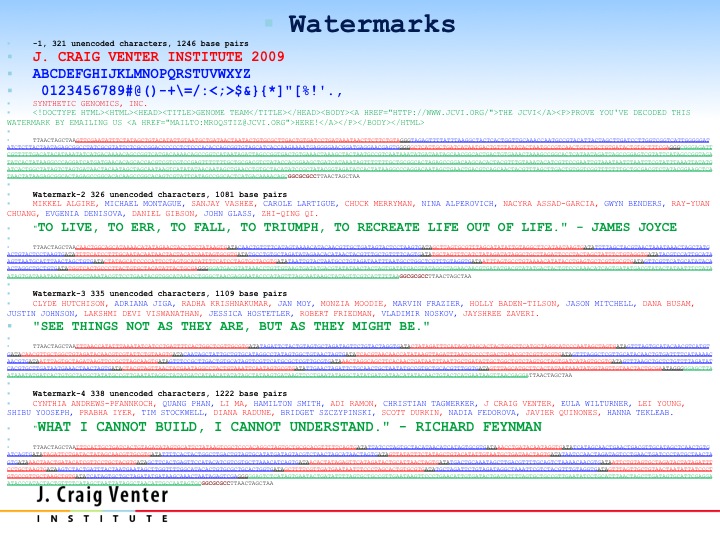
"One of the ways that we knew that what we had was a synthetic cell was by watermarking the DNA so we could always tell our synthetic species from any naturally occurring one. Now about the watermarks, when we watermarked the first genome we just used the single letter amino acid code to write the authors names in the DNA. We were accused of not having much of an imagination. For this new genome we went a little bit farther by adding three quotations from the literature. But first the team developed a whole new code where by we could write the English language complete with numbers and punctuation in DNA code. It was quite interesting. We sent the paper to Science for a review, and one of the reviewers sent back their review written in DNA code, much to the frustration of the Science editor, who could not decipher it. (Laughter) But the reviewer's DNA code was based on the ASCII code, and with biology that creates a problem because you can get long stretches of new without a stop codon. We developed this new code that puts in very frequent stop codons, because the last thing you want to do is put in a quote from James Joyce and have it turn into a new toxin that kills the cell or kills you. You didn't know poetry could do that, I guess. // We built in the names of the 46 scientists that contributed to the effort, and also there was a message with an URL. So being the first species to have the computer as a parent, we thought it was appropriate it should have its own Web addressed built into the genome. As people solved this code, they would send an e-mail to the Web address written in the genome. Once numerous people solved it, we made this available."
La segunda cita viene de American Prometheus, de Oppenheimer.
"All living cells that we know of on this planet are DNA software driven biological machines comprised of hundreds to thousands of protein robots coded for by the DNA software. The protein robots carry out precise biochemical functions developed by billions of years of evolutionary software changes."
"We can digitize life, and we generate life from the digital world. Just as the ribosome can convert the analogue message in mRNA into a protein robot, it's becoming standard now in the world of science to convert digital code into protein viruses and cells. Scientists send digital code to each other instead of sending genes or proteins."
"I suggested in place of sending living humans to distant galaxies that we can send digital information together with the means to boot it up in tiny space vessels. More importantly and as I will speak to on Saturday evening synthetic life will enable us to understand all life on this planet and to enable new industries to produce food, energy, water and medicine as we add 1 billion new humans to earth every 12 years."
La primera idea ya la planteó Olaf Stapledon al final de Last and First Men. La segunda es excelente, pero la solución al crecimiento de la población ha de venir por otro lado. Ahora que el colofón de la conferencia lo pone Watson, de Watson y Crick:
"I think chemistry is a good thing. I think our finding the DNA structure was unusual in that Crick or I, neither of us knew any chemistry. Luckily there was a chemist in the room, and helped."
Quizá no esté de más recordar en este contexto a Herbert Spencer, que a medidados del siglo XIX ya definió la vida como un proceso químico autorreproductivo de alta intensidad y rendimiento. Sin poder describirlo en más detalle, claro, al faltarle los elementos, el lenguaje y el código, al estar la química en mantillas, y la informática por inventar.
Curso sobre biología evolutiva en Yale
Apagón por partes
martes, 31 de julio de 2012
Apagón por partes
Un apagón en la India deja a 600 millones de personas sin electricidad. Ojo que se dice pronto. Y no es el primero de estos gigantescos. Ojo que en algunas de las teorías catastrofistas sobre el colapso de la sociedad industrial, los apagones masivos cada vez más frecuentes son a la vez señal y causa de decadencia. Aquí en España los hubo hace tres o cuatro años cuando las luces de navidades. No sé si con la crisis de energía que se nos viene encima veremos más esas luces tan a lo grande.
Cosmos interruptus
lunes, 23 de julio de 2012
Cosmos Interruptus
O, the discovery of a Great Gaping Gulf whereinto the World is Like to be Swallowed. Según la teoría del Big Bang, el universo surgió de la nada por motivos desconocidos. Algo especulan al respecto los astrofísicos (ver por ejemplo esta conferencia de Neil Turok, "What Caused the Big Bang"?) pero, en suma, queda un interrogante mayúsculo. Siendo que toda nuestra información es transmitida por señales o proviene de fenómenos que han dejado huella, todo lo que podemos saber limita con un punto infranqueable, donde se generan los fenómenos discretos o la energía que transmite la información. No sabemos qué causó el Big Bang, ni siquiera si tiene sentido hablar de causalidad en este caso que (en lo que sabemos y podemos saber) es único, una singularidad en más de un sentido.
Al no saber nada sobre el origen, hay otra cosa que no sabemos. No sabemos si las condiciones creadas por el Big Bang estabilizan el cosmos de modo que sea imposible el surgimiento inopinado de otro Big Bang, en cualquier punto del espacio-tiempo, o de otro universo en expansión que se lleve el nuestro por delante.
Y así está la cosa. Lo que vemos (la tierra, el mar, las nubes, la gente y sus cosas, los pájaros volando) parece tener una cierta estabilidad, estar en cambio lento pero controlado, seguir un proceso ordenado. Los cataclismos que esperamos son también lentos y previsibles en cierto modo: el agotamiento de la energía del petróleo, o del sol en un lejano futuro, el cambio climático, un terremoto quizá que resquebraje un poco nuestro mundo, a todo tirar (y esto no lo queremos ni pensar) un asteroide que pueda acabar con todo súbitamente con unos pocos meses quizá de preaviso. Todo es inestable, pero (lo primero) no nos gusta pensar en ello, y (lo segundo) nos parece extremadamente implausible que todo pudiera desaparecer en un momento: creemos conocer el mundo y tenerlo si no bajo control, al menos razonablemente previsto.
Yo ví sin embargo, hará menos de veinte años, una catástrofe cósmica de tamaño planetario—filmada por una sonda espacial que pasaba junto a Júpiter. Cayó allí un cometa que causó una explosión mayor que todo nuestro planeta—un cometa que con un poquito menos de probabilidad sólo, podía perfectamente haber caído en la Tierra, y se acabó la Historia. Se quedó la cosa en una noticia de curiosidades para rellenar el telediario.
Pero es que todo es aún más inestable. Aparte de los derrames cerebrales que nos pueden dar súbitamente, para acabar también la historia a nivel local, está la posibilidad inherente de que todo lo que conocemos desaparezca en un segundo. Ya no es que la tierra sea poco firme, o que al sol le falten pilas. Es que todo es fundamentalmente inestable, si aceptamos lo que hemos dicho al principio sobre el Big Bang. Todo está donde está por razones que desconocemos, y podría desaparecer en un momento. No porque yo lo diga, sino porque una vez estudiado lo que hay, las cosas son así.
Todo podría desaparecer en cualquier momento, and leave not a wrack behind.
Siendo esto así, cualquier momento vale como conclusión final de todo—no hay por qué esperar a que la larga historia siga su curso previsible y quizá totalmente imaginario. Ya no es que "hoy es el primer día del resto de la vida"— ni siquiera que haya que vivir cada día como si fuera el último . Es que por sus propios méritos ya lo ha sido. La historia, de por sí, está acabada ya. Cualquier momento podría ser el momento final de la historia, y eso hace que en cierto modo cualquiera ya lo sea. En la medida en que no lo es—es por la pura casualidad en la que vivimos.