Blogia
Vanity Fea

Literatura y crítica

Mendilow on Metafiction

martes, 2 de julio de 2013


Mendilow on Metafiction

One of the final sections of A. A. Mendilow's Time and the Novel (1952), "Planes of reality", p. 224-28—on novels which problematize the conventions of reality and its representation, and tend to problematically embed worlds within fictional worlds. Mendilow does not use the term "metafiction", but it's his subject. Plus "A note on Orlando" (228-31), one of his major examples along with other novels by Woolf and with Tristram Shandy:


de-profundis
Planes of Reality
Gide was led to this problem of the author-character relationship to an approach reminiscent of 'the infinite observer' in Dunne's philosophy of 'Serialism'. Gide projected a series of extensions of himself into his novel The Counterfeiters, each a novelist with a different interpretation of reality and a different technique for stylising it into art, each critical of the other's distortions and methods. 


I am beginning to catch sight of what I might call the 'deep-lying subject' of my book. It is—it will be—no doubt, the rivalry between the real world and the representation of it which we make to ourselves. The manner in which the world of appearances imposes itself upon us, and the manner in which we try to impose on the outside world our own interpretation—this is the drama of our lives. (59)


One is at times reminded of a passage in a poem of Patmore's:


                                               I knew
He thought I thought he thought I slept. (60)


This play of consciousness within consciousness is in a sense the psychological equivalent of the structural technique of enveloping plots. The tale within a tale is familiar from the Thousand and One Nights, theDecameron, the Canterbury Tales, or to take more recent examples, Godwin's Caleb Williams and Emily Brontë's Wuthering Heights.

The picaresque plot is in a way an extension of the primitive type of enveloping plot, for each incident or proto-tale in the career of the hero forms in effect an independent unit, linked only by a common character and by the idea of temporal succession. The enveloping plot here often disappears or remains in a rudimentary form, though it may, as in Don Quixote, provide a coordinating principle that gives all their significance and point to the component incidents.

A change in the centre of gravity of the novel is provided by the familiar device of inserting short stories, as Wandering Willie's Tale in Redgauntlet, or Le Fever's Tale in Tristram Shandy. Here, the enveloping plot is no longer a merely a convenient framework for individually separate tales, but seizes the place of importance. The enclosed tale exemplifies or illustrates the main issues, or it provides relief from the stress of the fictive present or the novel by a divagation into the past, or it creates suspense by interrupting at some crucial moment the continuity or the main-stream of the narrative. Parallel with this is the play within the play ofte nused by Shakespeare, while Sheridan's Critic and Buckingham's Rehearsal resemble the simpler form of enveloping plot, where the enclosed unit is the more important, and the outer plot serves as a framework for it.

Conrad went a step further. He exploited the opportunities offered by the 'nest of tables' technique to shift his points of reference and as a result his temporal perspectives. This provided him with a method of interposing a number of refracting minds between the narrator and the matter narrated. As with Gide, the effect is one of mutually corrective balances and checks, and it suggests that he also was acutely aware how defective is a direct interpretation of reality presented by the author as the true picture. This same diffidence that demands the limiting of the author's omniscience lies behind Henry James's use of the restricted point of view and his impersonal analysis of the detached observer who is, like the people he observes, himself fumbling and stumbling towards the truth of a situation; it likewise explains perhaps Virginia Woolf's use, as in Jacob's Room, of the multiple point of view.

Henry James was particularly interested in Conrad's technique of interposed refractors, and his discussion of its use and purpose in Chance is illuminating. (61). He himself was to try a more daring experiment with transposed planes of reality in a remarkable unfinished novel, The Sense of the Past. The time-scheme of this is so complex as to be almost bewildering. Ralph is so overwhelmed by the need


to recover the lost moment, to feel the stopped pulse  . . . as experience. (62)


He is fascinated by the picture of an ancestor who was ridden by the compulsion to project himself into the future. As he explains to his friend:


am the Future . . . for him; which means the Present for you. (63)


The two are given their desire. Ralph loses his original present and becomes his past which is his ancestor, contemporaneous with his ancestor's circle of acquaintances. He is however cursed with a double consciousness: that of his new present which was his past, and of his old present which is now his future. The coexistence within him of two time-series deters him from yielding to his love for Nan, and he thereby breaks the identity of himself and his ancestor, now his posterity. He


has wronged the personality of the other fellow in him, in himself, Ralph, by depriving him of the indicated, the consonant union with the fine handsome desirable girl whom the 1820 man would perfectly and successfully have been in love with. (64)


Gide's treatment of the planes of reality was developed further  in a witty Pirandello-like fantasia—At Swim-Two-Birds (65). This book is a first person novel. The is shown in the pangs of writing a novel, the chief character of which is a novelist. As the characters which the and his novelist create come to life in their respective pages, they begin to do so literally and little by little acquire a degree of reality little less than their creators. In time they get out of hand and, falling out with their writers, turn the tables and write them back. And so the personages of the novelist more and more determine the behaviour of their unwilling author, while he in turn constantly interferes with the intentions of the I whose views he cannot accept; and over the whole contrapuntal performance presides the real author leading or led by all his creations.

Experiments such as these with their ever-changing points of reference and times-series bristle with temporal complications that ramify into the most complex patterns. They are counterpointed novels.


What I should like to do is something like the art of fugue-writing (66)


exclaims Gide's novelist-protagonist, a desire echoed exactly by Huxley's novelist and which is responsible for the title Point Counter Point.

A Note on Orlando 
The writer who is most commonly acclaimed as the founder of the psychological novel is Samuel Richardson. Like Saul the son of Kish whose concern for some asses led him to a kingdom, Richardson set out to compile a collection of uplifting letters for the use of the semi-literate and proceeded to start the modern novel on its career. But like Saul he failed to establish a dynasty, though his achievements were important and his fame exceeing great in his day. It is to Sterne rather than to Richardson that the modern psychological novel traces its ancestry, and Tristram Shandy may with justice be regarded as the first modernist novel.

In the mock-serious preface to Orlando, Virginia Woolf, referring to the writers who had most influenced her mentioned as one of 'the first that came to mind' Laurence Sterne, and in that brilliant biography with a difference the family likeness comes out very clearly. Like sterne, the author is at pains to emphasize the psychological as constrasted with the chronological values of duration, and to bring out the difference between the two by the adroit use of one as a yardstick to measure the other. The inadequacy of calendar time is piquantly demonstrated by Orlando's varying sense of its passing:


Orlando gave his orders and did the business of his vast estates in a flash; but directly he was alone on the mound under the oak tree, the secods began to round and fill until it seemed as if they would never fall. (67)


This refusal to accept calendar time as a standard is the explanation of the unconventional treatment of centuries in the biography. It also explains the rejection of temporal sequence and continuity. The biographer switches from one discriminated occasion into the heart of another without warning; seconds expand into years, as when she falls in love and marries in the course of three and a half seconds; years under the oak tree pass like seconds; separate durations telescope and proceed simultaneously.


Some weeks added a century to his age, others no more than three seconds at most . . . Life seemed to him of prodigious length. Yet even so, it went like a flash . . . he would try to think fro half an hour—or was it two years and a half? (67)


Yet even the digressions and intercalated episodes serve to focus the attention on time as a dramatic now; the only tense is the fictional present as given by the prrocess of consciousness which is always nine-tenths past. And for these divagations from the customary progressions, there are close parallels in Tristram Shandy. 
aetatis suae 

Virginia Woolf has even gone so far as to borrow some of Sterne's highly idiosyncratic quirks, such as leaving a blank space which the reader's imagination is invited to fill (68), or setting off the fictional date of the character's position in time against the real date of the author's writing. (69). She is as concerned as was Sterne to show the progress of the writing of the book pari passu with the progress of the subject of it. In so doing, she too constantly recalls the reader from his fictive to his real present. She indulges in critical disquisitions, she discusses with him the problems besetting the biographer, the technique of her book, the relation of fiction to reality, of author to character; she informs him what she is doing and how and why she is doing it; and always, like Sterne, she misses no opportunity of cocking a very decorous snook at all the conventions and all the theories established by all the respected critics. These discussions are not mere digressions. They are used almost invariably to suggest longueursin the fictional time, as notably in the pause in the action that marks the waiting for the birth of Orlando's son. 

Actually, Orlando is as much, or as little, a biography as Tristram Shandy is an autobiography. It is a study in heredity and tradition. It is at once an account of the composition of a poem and of the progress of literature in the light of the cahnging critical views, tastes and fashions of the last few centuries; it is a biography of a real person, Victoria Sackville-West, in terms of the history of her family; and it is an analysis of the androgynous elements in the human personality, presented not spatially, that is, as coexisting side by side, but temporally as well, that is, as extended in time. This unusual method allows the portrayal of each sexual quality as it becomes dominant in different stages in the development of a person—a fact which we recognise in our use of the world 'tomboy', for example. It also enables us to gauge the changing standards of society and convention as to what constitutes true masculinity and femininity. Furthermore, it reveals those dominant characteristics in our forebears which determine the quality and proportion of the masculine and feminine elements in us. 

Above all, Orlando exemplifies the principle that unites all Virginia Woolf's work: the immanence of the past in the present, the Bergsonian conception of the moment as the microcosm of life. As in her later novel Between the Acts,in which a very similar technique is used, the time-units which express this principle are extended. Instead of the personal past pervading the very moment of perception, the wider past of the centuries of tradition indwelling in every work of art, and of the generations of inherited traits latent in a contemporary personality give added depth and significance in the understanding of that work of art and that personality. Regular biography and formal literary criticism can analyse the process objectively, but only imaginative fiction can show it in operation from within. In this piece of riotous fantasy, we see something akin to what, in the mechanism of dreams, Freudians call 'displacement'. Various aspects of a single subject (as here, the poem) are dissociated and projected into separate entities, and then by the process of interpretation, they are related once more and synthesized. In Orlando, we see several such themes evolving separately in time, but each must be seen in its connections with every other as that evolves. This close counterpointing is a marked feature of the book. 

The whole point of Orlando is that it presents the growth of literary taste, the creation of a poem, the changes in the 'climate of opinion', the history of a family, the development of a personality, in two time planes at once. The character of Orlando is shown between the dates 1586 and 1928, growing in age from sixteen to thirty-six. We have what biologists would call a description of ontogenetic and phylogenetic development, as a foetus progresses in the course of nine months through millions of years of evolution, passing through and beyond the stages reached at different times by successive series of ancestors. The phylogenetic time is incorporated into the ontogenetic time as one's ancestors are parts of ourselves.

Both Tristram Shandy and Orlando are fantasias on a time-theme, with Bergson replacing Locke as the philosophic inspirer. Both achieve their most novel effects by proceeding simultaneously in several dimensions of time. Neither may be taken too seriously. If the main motif of Tristram Shandy is the hobby-horse, Orlando concludes with the return of the wild-goose he and/or she has been chasing for three and a half centuries.


____

Notes

(59) p. 225.
(60) The Angel in the House.
(61) in Notes on Novelists, p. 274 passim.
(62) p. 47.
(63) p. 102.
(64) This is from the notes on the unfinished novel, pp. 315-16.
(65) Flann O'Brien, 1939.
(66) p. 210.
(67) Chapter II. pp. 58, 59.
(68) Chapter V. p. 146.
(69) e.g. Chapter II, p. 46 where it is given as November 1wt, 1927 or chapter VI, p. 171 where it is October 11th, 1928.

Time and the Novel (Conclusion) 


El presente retrospectivo en la novela moderna

jueves, 27 de junio de 2013


El presente retrospectivo en la novela moderna

Un pasaje de Time and the Novel de Adam Abraham Mendilow (1952).  Como modelos para sus comentarios del uso del tiempo en la novela moderna, toma a Sterne primero, y a Virginia Woolf a continuación. Los personajes de Virginia Woolf, señala, tienen en común una intensa preocupación con la experiencia presente, con el momento vivido.

She felt that she wanted to enclose the present moment; to make it stay; to fill it fuller and fuller, with the past, the present and the future, until it shone, whole, bright, deep with understanding. (Woolf, The Years).


Por cierto que esta cita de The Years (Pan Book, 1948, p. 323, cit. en Mendilow 218) es intensamente reflexiva o implícitamente metaficcional, en la medida en que parece describir no sólo la experiencia temporal vivida por el personaje, sino también la modalidad de tratamiento del tiempo que busca Virginia Woolf en su escritura.

Sigue así el comentario de Mendilow:

The effect on the novel is three-fold: while the 'inner novel' is presented as a continuous present (actually it is usually written in a fictional past but is felt as a fictive present, an effect much strengthened by the interior monologue and stream-of-consciousness techniques which are grammatically in the present tense), the past, paradoxically, plays a much greater part in it; the past is never presented by the author ab extra in the form of chronologically arranged exposition preceding or inserted into the main action, but as sifted through a character's mind; the novel is subject to all the temporal vagaries of the 'time-shift', and is therefore 'selected' on different principles from those obtained in the older conventional novels. 

The time-area conveyed by these novels is commonly restricted to a very short period, or to a number of short periods at varying intervals. The characters would appear foreshortened, out of all proportion, if they were judged by a knowledge of a few hours only of their lives, without any reference to what came before the period treated. To have meaning, their lives must be understood in the light of their past which has conditioned their reactions to the present and determined their outlook and personality. Moreover, as all feelings and thoughts are linked to the past, a good deal of that past must have its place in any description of thoughts and feelings. Hence in a novel dealing only with present events, everything anterior to the starting-point of the novel may be given only as it arises in the character's mind, in other words, as it becomes part of his present. But always 'the accent falls differently from of old'. (38) The event in the past at the time of its occurrence is not as it is recalled later. Something has changed—the perceiver; and the thing perceived is therefore different. The character in consequence


. . . cannot say what portion is in truth
The naked recollection of that time,
And what may rather have been called to life
By after-meditation. (39)


For the modern novelist, therefore, the event loses interst as an event in itself; it serves rather as a point de répère for the portrayal of the character as he is in the present of the novel. The reaction, not the action, is important; the past is seen from the present and in the light of the present, backwards, not in its own right from its own time forwards. And so almost every character in Virginia Woolf's novels feels like Rose in The Years:


Her past seemed to be rising above her present. (40)


Clarissa, in Mrs. Dalloway, trying to savour to the full the essence of the present,


plunged into the very heart of the moment . . . the moment of this June morning on which was the pressure of all the other mornings. (41)


Rhoda in The Waves would like to escape from the moment.


But I am fixed here . . .  An immense pressure is on my. I cannot move without dislodging the weight of centuries. (42)


Lily in To the Lighthouse trying to concentrate her feeling for Mr. Bankes in a suitable formula


felt herself transfixed by the intensity of her perception. (43)


As she listens to him speaking,


the load of her accumulated impressions of him tilted up, and down poured in a ponderous avalanche all she felt about him. That was one sensation. Then up rose in a fume the essence of his being. That was another. (44)


Orlando, alone under the oak tree, meditates on the eternal verities.


What is love? What friendship? What truth? but directly he came to think about them, his whole past, which seemed to him of extreme length and variety, rushed into the falling second, swelled it a dozen times its natural size, coloured it a thousand tints, and filled it with all the odds and ends in the universe. (45)


In the modern view the existence of the past as past is denied, while the existence of the past as present is powerfully affirmed. We live in fact in a series of


presents sliding into each other, each with a past which is referable to itself, each past taking up into itself those back of it, and in some degree reconstructing them from its own standopoint. The moment that we take these earlier presents as existences apart from the presentation of them as pasts they cease to have meaning to us and lose any value they may have in interpreting our own present . . . (46)

______


(38) V. Woolf: The Common Reader, p. 189.
(39) Wordsworth: The Prelude, Book III, ll. 610-3.
(40) p. 127.
(41) pp. 41-2.
(42) p. 114.
(43) p. 42.
(46) Mead: op. cit., p. 9.
 

Esta última cita viene de un ensayo de George Herbert Mead, The Philosophy of the Present. Lo traduje en tiempos,por aquí puede verse; es tan recomendable en su línea como Mendilow en la suya propia; lo cierto es que no esperaba verlo citado en un libro de crítica de 1950, pero Mendilow obviamente sabía lo que hacía y decía.


Exquisite Moments 


Gilgamesh y la escritura

lunes, 24 de junio de 2013

Gilgamesh y la escritura


Reaparece mi artículo sobre "Gilgamesh y la escritura"

—en las revistas electrónicas de antropología y de estética del Social Science Research Network. Publicado en Narrativas 9 (2008): 14-20.

http://papers.ssrn.com/abstract=2280022 

eJournal ClassificationsDate
AARN Subject Matter eJournals
                          
June 17, 2013
PRN Subject Matter eJournals
             
June 17, 2013

Narración, escritura, y orientación solar


Entrevista con Margaret Atwood

viernes, 14 de junio de 2013

Entrevista con Margaret Atwood

The Poetics of Subliminal Awareness

martes, 11 de junio de 2013

The Poetics of Subliminal Awareness


This is the long version of a paper I wrote on Vladimir Nabokov; it's been included now in four of the SSRN ejournals. A shortened version was published in the European Journal of English Studies.

The Poetics of Subliminal Awareness: Re-reading Intention and Narrative Structure in Nabokov's 'Christmas Story".http://papers.ssrn.com/abstract=2245565 


eJournal ClassificationsDate
CSN Subject Matter eJournals


April 05, 2013
LIT Subject Matter eJournals
    
        
April 05, 2013
LIT Subject Matter eJournals
    
April 05, 2013
RCRN Subject Matter eJournals
    
        
April 05, 2013

Hay un resumen en español aquí:


Poética de la consciencia subliminal

Narrativity of the Photoblog

lunes, 10 de junio de 2013

Narrativity of the Photoblog


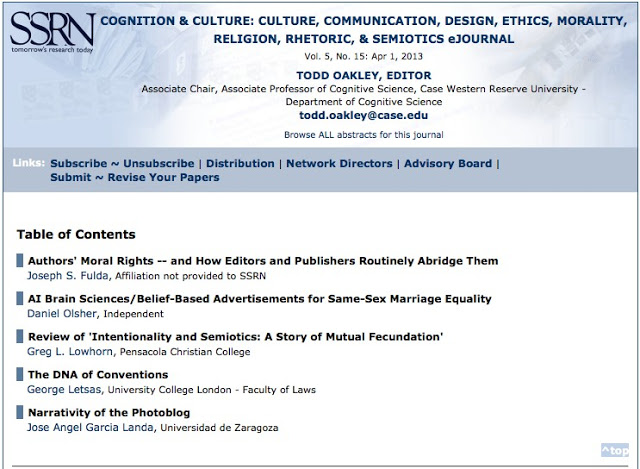
Un artículo que elaboré partiendo de este post sobre la narratividad del fotoblog, y que por el momento ha ido a parar a varias revistas electrónicas de la Social Science Research Network, por ejemplo a esta Cognition & Culture eJournal:


Narrativity of the Photoblog

 Abstract: 

This paper examines the storytelling dimension of personal photoblogs from the point of view of narrative semiotics, taking into account both deliberate and spontaneous narrativity, and the narrative sequences constructed by the medium as well as those constructed by the viewers.

Click on the left-hand column, and see under the date of the paper: March 24, 2013:

Narrativity of the Photoblog


http://papers.ssrn.com/abstract=2238083

eJournal ClassificationsMessage
AARN Subject Matter eJournals
                          
Added to eLibrary 
CSN Subject Matter eJournals
                          
Distributed in Cognition & the Arts eJournal
Vol 5, Issue 7, April 01, 2013 
CSN Subject Matter eJournals
                          
Distributed in Cognition & Culture: Culture, Communication, Design, Ethics, Morality, Religion, Rhetoric, & Semiotics eJournal
Vol 5, Issue 15, April 01, 2013 
RCRN Subject Matter eJournals
             
Distributed in Rhetorical Theory eJournal
Vol 2, Issue 2, April 02, 2013 


Mi álbum de fotos 2012


Neuroaesthetics of Music

domingo, 9 de junio de 2013

Neuroaesthetics of Music

An article from the NYT posted by Norman Holland to the PsyArt list:
Hi, gang,

This is from today's New York Times.  Zatorre has been working and writing on music and the brain for a long time.  One thing that interests me as a literary type: we get pleasure from music's creating expectations and gratifying them; stories have the same appeal, expectation-gratification, wanting-liking, wanting-liking, wanting-liking . . .
'
                      --With warm regards,

                                          Norm


Why Music Makes Our Brain Sing

by ROBERT J. ZATORRE and VALORIE N. SALIMPOOR
June 7, 2013
Read Later

MUSIC is not tangible. You can’t eat it, drink it or mate with it. It doesn’t protect against the rain, wind or cold. It doesn’t vanquish predators or mend broken bones. And yet humans have always prized music — or well beyond prized, loved it.

In the modern age we spend great sums of money to attend concerts, download music files, play instruments and listen to our favorite artists whether we’re in a subway or salon. But even in Paleolithic times, people invested significant time and effort to create music, as the discovery of flutes carved from animal bones would suggest.

So why does this thingless “thing” — at its core, a mere sequence of sounds — hold such potentially enormous intrinsic value?

The quick and easy explanation is that music brings a unique pleasure to humans. Of course, that still leaves the question of why. But for that, neuroscience is starting to provide some answers.

More than a decade ago, our research team used brain imaging to show that music that people described as highly emotional engaged the reward system deep in their brains — activating subcortical nuclei known to be important in reward, motivation and emotion. Subsequently we found that listening to what might be called “peak emotional moments” in music — that moment when you feel a “chill” of pleasure to a musical passage — causes the release of the neurotransmitter dopamine, an essential signaling molecule in the brain.

When pleasurable music is heard, dopamine is released in the striatum — an ancient part of the brain found in other vertebrates as well — which is known to respond to naturally rewarding stimuli like food and sex and which is artificially targeted by drugs like cocaine and amphetamine.

But what may be most interesting here is when this neurotransmitter is released: not only when the music rises to a peak emotional moment, but also several seconds before, during what we might call the anticipation phase.

The idea that reward is partly related to anticipation (or the prediction of a desired outcome) has a long history in neuroscience. Making good predictions about the outcome of one’s actions would seem to be essential in the context of survival, after all. And dopamine neurons, both in humans and other animals, play a role in recording which of our predictions turn out to be correct.

To dig deeper into how music engages the brain’s reward system, we designed a study to mimic online music purchasing. Our goal was to determine what goes on in the brain when someone hears a new piece of music and decides he likes it enough to buy it.

We used music-recommendation programs to customize the selections to our listeners’ preferences, which turned out to be indie and electronic music, matching Montreal’s hip music scene. And we found that neural activity within the striatum — the reward-related structure — was directly proportional to the amount of money people were willing to spend.

But more interesting still was the cross talk between this structure and the auditory cortex, which also increased for songs that were ultimately purchased compared with those that were not.

Why the auditory cortex? Some 50 years ago, Wilder Penfield, the famed neurosurgeon and the founder of the Montreal Neurological Institute, reported that when neurosurgical patients received electrical stimulation to the auditory cortex while they were awake, they would sometimes report hearing music. Dr. Penfield’s observations, along with those of many others, suggest that musical information is likely to be represented in these brain regions.

The auditory cortex is also active when we imagine a tune: think of the first four notes of Beethoven’s Fifth Symphony — your cortex is abuzz! This ability allows us not only to experience music even when it’s physically absent, but also to invent new compositions and to reimagine how a piece might sound with a different tempo or instrumentation.

We also know that these areas of the brain encode the abstract relationships between sounds — for instance, the particular sound pattern that makes a major chord major, regardless of the key or instrument. Other studies show distinctive neural responses from similar regions when there is an unexpected break in a repetitive pattern of sounds, or in a chord progression. This is akin to what happens if you hear someone play a wrong note — easily noticeable even in an unfamiliar piece of music.

These cortical circuits allow us to make predictions about coming events on the basis of past events. They are thought to accumulate musical information over our lifetime, creating templates of the statistical regularities that are present in the music of our culture and enabling us to understand the music we hear in relation to our stored mental representations of the music we’ve heard.

So each act of listening to music may be thought of as both recapitulating the past and predicting the future. When we listen to music, these brain networks actively create expectations based on our stored knowledge.

Composers and performers intuitively understand this: they manipulate these prediction mechanisms to give us what we want — or to surprise us, perhaps even with something better.

In the cross talk between our cortical systems, which analyze patterns and yield expectations, and our ancient reward and motivational systems, may lie the answer to the question: does a particular piece of music move us?

When that answer is yes, there is little — in those moments of listening, at least — that we value more.

Robert J. Zatorre is a professor of neuroscience at the Montreal Neurological Institute and Hospital at McGill University. Valorie N. Salimpoor is a postdoctoral neuroscientist at the Baycrest Health Sciences’ Rotman Research Institute in Toronto.

Conferencia sobre Virginia Woolf

domingo, 9 de junio de 2013

Conferencia sobre Virginia Woolf


Laura Freixas
Virginia Woolf: huerto, jardín y campo de batalla