Blogia
Vanity Fea

Literatura y crítica

Notas sobre el dialogismo, en eJournals

jueves, 6 de junio de 2013

Notas sobre el dialogismo, en eJournals

Un texto de Mijail Bajtin que traduje con anotaciones reaparece en varias revistas electrónicas del Social Science Research Network, entre ellas el Cognitive Linguistics eJournal editado por Mark Turner:

ssrncognitext

Notas sobre el dialogismo de Mijail Bajtin en 'El problema del texto en la lingüística, la filología y las ciencias humanas' (Annotations on Mikhail Bakhtin's Dialogism in 'The Problem of the Text in Linguistics, Philology, and the Human Sciences') http://papers.ssrn.com/abstract=2226073 

Pinchando en la columna de la izquierda, aparece con fecha de 1 de marzo de 2013 en estas revistas:

eJournal ClassificationsMessage
CSN Subject Matter eJournals
    
        
Distributed in Cognitive Linguistics: Cognition, Language, Gesture eJournal
Vol 5, Issue 9, March 13, 2013 
PRN Subject Matter eJournals
    
        
Distributed in Aesthetics & Philosophy of Art eJournal
Vol 5, Issue 10, March 12, 2013 
PRN Subject Matter eJournals
    
        
Distributed in Philosophy of Language eJournal
Vol 6, Issue 11, March 15, 2013 
RCRN Subject Matter eJournals
    
        
Distributed in Rhetorical Analysis eJournal
Vol 2, Issue 3, March 13, 2013 

El drama: Forma y acción, no mensaje

jueves, 6 de junio de 2013

El drama: Forma y acción, no mensaje

Un pasaje de J. L. Styan, The Elements of Drama, contra la idea de un teatro "de ideas" o "realista", y defendiendo el mostrar sobre el decir, y las convenciones, la estilización, la construcción de una forma dramática autosustentada:
indirection
By the laws of comic theatre and of any comic art, perhaps the more incisevely and vigorously the writer wishes to probe, the farther into a Ruritania must he transport the spectator first. 

So a first step towards judgment is not to ask how far it is like life, but why it is different from life. But in asking 'why?', we come close to looking for theat tiresome, misleading, ungainly phantom, the play's 'message'. The common assumption that the more the playwright teaches a tidy lesson, the more considerable it is, is a dangerous fallacy. Though we may consciously disavow it, it is an assumption we hold unwittingly. Drama does not tell what it has to say, but shows it. The good mother does not say to her child, 'Go away and play'; she says specifically, 'See if you can find the cotton-reel in my basket'. The playwright owes to his audience to find particular and concret action for the general and abstract idea, so that the playgoer can move across common ground with him. Because the stage expects concrete detail of behaviour for its living actos, no other literary form is more objective, less moralizing. (...)

Without losing one's sense of the complexity of the whole, the discssion must become one about the ordering and emphasis of the play and the relation of its parts, not immediately about its content or message. Injustice has been done to the work of Bernard Shaw, though he invited it himself, by a general refusal to give him credit as an artist before assessing hims as a thinker. This is somewhat true of Molière, is still largely true of Strindberg and Pirandello, for years was true of Shakespeare, and may yet blight the fortunes of M. Anouilh today. Shaw's own attitude to Ibsen, as seen in The Quintessence of Ibsenism, showed a similar error of judgment. Should the spectator become aware of the preacher in the playwright, aware that a view of life is being thrust upon him, the play will destroy itself. 
 
A poem can make a deep and broad meaning out of a tiny subject, and what is true of poetry is true of drama. The meaning that matters emerges from the way the subject is treated. the family of The Cherry Orchard makes a departure, the family of The Three Sisters does not, but there the seminal ideas end: the rest is growth and fruition. The satisfaction of drama arises from no logical consistency in the events, nor from their magnitude. The power of the play comes of its constency within itself, and its content achieves magnitude by the quality of its exploration, its with of view and its sense of proportion.

In arriving at a judgment, the second step is therefore one inseparable from our decision about the quality of the texture and the offering of the impressions, together with decisions about the delicacy and precision by which the author and his agents originate and project them. (1960: 262-3)


Creativity and the Everyday Brain

miércoles, 5 de junio de 2013

Creativity and the Everyday Brain


Play
0:00 / 51:00
  • Creativity and the Everyday Brain with Rex Jung

Troy Story 3

domingo, 2 de junio de 2013

Troy Story 3


Aparece en un par de revistas electrónicas mi articulillo sobre la materia de Troya escrito en los 80. El título es un tanto inadecuado, pues se refiere más bien el artículo a las raíces medievales de la imagen de Troya heredada por el Renacimiento. Desde Dares y Dictys.

Homer in the Renaissance: The Troy Stories


Date posted: December 14, 2012   

http://papers.ssrn.com/abstract=2188985 


eJournal ClassificationsDate
CRN Subject Matter eJournals
    
Dec. 14, 2012
LIT Subject Matter eJournals
    
        
Dec. 14, 2012

En Transfer

viernes, 31 de mayo de 2013

En Transfer

El discurso pronunciado por Harold Pinter con ocasión de la entrega del Premio Nobel de literatura que le dieron se titulaba "Arte, Verdad y Política". Contenía un polémico alegato contra algunos aspectos de la política exterior de los USA, y lo tradujimos de una tancada en su momento. Ahora ha aparecido en Transfer:
Art, Truth, and Politics (2005) de Harold Pinter: Traducción de un texto culturalmente relevante.

En el número de mayo de 2013, mes en el que todavía estamos. Mañana es junio, y mañana cumplo 52. Ya casi me da igual.

Luto por anticipado

miércoles, 29 de mayo de 2013

Luto por anticipado


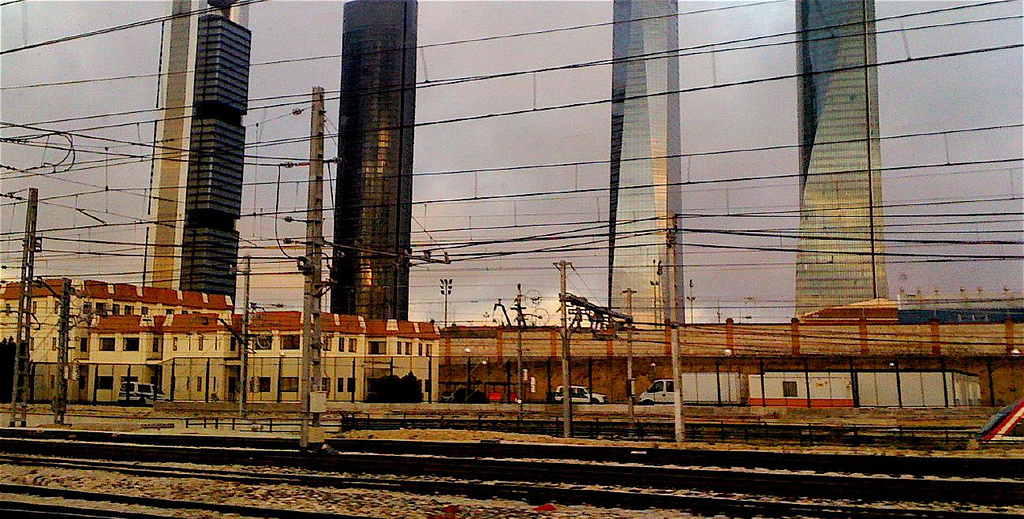
Cuatro torres 7  
 

El comienzo de El Séptimo Velo, de Juan Manuel de Prada:
 
Llegué a la ciudad de mi infancia apenas una hora después de que mi madre hubiese expirado. Cuando las personas que amamos son ya ancianas o llevan largo tiempo consumidas por la enfermedad, tendemos a representarnos anticipadamente su muerte, en un ejercicio mental preparatorio del trance que nos aguarda. Al contemplar su progresivo deterioro, el avance minucioso de las arrugas, la pérdida inexorable de facultades, los estragos de la decrepitud, en esos meses o años de convivencia previa con la muerte, apreciamos y valoramos lo que pronto perderemos y aprendemos a encarar ese futuo más o menos próximo en que faltarán. Nuestra piedad actúa como un mecanismo de defensa, previniéndonos contra su muerte; y así, las lloramos antes de tiempo, honramos su memoria antes de tiempo, nos atribulamos y desesperamos antes de tiempo, porque sabemos que ese dolor sostenido, consuetudinario casi, nos herirá más livianamente que el dolor abrupto que sobreviene a una pérdida que hemos preferido ignorar. Desde que a mi madre le declararan aquella metástasis cancerígena que interesaba los pulmones y el hígado y hacía inútil cualquier intervención quirúrgica, me había esforzado por asumir su muerte irremediable, convirtiendo su agonía en una despedida dilatada, asistiéndola siempre que podía en sus extenuantes sesiones de quimioterapia. Un espectador desavisado habría interpretado mis desvelos como una conmovedora muestra de entrega filial; pero yo sabía íntimamente que mi propósito era también egoísta, pues ya tenía experiencia de la muerte como golpe fortuito que nos desarbola y trastorna, y no me veía con ánimos para volver a soportarla.


Coule la Seine

miércoles, 29 de mayo de 2013

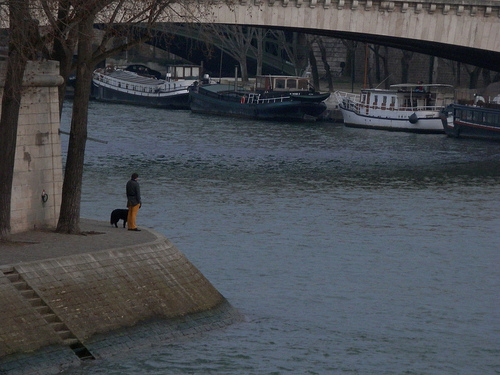
Coule la Seine

Coule la Seine by JoseAngelGarciaLanda
Coule la Seine, a photo by JoseAngelGarciaLanda on Flickr.
Sous le pont Mirabeau coule la Seine
Et nos amours
Faut-il qu'il m'en souvienne
La joie venait toujours après la peine

Vienne la nuit sonne l'heure
Les jours s'en vont je demeure

Les mains dans les mains restons face à face
Tandis que sous
Le pont de nos bras passe
Des éternels regards l'onde si lasse

Vienne la nuit sonne l'heure
Les jours s'en vont je demeure

L'amour s'en va comme cette eau courante
L'amour s'en va
Comme la vie est lente
Et comme l'Espérance est violente

Vienne la nuit sonne l'heure
Les jours s'en vont je demeure

Passent les jours et passent les semaines
Ni temps passé 
Ni les amours reviennent
Sous le pont Mirabeau coule la Seine

Vienne la nuit sonne l'heure
Les jours s'en vont je demeure


(Apollinaire)

Absence, Poetry, and Hindsight

sábado, 25 de mayo de 2013

Absence, Poetry, and Hindsight

(From Mark Freeman's Hindsight: The Promise and Peril of Looking Backward):

But it could also be that absence is not complete and that the world of ordinary experience bears within its absence a certain presence, a limited presence, which the poet, in turn, must try to bring to light. The poet Seamus Heaney has spoken of the "redressing" effect of poetry in this context, which "comes from its being a glimpsed alternative, a revelation of potential that is denied or constantly threatened by circumstances " (1995, p. 4). I also spoke earlier of the idea of "recuperative disclosure," the notion being that poetry, like hindsight, seeks to explicate what is there, in the world, and thereby rescue it from the forgetful oblivion that so often characterizes our relatedness to things. In a sense, you could say that poetry deals with what's not there and there at the same time. From one angle, it's about what is absent in presence; it's about what's often missing from our ordinary experience of things by virtue of its being "denied" or "threatened by circumstances." From another angle, it's about what's present in absence, the existence of a certain potential, "waiting" to be disclosed. Along the lines being drawn here, there is nothing intrinsically defensive or illusory at all about poems. On the contrary: they may very well serve as vehicles of disclosure and revelation, not so much "giving" meaning to experience as allowing it to emerge.