Blogia

Vanity Fea

"René Girard , Pierre Bourdieu: des affinités méconnues"

miércoles, 29 de junio de 2016


"René Girard-Pierre Bourdieu: Des affinités méconnues." Colloque organisé le 18 juin 2013 à la BnF par Bruno Viard, en partenariat avec l'ARM (Association Recherches Mimétiques) et le CIELAM (Centre interdisciplinaire d'étude des littératures d'Aix-Marseille). Audio. YouTube (Recherchesmimetiques) 30 Aug. 2013.
https://youtu.be/PV4F6Hz4Qs4
2016


"Les sujets sociaux sont des sujets qui désirent être reconnus, mais ils désirent être reconnus en tant que donateurs."

Le premier speaker ramène donc Girard (le désir) et Bourdieu (la reconnaissance) dans un paradigme qui manque: celui du don théorisé par Marcel Mauss.

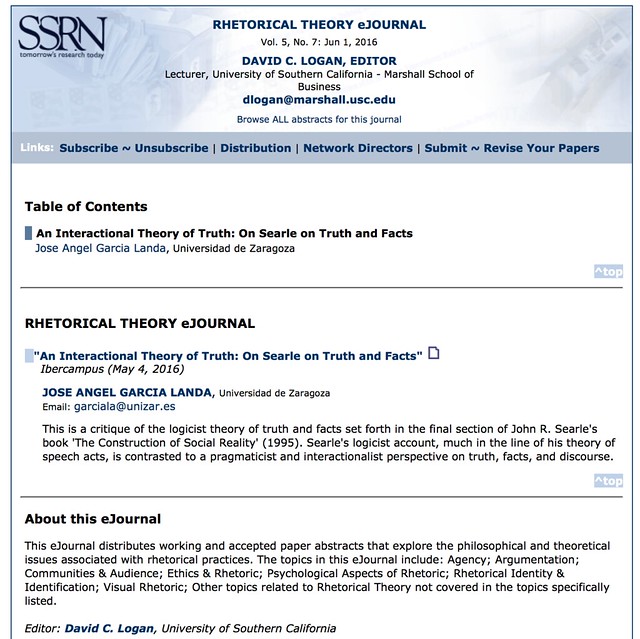
An Interactional Theory of Truth: On Searle on Truth and Facts

miércoles, 29 de junio de 2016

This is a critique of the logicist theory of truth and facts set forth in the final section of John R. Searle's book The Construction of Social Reality (1995). Searle's logicist account, much in line with his theory of speech acts, is contrasted to a pragmaticist and interactionalist perspective on truth, facts, and discourse.


An Interactional Theory of Truth: On Searle on Truth and Facts

http://ssrn.com/abstract=2780370

Jose Angel Garcia Landa


Universidad de Zaragoza

Ibercampus (May 4, 2016)

Number of Pages in PDF File: 10
Keywords: Discourse analysis, Truth, Facts, Philosophy, Epistemology, John R. Searle, Pragmatism, Interactionism, Statements, Pragmatics, Philosophy of language,


Date posted: May 20, 2016 ; Last revised: May 21, 2016

https://papers.ssrn.com/abstract=2780370


eJournal Classifications Message
AARN Subject Matter eJournals


Added to eLibrary
AARN Subject Matter eJournals


Added to eLibrary
CSN Subject Matter eJournals
    
        
Distributed in Cognitive Linguistics: Cognition, Language, Gesture eJournal
Vol 8, Issue 15, May 30, 2016
PRN Subject Matter eJournals
    
        
Distributed in History of Western Philosophy eJournal
Vol 9, Issue 13, May 24, 2016
PRN Subject Matter eJournals
    
        
Distributed in Epistemology eJournal
Vol 9, Issue 13, May 24, 2016
PRN Subject Matter eJournals
    
        
Distributed in Philosophy of Language eJournal
Vol 9, Issue 11, May 24, 2016
PRN Subject Matter eJournals
    
        
Distributed in Epistemology eJournal
Vol 9, Issue 13, May 24, 2016
RCRN Subject Matter eJournals
    
        
Distributed in Rhetorical Theory eJournal
Vol 5, Issue 7, June 01, 2016


En el Rhetorical Theory eJournal


_____. "An Interactional Theory of Truth: On Searle on Truth and Facts." Academia 2 May 2017.*
         http://www.academia.edu/32764292/
         2017
_____. "An Interactional Theory of Truth: On Searle on Truth and Facts." ResearchGate 3 May 2017.*
         https://www.researchgate.net/publication/316646162
         2017


On Searle on Truth and Facts


—oOo—

Retropost: Hemingway frívolo

miércoles, 29 de junio de 2016

Retropost #1024 (29 de junio de 2006): Hemingway frívolo


¿Tenía Hemingway un capital ético en España? ¿Lo derrochó con sus visitas tan publicitadas durante los años 50? Los periódicos del régimen (El Alcázar, Arriba, etc.) dieron una imagen favorable del escritor, a pesar de que "no siempre hubiera sabido escribir bien sobre los españoles". Hemingway no hizo en España declaraciones políticas (muy lejos de mostrarse filocomunista, o de besar la bandera cubana y apoyar la revolución de Castro "en todas sus acciones"). Tampoco es que hubiera un foro donde pudiera hacerlas, porque no había prensa de la oposición, ni por supuesto se invitaba a escritores extranjeros a las universidades a que diesen una visión crítica del país (jaja!). Presentarse como "amigo de España" o "amante de España" era fácilmente identificado por los medios del régimen como ser amigo del régimen. ¿No era una frivolidad por parte de Hemingway prestarse a esa manipulación? Jamás la desdijo públicamente, y los ambientes que eligió para moverse - ambientes toreros, hoteles de primera, fincas lujosas, restaurantes exclusivos - desde luego eran como un anuncio de neón bendiciendo la normalidad de España para los antiguos intelectuales pro-republicanos. No hizo Hemingway ningún intento visible, ni dentro de España ni fuera de ella, por expresar su visión de la España franquista, como no fuera de modo muy muy indirecto, en su libro sobre El peligroso verano. Pero un libro de toros y toreros no es evidentemente lugar favorable a la crítica social, ni es esa su misión primera. Un libro sobre toros y toreros "desde dentro" es ante todo un libro sobre el Establishment, y escrito desde el Establishment. La corrida es ante todo un espectáculo simbólico en el que el representante del orden sacrifica ritualmente al chivo expiatorio que encarna al otro yo abyecto a quien hay que expulsar, purificando el espacio imaginario de la polis. En la España de posguerra, el toro es el rojo, y todos los toreros son Nacionales, héroes de la Cruzada. Por supuesto no hay toreo sin el permiso de la Autoridad, y es así esencialmente le espectáculo de la Autoridad. Así Hemingway despilfarró su pasado como corresponsal de guerra en la España republicana, y arruinó su reputación en España, donde tan apenas se le enseña desde los años setenta. Ni siquiera su influencia literaria (a través, por ejemplo, del Sánchez Ferlosio de El Jarama) es muy reconocida. Hemingway, creo, debería haber sido más cuidadoso con sus visitas a España. Hemingway y Ava Gardner: la beautiful people nos ama. Incluso Por quién doblan las campanas, después de su amistad con círculos del régimen y falangistas, queda vaciado de su sentido político, para reducirse a las aventuras vitales de un individualista en uno de los dos bandos de una guerra en la que lucha por una cierta fascinación con la violencia, un bando que muy bien pudiera haber sido el otro si por azar hubiera aterrizado allí. Para Hemingway las ideas fueron en última instancia accidentales, palabras que dicen los hombres en sus conflictos. Adaptando la parodia que hacía Trotsky sobre San Juan podemos decir que para Hemingway, en el principio fueron la acción, la camaradería masculina y la hombría, y luego siguieron la idea o el posicionamiento político, como sus sombras o coartadas.

La sombra del viento 


—oOo—

Foto de pareja

martes, 28 de junio de 2016


DSC_3797
Fotos de estudio que nos ha hecho nuestro amigo y vecino de Flickr, Eustoquio: http://www.flickr.com/photos/134696591@N07/

How New Objects Are Created

martes, 28 de junio de 2016

HOW NEW OBJECTS ARE CREATED

How our world of objects arises ex nihilo—as a result of social interaction. This amounts to a philosophical account of how we live in a virtual reality of our own making. According to G. H. Mead's account in MIND, SELF AND SOCIETY (77-79):

The social process, as involving communication, is in a sense responsible for the appearance of new objects in the field of experience of the individual organisms implicated in that process. Organic processes or responses in a sense constitute the objects to which they are responses; that is to say, any given biological organism is in a way responsible for the existence (in the sense of the meanings they have for it) of the objects to which it physiologically and chemically responds. There would, for example, be no food—no edible objects—if there were no organisms which could digest it. And similarly, the social process in a sense constitute the objects to which it respondes, or to which it is an adjustment. That is to say, objects are constituted in terms of meanings within the social process of experience and behavior through the mutual adjustment to one another of the responses or actions of the various individual organisms involved in that process, an adjustment made possible by means of a communication which takes the form of a conversation of gestures in the early evolutionary stages of that process, and of language in its later stages.
Awareness or consciousness is not necessary to the presence of meaning in the process of social experience. A gesture on the part of one organism in any given social act calls out a response on the part of another organism and its outcome; and a gesture is the symbol of the result of the given social act of one organism (the organism making it) in so far as it is responded to by another organism (thereby also involved in that act) as indicating that result. The mechanism of meaning is thus present in the social act before the emergence of consciousness or awareness of meaning occurs. The act or adjustive response of the second organism gives to the gesture of the first organism the meaning which it has.
Symbolization constitutes objects not constituted before, objects which would not exist except for the context of social relationships wherein symbolization occurs. Language does not simply symbolize a situation or objet which is already there in advance; it makes possible the existence or the appearance of that situation or objet, for it is a part of the mechanism whereby that situation or object is created. The social process relates the responses of one individual to the gestures of another, as the meanings of the latter, and is thus responsible for the rise and existence of new objects in the social situation, objects dependent upon or constituted by these meanings. Meaning is thus not to be conceive, fundamentally, as a state of consciousness, or as a set of organized relations exsiting or subsisting mentally otuside the field of experience in which they enter; on the contrary, it should be conceived objectively, as having its existence entirely within this field itself. [NOTE: Nature has meaning and implication but not indication by symbols. the symbol is distinguishable from the meaning it refers to. Meanings are in nature, but symbols are the heritage of man (1924)]. The response of one organism to the gesture of another in any given social act is the meaning of that gesture, and also is in a sense responsible for the appearance or coming into being of the new object—or new content of an old object—to which that gesture refers through the outcome of the given social act in which it is an early phase. For, to repeat, objects are in a genuine sense constituted within the social process of experience, by the communication and mutual adjustment of behavior among the individual organisms whih are involved in that process and which carry it on. Just as in fencing the parry is an interpretation of the thrust, so, in the social act, the adjustive response of one organism to the gesture of another is the interpretation of that gesture by that organism—it is the meaning of that gesture.
At the level of self-consciousness such a gesture becomes a symbol, a significant symbol. But the interpretation of gestures is not, basically, a process going on in a mind as such, or one necessarily involving a mind; it is an external, overt, physical, or physiological process going on in the actual field of social experience. Meaning can then be described, accounted for, or stated in terms of symbols or language at its highest and most complex stage of development (the stage it reaches in human experience), but language simply lifts out of the social process a situation which is logically or implicitly there already. The language symbol is simply a significant or conscious gesture.
Two main points are being made here: (1) that the social process, through the communication which it makes possible among the individuals implicated in it, is responsible for the appearence of a whole set of new objects in nature, which exist in relation to it (objects, namely, of "common sense"); and (2) that the gesture of one organism and the adjustive response of another organism to that gesture whithin any given social act bring out the relationship that exists between the gesture as the beginning of the given act and the completion or resultant of the given act, to which the gesture refers. These are the two basic and complementary logical aspects of the social process.


Llego a ser el más leído en Filosofía

martes, 28 de junio de 2016


Llego a ser el autor más leído esta semana pasada en el área de Filosofía:


Llego a ser el más leído en Filosofía


—al menos en ResearchGate, donde llevo bastantes meses siendo habitualmente el más leído en Literatura, en Lingüística, y en Filología.  Me faltaba Filosofía. No sé si les gustará a los de las comisiones ministeriales, por lo de la interdisciplinariedad. A estas cosas no les suelen prestar mucha atención, ni tampoco poca.

Posicionamiento


—oOo—

Hemingway Transexual

martes, 28 de junio de 2016

Retropost #1023 (28 de junio de 2006): Hemingway Transexual


Me voy ahora a la conferencia de Valerie Hemingway, autora de Running with the Bulls. El libro se publicó hace un par de años, y ya ha salido en español, en traducción de Miguel Martínez-Lage (Taurus - fittingly - , 2005). Valerie es una señora encantadora, directa, sencilla y con un buen humor contagioso. Y sabia, tan sabia como pueda ser la abuela de cualquiera, o más.

Cuenta la historia de una chica irlandesa, criada en un internado de monjas desde los tres años, en una Irlanda provinciana y censora, sin James Joyce, sin televisión, sólo con historias habladas como entretenimiento, sin literatura moderna, a dieta con Dickens, Shakespeare, y vidas de santos. Que leía con avaricia todo lo que pillaba. Una amiga suya tenía un tío censor, que guardaba un estante lleno de libros prohibidos, para su propio deleite. Ven a echarles un vistazo, vale la pena. Al censor le robó la chica el libro que más le llamó la atención, por la imagen que mostraba en portada, extraña y nunca vista para ella: un torero en el ruedo frente al toro, Fiesta, de Hemingway. Y leyendo ese libro se interesó Valerie por primera vez por Hemingway y por España, y así la empujó hacia España su interés, con la oportunidad y el azar de un primer trabajo temporal que se le ofreció. Allí, por azar también, se le encargaría entrevistar a Hemingway. Era una jovenzuela inexperta, natural y nada impresionada por la fama del monstruo literario - se lo tomaba todo como venía, la vida era así. Y así le cayó en gracia a Hemingway, que la adoptó en su cuadrilla ambulante para seguir los duelos taurinos de aquel "verano peligroso" de 1959 entre Antonio Ordóñez y Luis Miguel Dominguín.

A dónde nos pueden llevar nuestras lecturas. A España, a conocer al autor. A convertirse en Valerie Hemingway. A convertirse en la esposa, o exposa, de Gloria Hemingway, la hija que Hemingway nunca hubiera querido tener.

Cuenta Valerie en su libro cómo Hemingway era una fuerza vital siempre en marcha, y con buen humor y dinamismo en una fecha tan peligrosamente cercana a su depresión y suicidio. Costaba seguirle la marcha al sesentón: ni siquiera su ídolo Orson Welles (ayer paseaba yo en Ronda por el paseo de Orson Welles) era tan vital. Una escena divertida, justo antes que el interés de Valerie por Orson Welles volviese a reunir a éste y a Hemingway tras su enfado mutuo años atrás por la película sobre la guerra de España. Entra la movable party de Hemingway en un restaurante francés, y llega el maître, todo sonrisas y reverencias:

- Monsieur WELLES!

Nubarrón negro.

- The name is HEMINGWAY.

Valerie siguió a Hemingway a Cuba, donde fue testigo de los últimos meses del escritor. Luego acompañaría a su viuda Mary remontando los tiempos difíciles tras el suicidio de su marido, y serían amigas hasta la muerte de Mary en 1986.

El funeral de Mary selló también la separación de Valerie y de su esposo Gregory. Había conocido a Gregory Hemingway, la oveja negra de la familia, en el funeral de su padre. El libro está dedicado a Gregory y a sus hijos, y narra los claroscuros de la relación que tuvieron. Gregory era persona a la vez expansiva y difícil, depresivo y cambiante, encantador y retorcido por turnos a veces, a veces a la vez. Con el tiempo descubrió Valerie que Gregory se ponía a escondidas la ropa de ella. Esta afición al travestismo fue a más, y más, y con ella la dificultad de la relación, por las ocultaciones y dobles vidas que él llevaba. Al final Greg Hemingway (cosa que hubiera horrorizado a su padre) acabó vestido para siempre de mujer, casi convertido en una copia de su propia esposa. (Cásese usted para eso con el hijo de Hemingway... Vaya sorpresa). Adoptó una identidad femenina, y se sometió a una operación de cambio de sexo: Greg pasó a ser Gloria. Valerie sufrió mucho con esta relación, y considera que Greg era un enfermo, pero el libro no está escrito desde el rencor, sino desde el recuerdo: así resultó ser la vida.

gloria hemingway
Greg/Gloria era una persona inteligente y difícil, y sería interesante conocer su versión de la historia, pero quizá no sea fácil siquiera imaginarla. Narró en un libro de cierto éxito algunos aspectos de la relación con su papá; y perdió su título de médico como consecuencia de su adicción a las drogas. Estaba, desde luego, marcado por la masculinidad militante de su padre, y desde pequeño estaba convencido de que su padre había deseado una hija. El rechazo violento de su padre cuando descubrió sus travestismos incipientes no hizo sino agravar la confrontación y las maniobras de reacción de Gregory. Su hijo John nos cuenta cómo mantuvieron a lo largo de los años contactos por carta, una relación de amor-odio, a veces muy agresiva e insultante por parte de Gregory, con respuestas de su padre not kind but in kind. Una relación que podríamos llamar de one-up(yours)manship. Su propio espejo, travestido y feminizado, devolviendo al famoso escritor una imagen abyecta de sus propios temores o frustraciones, y culminando en un cambio de identidad sexual.  The return of the repressed, with a vengeance. Se casó varias veces Gregory sin embargo, incluso volvió a casarse tras el divorcio de Valerie, y en conjunto tuvo al parecer seis hijos. Vivió su identidad sexual no como una elección controlada, sino como algo siempre problemático y conflictivo, su lado más irracional, como una tendencia adictiva y fetichista, que lo llevó a problemas crecientes con su familia, con la ley y consigo mismo. Se volvió, o su relación con el mundo lo volvió, cada vez más conflictivo, impredecible y problemático. Hoy, en la conferencia, nadie pregunta a Valerie sobre Greg/Gloria. Se considera tema delicado. Dos días después, John Hemingway sí habla de su padre, quizá como una manera de enfrentarse del modo menos traumático posible a un pasado que lo ha marcado también a él.

Gloria Hemingway, la hija que Hemingway deseó, pero no de esta manera, murió tristemente sola, de un ataque al corazón, en el pabellón de mujeres de la cárcel del condado de Miami-Dade, en octubre de 2001.

Categorías obsoletas
—oOo—

Spectators of Ourselves

lunes, 27 de junio de 2016

Spectators of Ourselves


[SPECTATORS OF OURSELVES - A DOUBLENESS INSIDE]

With thinking we may be beside ourselves in a sane sense. By a conscious effort of the mind we can stand aloof from actions and their consequences; and all things, good and bad, go by us like a torrent. We are not wholly involved in Nature. I may be either the driftwood in the stream, or Indra in the sky looking down on it. I 'may' be affected by a theatrical exhibition; on the other hand, I 'may not' be affected by an actual event which appears to concern me much more. I only know myself as a human entity; the scene, so to speak, of thoughts and affections; and am sensible of a certain doubleness by which I can stand as remote from myself as from another. However intense my experience, I am conscious of the presence and criticism of a part of me, which, as it were, is not a part of me, but a spectator, sharing no experience, but taking note of it; and that is no more I than it is you. When the play, it may be the tragedy, of life is over, the spectator goes his way. It was a kind of fiction, a work of the imagination only, so far as he was concerned. This doubleness may easily make us poor neighbors and friends sometimes.

Henry David Thoreau,
"Solitude," WALDEN.