Blogia

Vanity Fea

Bob Dylan - Things Have Changed

lunes, 16 de junio de 2014

Federico sobre la alternativa en el Ruedo Ibérico


Murió Javier Sánchez


lunes, 16 de junio de 2014

Murió Javier Sánchez

Nos hemos enterado, con retraso, de la muerte de uno de nuestros compañeros más cercanos, Javier Sánchez. No tan cercano desde que se jubiló y se fue a vivir fuera—pero los últimos años que estuvo en el departamento nos tomamos muchos cafés juntos. No los bastantes para mantener el contacto seguido... porque Javier se fue río abajo, más allá de Tortosa, tras la prejubilación—despidiéndose de la ciudad y del trabajo y de casi toda la gente con la que se trataba. También se había divorciado poco antes, con lo cual casi fue cosa de borrón y cuenta nueva, sin dar tiempo a la cuenta, ni a darse cuenta casi—y aún que se prejubiló, que si no hubiera estado agotando las pilas hasta el último día, y se hubiera muerto con las botas puestas. Vivimos para trabajar, y sólo se hace gran duelo de los que se mueren en activo.

Esta foto que le hice el último día que lo vi en el trabajo, quizá el último día que fue por allí, porque venía a dar cuenta de algo de su jubilación.  

"Se despide Javier Sánchez", la titulé....


Mucho se aisló Javier al final; pasó una temporada difícil, y creo que le había cogido algo de fobia a la profesión. Pero por mucho que se aislase no man is an island, y desde aquí se oye la campana que dobla por él, y por nosotros. Se había dedicado a la lexicografía, a la paremiología y a los estudios renacentistas—aquí está su página de Dialnet, con algunas publicaciones suyas y alguna mal atribuida. Había fundado Javier la Sociedad Española de Estudios Renacentistas Ingleses (SEDERI). Estaba, por cierto, algo desilusionado porque nunca tuvieron la atención de invitarlo, siquiera como presidente fundador, a dar una conferencia cuando dejó de organizar los congresos él. Pero qué más dará eso ya, eso y todo. A mí me tenía simpatía, no sé si se acordaría de que había sido profesor mío, allá por los ochenta. De fonética inglesa—y de inglés también, uno de los primeros profesores que me encontré al llegar a la facultad—que de todo le tocó enseñar. Le hice un trabajo de curso allá hace más de treinta años, éste, en el que comparaba el vocalismo del inglés con el del francés. En un colegio francés había estado interno Javier, cuando creyó que iba para seminarista, es uno de los episodios curiosos de su vida que fue un tanto a bandazos y cambios súbitos e inesperados.... Aunque muchos años estuvo de seguido en este departamento, era aquí de la vieja guardia, de los tiempos de Cándido, de los que son una institución— y muchos años de colegas estuvimos, al principio con poco trato, luego con algo más en los últimos años. Me regaló unos cuantos libros al irse, y he heredado además en cierto modo una de las asignaturas que él venía impartiendo últimamente, la de teatro inglés—"Our revels now are ended", and all that jazz. Luego me prejubilo yo también. Hemos propuesto que le dediquen un número de la revista del departamento—ceremonias inútiles y precarias de estas que hacen los vivos para los vivos, porque a los muertos no les podemos decir nada, siempre llegamos demasiado tarde. Algunas veces todavía más—a Javier ninguno lo tratamos demasiado bien, ni siquiera los que tenía más cerca y deberíamos haber estado más pendientes de él. 
Al final siempre te mueres solo, ni siquiera mal acompañado. Aunque buenos ratos también pasamos, también. Y hasta puede decirse que en realidad nos despedimos —de esas despedidas que, por suerte, no piensas que van a ser la última. Aún podría dejarse caer un día, quizá, a la hora del café—cosas habría que me sorprenderían más, así somos la gente.

________


Publicaciones que conozco de Javier Sánchez: 


Sánchez Escribano, Francisco Javier. "Estudio de las fuentes de The Tempest." MA diss. U de Zaragoza, 1973.
_____. "James Howell: un hispanista inglés del siglo XVII." PhD diss. U of Zaragoza, 1979.
_____. "James Howell: un galés del siglo XVII, viajero por el País Vasco." Boletín de la Institución "Sancho el Sabio" 23 (Vitoria, 1979): 139-55.
_____. "Los maridos en The Canterbury Tales." Cuadernos de Investigación Filológica 5.1/2 (1979): 129-44.*
_____. "Tamburlaine y su teoría del poder." Miscelánea 1 (1980): 55-62.*
_____. "La pronunciación del español según las gramáticas de James Howell. Sus fuentes." Miscelánea 2 (1980): 55-72.*
_____. "Los diccionarios políglotos de James Howell: Fuentes y aportaciones personales." Atlantis 5 (1983): 5-22.
_____. "The Tempest y dos novelas francesas: análisis temático." Miscelánea 3 (1983): 27-52.*
_____. "Variedades dialectales del inglés." Actas de las I Jornadas de Lengua Inglesa. Teruel, 1984. 65-74.
         2014
_____. "Paremiología comparada: la primera colección de refranes españoles publicada en Inglaterra." Actas del IV Congreso de AEDEAN. Salamanca, 1984. 183-96.
_____. "La clase media en Keep the Aspidistra Flying." Miscelánea 4 (1984): 47-58.*
_____. "Los dioses en Dido, Queen of Carthage." Miscelánea 5 (1984): 9-20.* (Marlowe).
_____. "Variedades dialectales del inglés." In Actas de las I Jornadas de Lengua Inglesa. Teruel: Colegio Universitario de Teruel, Departamento de Lengua Inglesa, 1984. 65-74.*
_____. "Hacia una didáctica de la literatura." In Didáctica de la lengua y literatura inglesas I. Huesca: Colegio Universitario de Huesca, Departamento de Inglés, 1984. 105-17.*
_____. "Moby-Dick: El mito de la ballena blanca." Actas de los V Encuentros de Literatura Norteamericana.Ed. Manuel Górriz Villarroya. Teruel: Colegio Universitario de Teruel, Departamento de Inglés, 1986. 15-24.*
_____. "La literatura inglesa en la Universidad." In Didáctica de la lengua y literatura inglesas II. Huesca: Colegio Universitario de Huesca, Departamento de Inglés, 1985. 77-83.*
_____. "La unidad de tiempo en Romeo and Juliet." Miscelánea 6 (1985): 71-80.*
_____. "Traducción de refranes españoles al inglés en el siglo XVII." Actas de las Jornadas de Traducción.Ciudad Real: Facultad de Letras, 1986. 233-47.
_____. "La traducción de Le Cid de Corneille al inglés: un problema de fechas (Las traducciones de Joseph Rutter)." Actas de las I Jornadas Nacionales de Historia de la Traducción. León: Universidad de León, 1987. 277-82.
_____. "La versión inglesa de la Historia de Hipólito y Aminta, de Francisco de Quintana: aportación bibliográfica." In Translation Across Cultures: La traducción entre el mundo hispánico y anglosajón: Relaciones lingüísticas, culturales y literarias. Actas XI Congreso AEDEAN. Ed. J. C. Santoyo. León: Universidad de León, 1989. 173-80.*
_____. "La versión inglesa de Experiencias de Amor y de Fortuna de Francisco de Quintana (1651)." In De clásicos y traducciones: Versiones inglesas de clásicos españoles (s. XVI-XVII). Ed. Julio César Santoyo and Isabel Verdaguer. 1987. 189-204.
_____. "English translations from the Spanish through French in the 17th century." In SEDERI 1. Ed. Javier Sánchez. Zaragoza: Librería General, 1990. 139-56. Online at Dialnet.*
         2014
_____. "James Howell y The Spanish Match." In Stvdia Patriciae Shaw oblata. Oviedo: Servicio de Publicaciones de la Universidad de Oviedo, 1991. 2.299-313.*
_____. "The Spanish Match Through the Texts: Jonson, Middleton and Howell." In SEDERI 2. Ed. S. González Fernández-Corugedo. Oviedo: Universidad de Oviedo, 1992. 230-46. Online at Dialnet.*
         2014
_____. "Tamburlaine, the Scourge of God: Mexía, Marlowe and Vélez de Guevara." SEDERI 4 (1993): 203-16.
_____. "Who's who in SEDERI." SEDERI IV (1993): 281-305.
_____. "Ricardo II de Inglaterra: historia de una rebelión." Homenaje a María Luisa Ledesma. Zaragoza: Universidad de Zaragoza, Departamento de Historia Medieval, 1993. 827-42. Online at Dialnet.*
         2014
_____. "Medieval into Renaissance: The Case of King Richard II and Henry IV." SELIM 6 (1995): 325-35.
_____. "Shakespeare's Richard II: A Historical Reading." In SEDERI VI. Ed. Ana Manzanas. Salamanca: U de Castilla-La Mancha, 1996. 163-74.*
_____. Proverbios, Refranes y traducción: James Howell y su colección bilingüe de refranes españoles (1659). Zaragoza: Sederi, 1996.
_____. "Shakespeare's Richard II: A Historical Reading." Sederi 6 (1996): 163-73.*
_____. "English Renaissance Studies in Spain: A Bibliography up to 1995." SEDERI 10 (1999-2000): 241-304.* Online at Dialnet:
         2014
_____. "Portuguese in England in the Sixteenth and Seventeenth Century." SEDERI 18 (2008): 108-34.* Online at Dialnet:
         2014
_____. "La lexicografía plurilingüe inglesa en los siglos XVI y XVII: los diccionarios de James Howell."Philologia hispalensis 22 (2008): 299-318. Online at Dialnet:
         2014
_____, ed. SEDERI 1. Zaragoza: Librería General, 1990. 
_____, ed. Picaresca española en traducción inglesa (ss. XVI y XVII). Zaragoza: Universidad de Zaragoza, 1998.
Sánchez Escribano, Javier, and Mª Pilar Cuartero Sancho. "Fuente latina en 'The Cat and the Devil' de Joyce." Homenaje a Esteban Pujals Fontrodona. Oviedo: U de Oviedo / AEDEAN, 1982.* 
Sánchez Escribano, Javier, and Mª Luisa Dañobeitia Fernández. "Bibliografía española de William Shakespeare." In Shakespeare en España. Ed. J. M. González. Zaragoza: Pórtico, 1993. 469-97.*


—oOo—
Figurations of Intermediality CFP

lunes, 16 de junio de 2014

Figurations of Intemediality CFP

Figurations of Intermediality in Film
XV. Film and Media Studies Conference inTransylvaniaCluj-Napoca, October 24-26, 2013.Deadline for proposals: 30 June, 2014.

CALL FOR PAPERS
Intermediality has emerged as one of the major theoretical issues of contemporary thinking about film bringing a fresh view upon the ways in which the moving pictures can incorporate forms of all other media, and can initiate “dialogues” between the distinct arts. The most important works on cinematic intermediality so far have targeted the notion of intermediality both as a general concept and as a specific rhetoric in the works of individual artists (like Peter Greenaway or Jean-Luc Godard). Surveying the current cinematic “landscape” we may encounter some astonishing films that seem to have been designed on the principle of dismissing a conventional, “self-effacing” style (to use Bordwell’s term for classical cinema) in favour of forging an explicitly intermedial visual rhetoric. From the experimental, avant-garde canon to some current examples of mainstream, “hypermediated” digital cinema, from painterly movies bordering on installation art (like Lech Majewski’s The Mill and the Cross or The Roe’s Room), to so-called “slow cinema” projects, such films challenge us in finding the adequate theoretical framework for analysis.
By organizing this conference we would like to initiate a wider discussion among scholars whose researches may be connected to the idea of inter-media relations in moving images and are engaged in deeper explorations into the poetics of intermediality in film. In doing so we wish to bring into the spotlight one of the key aspects of intermediality:the fact that intermediality as such always manifests itself as a kind of “figuration” in film through which medial differences are visibly and self-reflexively “re-inscribed” within the moving image, and that in general, philosophical terms, intermediality can even be conceived as belonging to the domain of the “figural” in the sense used by Lyotard, and elaborated by D. N. Rodowick in his book Reading the Figural (in which he claims the “figural” to be a kind of interface for media relations in film).
In the past few decades there have been several important theoretical works that have dealt with the ways in which moving images operate within a network of interrelated media and with instances in which the boundaries between individual media and arts have been effectively blurred through techniques that enable the features of one medium to resurface within another, and which may offer theoretical vantage points for analyzing possible figurations of intermediality. We may list here studies re-evaluating cinema’s connections to traditional forms of visual arts (e.g. Angela Dalle Vacche’s, Susan Felleman’s, Belén Vidal’s, Steven Jacobs’s works on cinema and painting, or theoretical analyses of the figuration of the tableau vivant in cinema in seminal books by Brigitte Peucker, Pascal Bonitzer, Joachim Paech, etc.), but also the recent studies referring to the relationship of cinema and photography (e.g. Damian Sutton, Garrett Stewart, Régis Durand, David Campany, etc.), and implicitly to the relationship of stillness and motion within cinema, along with analyses of the connections between cinema, video and installation art (e.g. Raymond Bellour, Yvonne Spielmann, etc.).
In the context of shifting paradigms in film poetics from stylistic patterns of modern or postmodern cinema towards what we may term as “post-media cinema,” the figural aspects of intermediality also manifest new forms that may require a search for further theoretical perspectives for identifying and interpreting techniques that figurate intermedial relations. In doing so, perhaps, we should also keep in mind that although intermediality often occurs as a form of aesthetic detachment or as some sort of hypermedia ornamentalism, such figurations can also insist on “tangibility,” or, as Brigitte Peucker reminds us in her book, The Material Image. Art and the Real in Film (2007), on “the merger of representation with reality,” both through establishing the viewers’ intimacy with the medium and through the performative potential of such figures to produce an increasingly haptic cinema, a cinema of “sensual excess” in which the “body” of the medium and the mediation of bodies and sensations sometimes become intertwined in ways that may suggest a rethinking of the figurations of intermediality from the perspective of phenomenology or visual anthropology, and so on. As such, intermedial figurations may be conceived as open to a wide range of philosophical, aesthetical, ideological, historical, and media theoretical interpretations that we hope papers presented at this conference will explore.
Proposals are invited to address (but are not limited to) the following questions either from a theoretical point of view or through concrete analyses:
                 ·   Intermediality and the figurations of intermediality in film from a theoretical perspective:
a) theories of intermediality and intermedial figurations (film and media theoretical, philosophical approaches, psychoanalysis, visual anthropology etc.);
b) intermediality and the concept of “the figural” and “figuration” as discussed by Lyotard, Deleuze, Rodowick, etc.
·   The rhetoric of intermedial cinemaart theoretical and aesthetical considerations: figuration and (dis)figuration, mise-en-abyme and embedding, intermediality and metalepsis, the tableau vivant in cinema, possible trans-medial “adaptations” of traditional rhetorical figures/tropes (e.g. ekphrasishypotyposis, etc.),
·    Intermediality and inter-sensuality in film: figures that merge “hypermediacy” with “immediacy,” the represented and sensed body as a site of intermedial figurations, etc.
·    Remediated images as figurations of intermediality and post-mediality: recontextualization as/and remediation, reframing, media collage, remix, etc.
·    Figurations of intermediality as imprints of (and meditations upon) history and time, cultural and personal identity or intercultural exchange:
a) relating the rhetoric of intermediality to the specific personal, cultural, historical, ideological contexts, ideas and artistic paradigms in which they occur;
b) the poetics and politics of intermediality in the cinema of Eastern and Central Europe.
Confirmed keynote speakers:
¢     Brigitte Peucker (Yale University, USA), author of Incorporating Images: Film and the Rival Arts (1995), The Material Image: Art and the Real in Film (2007), currently working on a book titled Aesthetic Spaces: The Place of Art in Film.
¢     Eivind Røssaak (National Library of Norway), author of The Still/Moving Image: Cinema and the Arts (2010), and editor of the volume Between Stillness and Motion(2011).
We invite both proposals for individual papers and pre-constituted panels. Panels may consist of 3 or 4 speakers. The time for presentations is limited to maximum 20 minutes, followed by a 10 minute debate.

Deadline for the submission of proposals: June 30, 2014.
We will notify you about the acceptance of your proposal by: July 7, 2014.
Submission of proposals: please download the submission form from our website, complete and send it as an attachment to the following address:2014.intermedia.figurations@gmail.com.

................................
Dr. ÁGNES PETHŐ, Head of Department
Sapientia University, Cluj-Napoca, Romania
Department of Film, Photography, and Media,

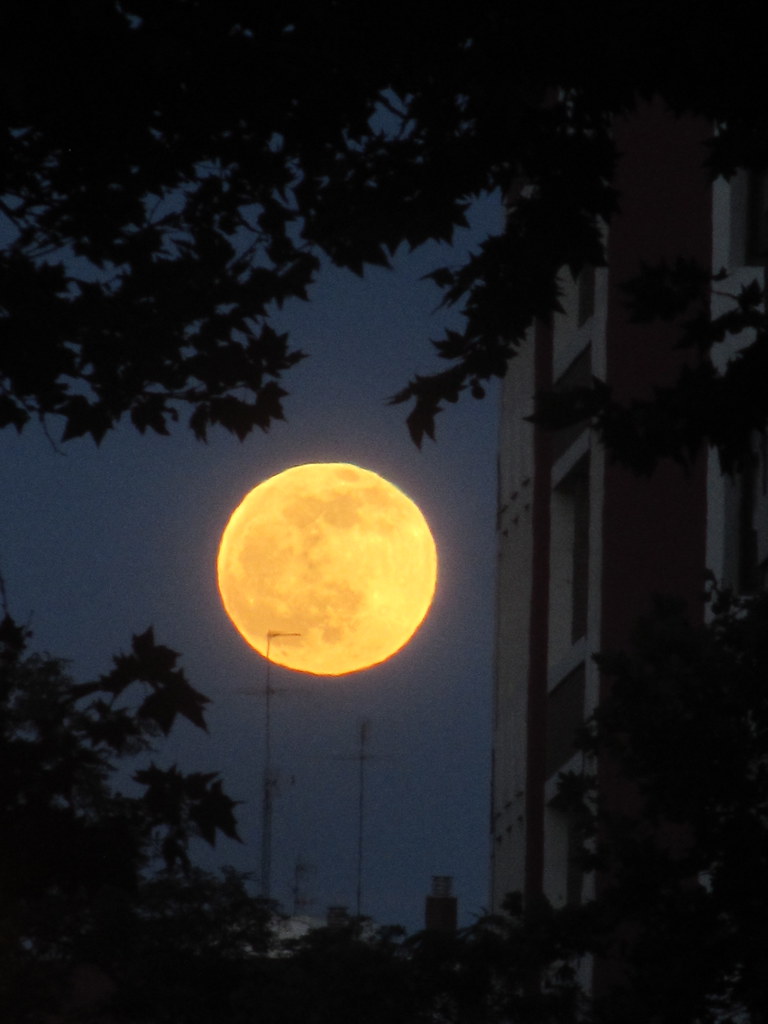
Full Moon on My Street


domingo, 15 de junio de 2014

Full moon on my street


Full moon on my street
 

—oOo—

Días del futuro pasado

domingo, 15 de junio de 2014

Días del futuro pasado

Nos vamos a ver esta, por seguir con las viejas costumbres—estos de la Ex-Patrulla X nacieron conmigo: 


xmendaysofX-Men: Días del futuro pasado(2014) 
"X-Men: Days of Future Past"(original title)

 131 min  -  Action | Adventure |Sci-Fi  -  5 June 2014 (Spain)
8,5
Your rating: 
  -/10  
Ratings: 8,5/10 from 146.106users   Metascore: 74/100 
Reviews: 491 user | 371 critic | 43 from Metacritic.com
The X-Men send Wolverine to the past in a desperate effort to change history and prevent an event that results in doom for both humans and mutants.

Director:

Bryan Singer

Writers:

Simon Kinberg (screenplay), Jane Goldman (story), 2 more credits »


La idea básica de corregir el pasado está, claro, no sólo en Terminator, sino en historias más antiguas, como Asem de Goldsmith, o la historia de Don Illán el mágico, de Don Juan Manuel. La mayor aportación aquí es la indicada en el cartel, la conversación entre el present self y el past self del Profesor X. Y es cierto que el pasado es un territorio desconocido, y el futuro todavía más... Según Leonard Cohen, sucede al revés que en la película. I seen the future, brother—it is murder.

Para doxas temporales, esa idea popular y científico-matemática de que todo el tiempo en realidad existe simultáneamente, en la eternidad...  Qué bonito sería, que todo estuviese almacenado en algún sitio. 


Incuso dibujé un tebeo o dos de los X-Men, en los 70-80.  Ese sí que está más o menos almacenado...  Mi favorito no sé si era Cíclope, o el Angel:

angel
—oOo—

10 libros sobre economía liberal

domingo, 15 de junio de 2014

10 libros sobre economía liberal

Entrevista de Mario Noya a Carlos Rodríguez Braun, que recomienda algunos clásicos del liberalismo.

Arvo Pärt - Symphony No. 4 'Los Angeles'