Blogia
Vanity Fea

Literatura y crítica

CFP: Memory and Restitution

MARTES, 5 DE FEBRERO DE 2013

CFP: Memory and Restitution

A photo on Flickr

Memory and Restitution

Date: 5-6th July, 2013
University of Westminster, London.

Organisers:
Dr Lucy Bond (Westminster)
Dr Rick Crownshaw (Goldsmiths)
Dr Jessica Rapson (Goldsmiths)

Keynotes
Professor Stef Craps, University of Ghent
Professor Lyndsey Stonebridge, University of East Anglia
Professor Anna Reading, King's College London

Following recent attention to the "cosmopolitan" (Levy and Sznaider 2006) or
"multidirectional" (Rothberg 2009) dimensions of memory, this colloquium
foregrounds commemorative practices as global positioning systems that enable
individuals and collectives to situate themselves (temporally and spatially,
emotionally and intellectually, politically, and ethically) in relation to
others.  Having conceptualised memorative processes thus, we seek to
investigate the complex relationship between memory and restitution in the
aftermath of both human and natural destruction.

Interrogating the implicit hierarchies of life encoded in disparate forms of
historical reckoning, the colloquium considers whether it is possible to
imagine a universal model of restitution, or whether processes of redress are
necessarily a product of the cultural and historical context in which they
arise. We ask how memorial discourses contribute to official and unofficial
forms of justice through their imbrication with the diverse institutions of
the public sphere.  We analyse the ways in which memory may be shaped by the
medium of representation and redress, asking whether different types of
disaster (environmental, genocidal, terrorist) demand disparate modes of
restitution and/or commemoration and articulation.

The organisers invite papers that might consider, but are not limited to, the
following:

* ****The difficulties of working through traumatic events in ways that
accommodate both the needs of individual victims and the demands of wider
society.

* ****The relationship between divergent forms of historical redress in the
public sphere - from judicial trials to museum exhibits, works of literature,
financial compensation, governmental acts, commemorative architecture, and
claims over territory or land.

* ****The differences between restitution, retribution, compensation, and
closure, and the divergent ethical and political implications attached to
these varying forms of historical reckoning as they are manifested in
cultural and commemorative practice.

* ****The connection between judicial effect and the media of historical
representation; the kinds of individual and collective sovereignty that
result from different modes of restitution.

* ****The political and ethical implications of transferring models of
justice from one cultural or historical context to another, and the issues at
stake with adopting a comparative approach to memory.

* ****How the work of transnational bodies impacts, complements, or
frustrates attempts to reckon with difficult pasts in local and national
communities.

* ****The ways in which diverse forms of cultural practice aim to resist
reinscribing structures of inequality at local, national, and global levels.


Please send abstract of no more than 300 words to
memoryandrestitution@gmail.com by
Friday 15 March, 2013

Information Systems eJournal

martes, 5 de febrero de 2013

Information Systems eJournal


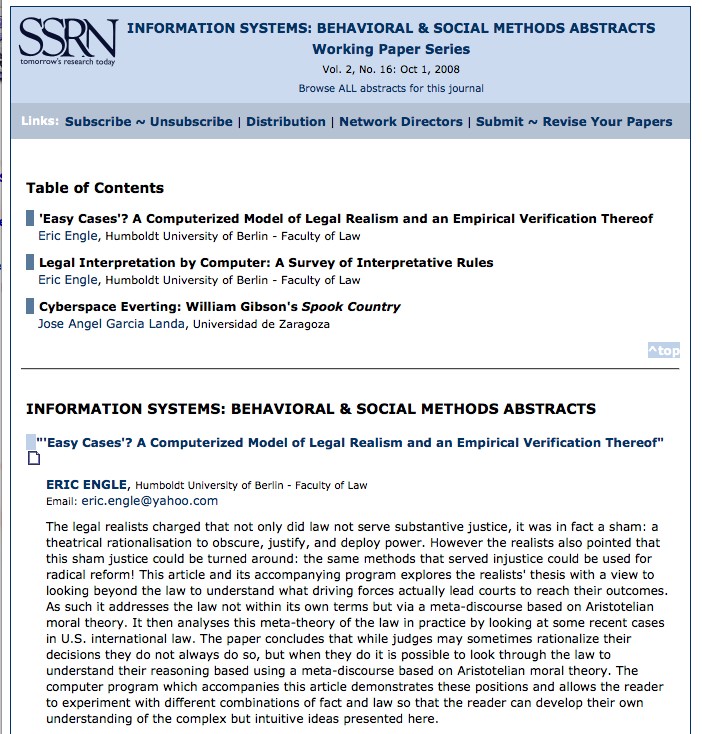
Aparece mi artículo "Cyberspace Everting", sobre la novela Spook Country de William Gibson, en el Information Systems eJournal del SSRN, con fecha 23 de septiembre de 2008 (la revista es del 1 de octubre). Es una de las revistas más movidas que he visto por allí; a estas alturas ya está mi artículo en la página 75.  Lean por cierto el abstract del artículo de Eric Engle sobre el "realismo legal" arriba; "la ley no está al servicio de la justicia sino que es una racionalización teatralizada para oscurecer, justificar y desplegar el poder"; y "aunque los jueces a veces racionalizan sus decisiones no siempre lo hacen, pero cuando lo hacen es posible mirar a través de la ley para comprender sus razonamientos mediante un metadiscurso basado en la teoría moral aristotélica." Habría que pasarles el programa a los jueces a ver si entendían sus propios procesos judiciales.

Dos artículos sobre William Gibson

Mis publicaciones en revistas religiosas

SÁBADO, 2 DE FEBRERO DE 2013

Mis publicaciones en revistas religiosas


evilpope
 Pienso bastante en cuestiones de religión, y publico todo lo que escribo, aunque no escribo todo lo que pienso. Y lo que es más raro es que aparezca algún artículo mío en una revista religiosa. Pero aquí está sin embargo uno, titulado "La Visión del Templo: Espiritualidad antieclesiástica en el Evangelio de Judas y la Batalla por la Realidad", que aparece en una revista electrónica del SSRN sobre antiguas religiones, Ancient Religions eJournal. Título en inglés, claro, "The Vision of the Temple", etc., y en efecto versa sobre el ya no tan famoso Evangelio de Judas, que el público parece haber olvidado, las modas pasan rápido También aparecerá el artículo, me dicen, o aparece ya, en el Christianity eJournal, que está en proceso de encarnación.

Mi padre siempre me decía que la religión tenía que evolucionar. Yo le contestaba que lo que no era muy de esperar es que el dogma católico evolucionase mucho, pero que la religión de por sí ya había evolucionado; o al menos el pensamiento sobre la religión. Aquí hay una reflexión al respecto de Hegel, sobre la dialéctica de la religión y de la Ilustración. A este respecto también me impresionó muy favorablemente la reflexión de Herbert Spencer sobre los límites de ciencia y religión en First Principles, pero claro, la discusión se situaba a un nivel muy alejado de dogmas y de rituales de andar por casa.

La religión cada vez tiendo a verla más desde el punto de vista sociobiológico, y sociológico, como una herramienta de cohesión de grupo—ay los grupos, con sus moralidades, y su fútbol y sus fiestas y sus rituales de integración y pertenencia y autorreconocimiento. Por eso no es bienvenido el crítico religioso o escéptico, o el niño que dice que el rey está desnudo, y menos el adulto. Quizá sea una niñería para el adulto, molestarse en decir que los dogmas religiosos no tienen otra sustancia que la de una ficción teatral; en todo caso los adultos que así lo vean prefieren generalmente seguir el juego y no interrumpir la coherencia de la función. Muchos lo hacen tan bien, que ni siquiera llegan a saber nunca en qué creen o no creen. Y así se vive mejor, en general; es el medio flotante más favorable para el humano (medio). Es que ni Judas era ateo, vamos.

Todos los días es sábado

MARTES, 29 DE ENERO DE 2013

Todos los días es sábado


Vale, no es cierto, pero como si lo fuese. También me gusta imaginarme que estoy en un día de junio un poco fresquito, incluso en enero. Al menos si no sábado hoy es San Valero (al menos en Zaragoza lo es), día de salir a dar una vuelta al sol de invierno. Y he encontrado que mi artículo sobre Saturday de Ian McEwan está en el English and Commonwealth Literature eJournal del SSRN.

Ayer vimos por cierto Amor, de Haneke. Más o menos lo esperable y previsto. Recomendable para quien no tema qué esperar al final de su vida, cuando el orden se desmorona—pero es temible. Y previsible.


Too much attention to fictional violence

DOMINGO, 20 DE ENERO DE 2013

Too much attention to fictional violence

—says Jonathan Gottschall in The Storytelling Animal, arguing that fictional violence is not what leads to real violence. And I agree in part, but


There's an issue still

Your point is well argued and at least partly right. The representation of violence is involved with the nature of society in ways which cannot be simplistified by a foregone solution. But there remains one highly significant issue for debate. Does the representation of violence act like an addiction for our attention? Does it engage far more attention than it's worth? Isn't the proliferation of scenes of violence in films and video games one of the lowest ways to engage and hook up attention (a kind of cheap pornography for the most part). Shouldn't our best attention be directed elsewhere, and cheap representation of gratuitious violence be discouraged (especially by intellectuals with a social responsibility) more systematically? There is no possible end to the debate on the artistic necessity of representing violence. And yet I think that violence, real or fictional, attracts much more attention than it deserves. Ignoring cheap fictional violence and turning your attention elsewhere is a way of fighting a real evil resulting from violence, too— the evil of wasting our attention on the worst things and keeping it away from the best things.
(Plato puts forward a similar argument in the Republic).

En años veinticuatro

DOMINGO, 20 DE ENERO DE 2013

En años veinticuatro


by


Universidad de Zaragoza 
Facultad de Filosofía y Letras
50009 Zaragoza - Spain


almez

Of writing
many books
there is no end

—oOo—

Publico hoy esta 18ª edición de mi bibliografía, que empezó en 1989 ocupando un diskete de 3 pulgadas en un ordenador sin disco duro, y hoy llega a 350 Mb de texto, o sea un buen par de estantes de libros gordos, virtualmente hablando. 

Llevo más de 100.000 visitas desde 2004, fecha en que puse el contador actual. No son muchas, pero hay que tener en cuenta que ésos son sólo los usuarios que pasan por la portada principal de la bibliografía, la "puerta delantera". Son muchos más los que llegan por la puerta trasera, a través de Google directamente, localizando alguno de los miles de archivos incluidos en la bibliografía que responda a sus criterios de búsqueda. Google ha indexado de diversas maneras la bibliografía con sus propias copias, haciendo pdfs, etc., y lo mismo han venido haciendo últimamente otros servicios de documentación como eBookBrowse. Aparte, mucha gente incluye archivos cogidos de la bibliografía sobre algún tema de interés en sus propios Scribd, o sea que a estas alturas está la bibliografía en una fase de crecimiento incontrolado por esas vías. El otro día me daba Google 715.000 resultados de búsqueda por este título entrecomillado.

Y yo sigo sin cobrar un solo duro por hacer la bibliografía, porque no crean que esto me lo tienen en cuenta para nada a la hora de concederme un sexenio de investigación, ni de darme un proyecto ni nada parecido, que jamás he tenido ayuda ni reconocimiento oficial por estos años de trabajo en la bibliografía. Que ya son años veinticuatro, pasando de las musas al teatro.

Claro que para eso somos funcionarios, ¿no?  Además hago otras cosas, aparte de bibliografías.


Edward Gibbon

MIÉRCOLES, 16 DE ENERO DE 2013

Edward Gibbon

From The Oxford Companion to English Literature:

 Edward Gibbon (1737-94), born in Putney of a good family. He was a sickly child and his education at Westminster and at Magdalen College, Oxford, was irregular; in his posthumously published Memoirs he paints a vivid portrait of the 'narrow, lazy and oppressive' spriti of Oxford, and of the 'idle and unprofitable' time he spent there.  He became a Catholic convert at the age of 16, perhaps thorugh reading Conyers Middleton and Bossuet, perhaps through reading the works of the Elizabethan Jesuit Robert Parsons, and was sent off to Lausanne by his father, where he was reconverted to Protestantism. There he continued to read voraciously, as he had done since boyhood, his 'blind and boyish taste for exotic history' maturing into serious study of French and Latin classics; he also became attached to Suzanne Curchod (later Mme Necker, mother of Mme de Staël), but his father persuaded him to break off the engagement and he returned to England in 1758 after an absence of nearly five years. In 1761 he published his Essai sur l'étude de la littérature, of which an English version appeared in 1764. From 1759 he served as a captain in the Hampshire Militia until he left again for the Continent in 1763; it was in Italy, while 'musing among the ruins of the Capitol' that he formed the plan of his The History of the Decline and Fall of the Roman Empire. His improvident father's death left him in some difficulties, but he was able to settle in London in 1772 to proceed with his great work. He entered Parliament in 1774, voted steadily for Lord North, and was made a commissioner of trade and plantations, but his parliamentary career added nothing to his reputation. He was also elected to Dr. Johnson's Club in 1774. In 1776 appeared the first volume of the History which was very favourably received, although his chapters on the growth of Christianity provoked criticisms from those he mockingly dubbed the 'Watchmen of the Holy City'. To these theological critics Gibbon replied in 1779 in A Vindication of Some Passages in the XVth and XVIth Chapters. The second and third volumes appeared in 1781, but were less warmly received; he himself suspected he had become prolix through 'superfluous diligence'. He retired to Lausanne in 1783 to share the home of his old friend Deyverdun, who died not long afterwards. There Gibbon completed the work; he wrote as memorably of its completion as of its inception, describing his sense of freedom followed by a sober melancholy at taking 'an everlasting leave of an old and agreeable companion'. The last three volumes were published in 1788.  He returned to England and spent most of his remaining days in the home of his friend the Earl of Sheffield (John Baker Holroyd), who put together his remarkable Memoirs from various drafts and fragments, publishing them in 1796 with his Miscellaneous Works. The memoirs reveal Gibbon's sense of vocation as a historian, and record on several occasions his gratitude at having been born 'in a free and enlightened country'. The Decline and Fall is a work which responds to the full range of the culture of the Enlightenment, in both its English and its European aspects, and Gibbon has been seen as one of the last of the great Augustans. The standard edition of the History is by David Womersley (1994) and the standard biography is by Patricia Craddock; see also the life by D. M. Low (1937).

The History of the Decline and Fall of the Roman Empire, a work by Gibbon, vol. 1 of the first (quarto) edition published 1776, vols. ii and iii 1781, and the last three vols. 1788.

This, the most celebrated historical work in English literature, falls into three divisions, as defined by the author in the preface, according to a plan that expanded during composition: from the age of Trajan and the Antonines to the subversion of the Western Empire; from the reign of Justinian in the East to the establishment of the second or German Empire of the West, under Charlemagne; from the revival of the Western Empire to the taking of Constantinople by the Turks. It thus covers a period of about 13 centuries, and comprehends such vast subjects as the establishment of Christianity, the movements and settlements of the Teutonic tribes, the conquests of the Muslims, and the Crusades. It traces in fact the connection of the ancient world with the modern.

Gibbon's great erudition, breadth of treatment, and powerful organization, render this a lasting monument, of substantial accuracy as well as elegance. His measured and dignified prose is cool, lucid, and enlivened by ironic with, much of it aimed at the early Church and the credulity and barbarism that overwhelmed the noble Roman virtues he so much admired. J. B. Bury's editions (1896-1900, 1909-14, 1926-9) are supplemented with notes incorporating subsequent research, but most of Gibbon's scholarship remains unchallenged. There is an edition by D. Womersley, 3 vols. (1994).

Erasmus Darwin

MIÉRCOLES, 16 DE ENERO DE 2013


Erasmus Darwin

From The Oxford Companion to English Literature, ed. Margaret Drabble: 

DARWIN, Erasmus (1731-1802), educated at Cambridge. He spent part of his life as a physician at Lichfield, where he established a botanical garden. Declaring that 'the general design . . . is to enlist imagination under the banner of Science', he embodied the botanical system of Linnaeus in his long poem The Loves of Plants,published 1789. The work reappeared as Part II of The Botanic Garden (1791), of which Part I was 'The Economy of Vegetation'. The poem is in heroic couplets, in imitation of Pope. The goddess of Botany, descending to earth, expounds various natural phenomena throughout the four cantos of Part I, while Part II describes 'the Ovidian metamorphosis of the flowers, with their floral harems', stamens and pistils figuring as beaux and belles. The work contains an interesting embryonic theory of evolution, similar in many ways to that developed by the poet's grandson, Charles Darwin. The poem was ridiculed by Canning and Frere in 'The Loves of the Triangles', published in the Anti-Jacobin in 1798. In his prose Zoonomia (in which Wordsworth found the story of Goody Blake) published 1794-96, Darwin further describes the laws of organic life, both plant and animal, on an evolutionary principle. His heretical views on creation brought him into some disrepute. Anna Seward publishedMemoirs of him in 1804, and his grandson Charles published a life in 1879.

From The History Today Companion to British History: 

 Erasmus Darwin (1731-1802), scientist and writer. Grandfather of Charles Darwin, he studied medicine at Edinburgh, practised as a doctor in Derby, and was a notable botanist. Associate of English radical dissenters such as Joseph Priestley, he also corresponded with Rousseau, was a member of the Lunar Society and maintained an interest in psychology as well as deistical and atheistical speculation. In addition to composing scientific treatises, he provided a popular account of 'The Economy of Vegetation' and 'The Loves of the Plants' in his poem The Botanic Garden (1789-91)

LUNAR Society, a small informal club, formed about 1775, which met in Birmingham regularly (when the moon was full) for dinner and discussion. The original members comprised Boulton, Erasmus Darwin, Joseph Priestley, Watt, Wedgwood, Thomas Day, Richard Lovell Edgworth, Samuel Galton and six others. Historians have represented it as illustrative of the social milieu in which a new culture conducive to the Industrial Revolution was forged; recently, however, it has been stressed that similar societies met in country and cathedral towns, and were attended by gentry and clergy. Interest in science was by no means confined to dissenters and industrialists.