Blogia
Vanity Fea

Trabajos

Top keywords and documents

jueves, 23 de agosto de 2012

Top Keywords & Documents


Según la información del contador de Academia.edu, la gente llega a mis publicaciones sobre todo con estas palabras clave:

 Top Keywords

    22 historia del tiempo
    12 el autor real literario e impl...
    11 narrador implicito
    7 wayne booth rhetoric fiction
    7 la historia del tiempo

Los documentos más visitados (quizá incluso leídos) son:

Title                                                                                                            30 day views     All time views    Last viewed

El autor implícito y el narrador no fiable—según nuestro punto de vista     124     908     about 18 hours ago
Perspectiva narrativa sobre HISTORIA DEL TIEMPO, de Stephen Hawking     121     1700     a day ago
Speech Act Theory and the Concept of Intention in Literary Criticism     30     500     a day ago
Nuevas tendencias en traducción e identidad cultural     29     636     2 days ago
Intertextuality and Exoticism in Salman Rushdie's THE MOOR'S LAST SIGH     25     327     a day ago
Nivel narrativo, status, persona, y tipología de las narraciones     15     171     about 23 hours ago
Speech Acts, Literary Tradition, and Intertextual Pragmatics     15     221     2 days ago
Reseña de ADAM'S TONGUE, de Derek Bickerton     14     428     about 18 hours ago
Hindsight, Intertextuality, and Interpretation: A Symbol in Nabokov's "Christmas"     13     176     a day ago
Monsieur Verdoux: Notas sobre un caso ambiguo     13     230     4 days ago
Samuel Johnson's RASSELAS: The Duplicity of Choice and the Sense of an Ending     12     275     8 days ago
Podrás probar, de este libro, este saber (Shakespeare, Soneto 77)     12     77     3 days ago
Tematización retroactiva, interacción e interpretación: La espiral hermenéutica de Schleiermacher a Goffman     11     88     a day ago
El formalismo crítico académico durante las vanguardias     11     177     a day ago
Reflexivity in the Narrative Technique of AS I LAY DYING     11     494     a day ago
Literature in Internet     11     177     2 days ago
Por la Galaxia Gutenberg (The Surfer's Guide)     10     240     a day ago
Enunciación, ficción y niveles semióticos en el texto narrativo     8     49     3 days ago
Catastrofismo y retrospección: Hermenéutica narrativa en la biología y en la historia     8     218     2 days ago
Acción, Relato, Discurso: Estructura de la Ficción Narrativa     7     48     2 days ago
On Samuel Beckett     7     88     a day ago
Poetry: Authorship. The Poet.     6     12     6 days ago
Understanding Misreading: A Hermeneutic-Deconstructive Approach     6     81     a day ago
Science and Literature: Some Critical Parameters     6     61     a day ago
Harry Thompson, This Thing of Darkness: Narrative Anchoring     6     89     3 days ago
Atonement and Adaptation (on Ian McEwan's Novel and Joe Wright's Film)     6     199     a day ago
Sobre la competencia del narrador en la ficción     5     6     11 days ago
El modo del género narrativo: diversas interpretaciones     5     58     a day ago
Narrating Narrating: Twisting the Twice-Told Tale     5     96     a day ago
Retroactive Thematization, Interaction, and Interpretation: The Hermeneutic Spiral from Schleiermacher to Goffman     5     353     4 days ago


Otros menos leídos, en orden ya descendente:


A Comparison between the French and RP English Vowel Systems     5     65     5 days ago
Hemingway Meets Beckett: "The Road", de Cormac McCarthy     5     64     11 days ago
Narratology: an introduction     5     107     3 days ago
Cognición retrospectiva, intertextualidad e interpretación: Un símbolo en 'Navidad' de Nabokov     5     35     about 21 hours ago
Overhearing Narrative     5     50     2 days ago
Netiqueta, Cortesía, Estrategia y Sabiduría     4     16     9 days ago
Soneto, espejo, reloj, bloc y libro     4     7     24 days ago
'It's Stories Still': La reflexividad en las narraciones de Samuel Beckett     4     39     20 days ago
'Till Nohow On': The Later Metafiction of Samuel Beckett     4     139     12 days ago
Somos Teatreros: El sujeto, la interacción dialéctica, y la estrategia de la representación según Goffman     4     19     3 days ago
Gothic Novel; Horror Fiction     3     125     about 20 hours ago
The Poetics of Subliminal Awareness: Re-reading Intention and Narrative Structure in Nabokov's "Christmas Story"     3     24     about 22 hours ago
Bibliografía de las obras de Samuel Beckett (1906-1989)     3     137     2 days ago
La structure narrative dans "La Dentellière" de Pascal Lainé     3     7     20 days ago
Theory of Reflexive Fiction     3     13     20 days ago
Gender, I-deology: Essays on Theory, Fiction, and Film     2     44     26 days ago
Theorizing Narrativity     2     18     13 days ago
Out of Character: Narratología del sujeto y su trayectoria vital     2     49     4 days ago
'Abstracted to Death': Estética del bilingüismo y la traducción en la prosa de Beckett     2     14     4 days ago
Emergent Narrativity     2     47     7 days ago
Reading Racism: The Assumption of Authorial Intentions in Stephen Crane's 'The Monster'     2     337     18 days ago
Narración, Identidad, Interacción: Relectura     2     15     19 days ago
Deconstructive Intentions: On the Critique of the Hermeneutics of Understanding     2     35     5 days ago
Review of WE, THE OTHER VICTORIANS: CONSIDERING THE HERITAGE OF 19TH-CENTURY THOUGHT     2     8     19 days ago
'Silence Once Broken': Metalenguaje y clausura narrativa en Beckett     2     18     11 days ago
Arresting Deconstruction: On Gayatri Chakravorty Spivak's Cultural Criticism     2     137     17 days ago
Múltiples lectores implícitos     2     14     8 days ago
La subjetividad como máscara en las "Nouvelles" de Beckett     2     2     13 days ago
Potocki: Formalización del trayecto vital     1     31     17 days ago
13 lunas, 12 noches: Calendarios, ciclos, tiempos muertos y diferencia de género (a propósito de Twelfth Night).     1     5     5 days ago
Understanding Misreading: Hermenéutica de la relectura retrospectiva     1     10     18 days ago
Autor, Autor, Autor (Dencombe, James, Lodge y otros)     1     55     21 days ago
Hoodwinked by Aristotle     1     1     15 days ago
Out of Character: Narratología del sujeto y su trayectoria vital     1     6     about 20 hours ago
Hablarán de nuestra vida delante de nuestro cuerpo: La escritura como autoapropiación y trascendencia del sujeto en THE STONE DIARIES     1     17     7 days ago
'Another Game in Vew': The representation of the Poet in THE FAERIE QUEENE     1     69     8 days ago
'Unnullable Least': Vacío y metaficción en el Beckett de los ochenta     1     9     14 days ago
The Chains of Semiosis: Semiotics, Marxism, and the Female Stereotypes in THE MILL ON THE FLOSS     1     144     2 days ago
Review of Viviane Serfaty's "The Mirror and the Veil: An Overview of American Online Diaries and Blogs". (Amsterdam Monographs In American Studies, 11). …     1     54     6 days ago
The Holocaust/The Shoah/Nazi Genocide     1     65     17 days ago
'Personne': Aventuras de 'yo' en la trilogía de Beckett     1     15     14 days ago
Ireland: History     1     10     17 days ago
Actos de habla en la literatura: Reseña de la obra de J. Hillis Miller     1     34     29 days ago
Authorial Intention in Literary Hermeneutics: On Two American Theories     1     60     a day ago
Gender, I-deology and Addictive Representation: The Film of Familiarity     1     95     7 days ago
Review of "Recent Trends in Narratological Research"     1     21     26 days ago
Internalized Interaction: The Specular Development of Language and the Symbolic Order     1     54     4 days ago
Lenguaje y 'différance' en EL INNOMBRABLE     1     13     27 days ago
Mañana habrá sido escrito     1     2     24 days ago
Ensayando el blog—Qué aporta tu post     1     1     2 days ago
Review of Roger Sell's MEDIATING CRITICISM: LITERARY EDUCATION HUMANIZED     1     87     12 days ago
Adaptation, Appropriation, Retroaction: Symbolic interaction with HENRY V     1     3     16 days ago
Objects in the Rearview Mirror May Appear More Solid Than They Are     0     3     > 30 days ago
A Bibliography of Literary Theory, Criticism, and Philology     0     15     > 30 days ago
Colonialism and Post-Colonialism     0     19     > 30 days ago
Ian McEwan, SATURDAY     0     3     > 30 days ago
Expiación y adaptación (Sobre "Atonement", de Ian McEwan y Joe Wright)     0     7     > 30 days ago
Harry Thompson, THIS THING OF DARKNESS: Anclaje narrativo     0     0     > 30 days ago
The Poetics of Subliminal Awareness: Re-reading Intention and Narrative Structure in Nabokov's "Christmas Story"     0     6     > 30 days ago
Reseña de LITERATURE AS COMMUNICATION: THE FOUNDATIONS OF MEDIATING CRITICISM, por Roger D. Sell     0     45     > 30 days ago
Stanley E. Fish's Speech Acts     0     106     > 30 days ago
Narrating Narrating     0     28     > 30 days ago
Crítica acrítica, crítica crítica     0     2     > 30 days ago
Cómo mostrar cosas con palabras     0     72     > 30 days ago
Acritical Criticism, Critical Criticism: Critical Interaction, Reframing, and Topsight     0     0     > 30 days ago
Ficción narrativa y Evolución     0     1     > 30 days ago
Recent Literary Theory and Criticism in Spanish Anglistics: Some Observations on Its Institutional Context and Practices     0     24     > 30 days ago
"Pattern Recognition", de William Gibson: El presente presentido con jet-lag     0     44     > 30 days ago
Linkterature: From Word to Web: Or, Literature in the Internet - Internet as Literature - Literature as Internet - Internet in Literature     0     0     > 30 days ago
Los blogs y la narratividad de la experiencia     0     7     > 30 days ago
Wilde y el enigma de la Esfinge     0     0     > 30 days ago
Review of Giambattista Vico's THE ART OF RHETORIC     0     12     > 30 days ago
An Apocalypse of Total Communication     0     45     > 30 days ago
La Visión del Templo: Espiritualidad Antieclesiástica en el Evangelio de Judas y la Batalla por la Realidad     0     2     > 30 days ago
Benefit of Hindsight: Polibio, Vico, Wilde y el emergentismo crítico     0     2     > 30 days ago
Sobre la narración conversacional     0     0     > 30 days ago
La Noche de la Tempestad (Sobre la novela de César Vidal)     0     3     > 30 days ago
A comparison between the French and RP English vowel systems     0     90     > 30 days ago
La identidad intertextual: La misteriosa llamada de la reina Loana     0     1     > 30 days ago
Review of CHILDREN'S LITERATURE AS COMMUNICATION, ed. Roger Sell     0     133     > 30 days ago
Review of Viviane Serfaty's the Mirror and the Veil: An Overview of American Online Diaries and Blogs     0     0     > 30 days ago
Rereading(,) Narrative(,) Identity(,) and Interaction     0     33     > 30 days ago
Ackroyd's Shakespeare     0     0     > 30 days ago
A Blogal Conversation (Reseña de J. Torio, "A Global Conversation")     0     1     > 30 days ago
Deep-brained Sonnets     0     0     > 30 days ago
Husband to Mrs Milton     0     0     > 30 days ago
Cyberspace Everting: "Spook Country", de William Gibson     0     3     > 30 days ago
Reseña de HYPER/TEXT/THEORY, ed. George P. Landow     0     17     > 30 days ago
History of Scotland     0     45     > 30 days ago
El centro ausente: EL INNOMBRABLE de Beckett     0     0     > 30 days ago
Reseña de THE MOOR'S LAST SIGH, de Salman Rushdie     0     3     > 30 days ago
Review of Recent Trends in Narratological Research, ed. John Pier.     0     0     > 30 days ago
Early Modern English History     0     76     > 30 days ago
Tragedia y dinámica de fuerzas     0     22     > 30 days ago
John Battelle, "The Search" (Reseña)     0     12     > 30 days ago
Review of Nicholas Ray's TRAGEDY AND OTHERNESS     0     53     > 30 days ago
William Shakespeare: Hamlet     0     191     > 30 days ago
Goffman: La realidad como expectativa autocumplida y el teatro de la interioridad     0     5     > 30 days ago
Catastrophism and Hindsight: Narrative Hermeneutics in Biology and in Historiography     0     27     > 30 days ago
Tecnologías de manipulación del tiempo     0     4     > 30 days ago
Be Copy Now: Retroalimentación y dialéctica de la vida y el teatro en Shakespeare (Henry V, 3.1)     0     1     > 30 days ago
Narratology and Rhetoric: Scientific Terminology?     0     1     > 30 days ago
'The Enthusiastick Fit': The Function and Fate of the Poet in Samuel Johnson's RASSELAS     0     18     > 30 days ago



A photo on Flickr

Publicaciones de mi departamento


Two Assessments on Consilience and Retrospection

martes, 21 de agosto de 2012

Two Assessments on Consilience and Retrospection

Paper rejected, or at least not quite accepted... The editors suggest I send a revised version—but I'll try elsewhere I guess. Here's a preliminary version in Spanish.

Dear Professors Randall and McKim,

Thank you for your answer concerning the paper I sent to Narrative Works, "Consilience and Retrospection." I have found interesting suggestions and an encouragement for my work in the readers' reports you send, which to me are overall positive, even if they don't quite encourage the publication of my paper in the journal due in part to its line of concerns. Thank you also for your recommendation of Mark Freeman's book on hindsight; this is an author I enjoy but I did not know this particular reference, so that's a treat in store. As to the scope of the journal, I sent the paper to Narrative Works precisely because of its interdisciplinary approach, so I can't agree that this is not a paper for this journal, but of course it is for the editors to choose the range of interdisciplinary concerns they want to address. The narrativity issue the paper deals with might of course be further developed, but that is a task for other papers (or volumes!), and I feel this one needs the backgrounding and preliminary approach to which I devote the early and mid sections. The reviewers' assessments are judicious and reasonable, only I do not think I will be able to send a revised version— in my case, revised versions tend to become not only too long, but also I can't help moving into different directions and writing a different paper altogether. So if I eventually get to write another paper on a similar issue perhaps I'll try again with Narrative Works, but I am afraid I am too busy with other things at the moment; so I suppose in the case of this paper I will stick to its present form and send it to another journal or self-publish it. Which is a pity from my point of view because I did think it might belong with your journal—but at least I have seen from your readers' comments that my writing on these issues has some value and may merit the attention of scholars working in this area. So I thank you for your attention, and your readers for their kind and useful assessment of my paper, and look forward to some further collaboration in the future.
Best regards,
Jose Angel Garcia Landa


______


Dear Professor Landa,

Thank you for your submission to Narrative Works. Inserted below, you will find two reviews of your manuscript. Both reviewers describe your paper with such positive phrases as “well-written,” “learned,” “stimulating,” and “stylistically honed.” We agree with their assessment; however, we also share their concern about whether Narrative Works is, in fact, the appropriate place for this paper. We would ask you, then, to consider these two reviews carefully, especially the comments made by Reviewer #1 regarding the positioning of your discussion of narrative much earlier in the paper, to make it clearer to readers of the journal how your thinking contributes to our understanding of the narrative dimensions of human life. Regarding your discussion of “hermeneutical hindsight,” among the sources you might draw on would be Mark Freeman’s Hindsight: The Promise and Peril of Looking Backward (Oxford, 2010).

We would be delighted to publish your essay should you wish to revise it in light of the reviewers’ recommendations. Should you decide to do so, we would ask that you indicate precisely the extent of your revisions and how you have addressed the reviewers' concerns.

If possible, please return a revised version of your manuscript to us by October 1.

If you have any questions regarding next steps, please feel free to contact us. We look forward to hearing from you in due course.

Best wishes,
Bill Randall & Beth McKim

Reviewer #1

This is an interesting, well-written article that explores some important ideas. The main question I have concerns its appropriateness (in its present form) for Narrative Works.

The opening pages lead to a “quandary” of sorts relating to Gould, in particular, and disciplinary boundaries more generally.  By the author’s account, Gould is “defending both the absence of any sharp dichotomies [between the sciences and the humanities], and the separate cognitive realms of science on one hand and the humanities on the other.” The question, therefore, is whether there might be a “meeting point, or an interface, or at least an arena for debate” (p. 5).  From there we are introduced to the special significance of “hindsight bias which results from our  experiencing and interpreting phenomena as a temporal sequence, reworked and reelaborated by memory and attention.” As the author goes on to note, this “bias” can and indeed often does yield insight owing to the “superior perspective” from which interpretation occurs.  But it can also result in “undue simplifications of complex processes, ascribing them to one cause where there is an undecidable overdetermination of a complex vectoring of causes” (p. 7).  This is but one potentially ill consequence of hindsight bias.  There are others as well.

Having identified this bias, the author draws further on Gould, who underscores the potential value of narrative explanations not only in the humanities but also the sciences. Given the history of disciplinary specialization, Gould has suggested, there has been some reluctance to embrace the narrative mode.  But there is no denying its utility in coming to terms with complex historical phenomena.  As for the idea of consilience, as put forth by E.O. Wilson, it is, on Gould’s account, less a process of reconciliation and rapprochement than it is one of reductively assimilating (aspects of) the humanities to the realm of science.  As above, much of the material being explored in this section of the paper is interesting and significant.  But with the exception of the fairly brief reference to hindsight bias and narrative explanation, it’s not entirely clear how it fits the central concerns of the journal.

It’s not until page 17 that narrative really enters the picture.  For, what we learn is that “Consilience . . . has a narrative-hermeneutic dimension, and is approachable as a concept relevant to cognitive narratology.”  It’s still not clear how this (important) issue bears upon the difference between Wilson’s and Gould’s points of view on the concept of consilience.  Is the idea that Wilson’s scientific/scientistic “supremacism” insufficiently recognizes the narrative dimension of scientific understanding by virtue of its reductionism?  One might argue that Wilson’s view -- however problematic it may be – represents a classic hindsight move:  all of those goings-on that the humanities had claimed for its own can be assimilated to the scientific gaze.  Gould’s view is different, I realize.  But what, finally, is the significance of this difference?  And how does it relate to the retrospection issue?  I suppose the article represents something of a Gouldian plea for narrative understanding as the most appropriate mode of understanding for coming to terms with an unpredictable world.  But it would be good to know more about what the author most wants to say as s/he draws the essay to a close.  It would also be useful, for the purposes of this journal, for him/her to say a bit more about how these issues bear upon our conception and understanding of human beings. 

In sum:  this is an interesting, learned article that pursues some important questions about the relationship between science and the humanities.  It takes a while for the piece to explicitly address ideas pertinent to the journal.  And even when it does so it’s not quite clear (to this reader at any rate) what the author most wants to say.  Finally, as important as the science/humanities issue is, it would be useful, again, for the author to say more about how his/her version of consilience might bear upon our understanding of human beings.  By way of note, the author mentions the work of Paul Ricoeur at one point.  What Ricoeur has to say in Time and Narrative is of course relevant.  So too is his work on metaphor (e.g., his notion of metaphorical “rapprochement”), his later reflections on the relationship between life and narrative (e.g., the idea of emplotment as a “synthesis of the heterogeneous”), and his more general insistence on narrative as the privileged path for explicating human temporality.  Making some additional contact with Ricoeur or other narrative theorists might do well to address these concerns.


Reviewer #2

This is a learned and insightful essay. The author obviously is a “fox” with a broad horizon of interests that meander into many disciplines and fields of knowledge, including theory of knowledge, philosophy and history of science, critical studies of science, epistemology, evolutionary biology, primatology, intellectual history, and Greek philosophy. What is more, all of this is embedded into a broad literary cultura and interests in narrative theory. Strictly speaking, the format of this essay is that of commentary on Stephen Jay Gould’s The Hedgehog, the Fox, and the Magister's Pox: Mending the Gap between Science and the Humanities. But Gould's latest book, and especially its discussion of E. O. Wilson’s notion of consilience, serves more as a spring board for wide-ranging reflections on how we can combine the so-called two cultures of the humanities and the sciences across all the different fields just mentioned. I personally enjoyed reading this stimulating piece, and part of my pleasure was that it is well written and stylistically honed.

My only question is whether this is an article that works for Narrative Works. I don’t know the answer. On the pro side stands that, with articles like this one, the journal would doubtless extend its intellectual scope and raise its scholarly standards – which, to my mind, would be worthwhile. On the side of the concerns: I am not sure if the readers of Narrative Works are really the readers of this essay (and if the author is well advised to publish his work in this journal), not least because it is not really about a narrative issue. It addresses narrative as one of its many issues – suggesting a reading of consilience as a narrative-hermeneutic concept with a potential relevance for cognitive narratology. But then, this suggestion is made on p. 25, that is, at the very end of the paper.

In case the editors and the author consider publication in the journal – and, in principle, I would recommend its publication – I wonder, however, if it would not be more appropriate to give center stage to its “narrative point,” that is to the idea of re-interpreting consilience as a notion of narrative understanding. This idea, I think, is most promising and original. Unfortunately it’s only hinted at in the present version.  Presenting and discussing it might also include some kind of example, case study, or illustration – some edible flesh to the bones of concepts, as promising as they may be.


Consiliencia, evolución y anclaje narrativo 


Kitap Bilgi Bankasi / Anlatibilime Giris

martes, 17 de julio de 2012

Kitap Bilgi Bankasi / Anlatibilime Giris


anlatibilime giris


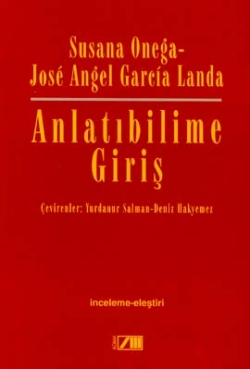
Me incluyen, con nombres ilustres y otros desconocidos como yo, en el Banco de Información del Libro (en Turquía).

Debe ser a cuenta este libro, Anlatlbilime Giris, o sea "Teoría de la Narración", que salió allí hace ya diez años.


Structural Narratology


Scoring More Than Most

martes, 10 de julio de 2012

Scoring More Than Most

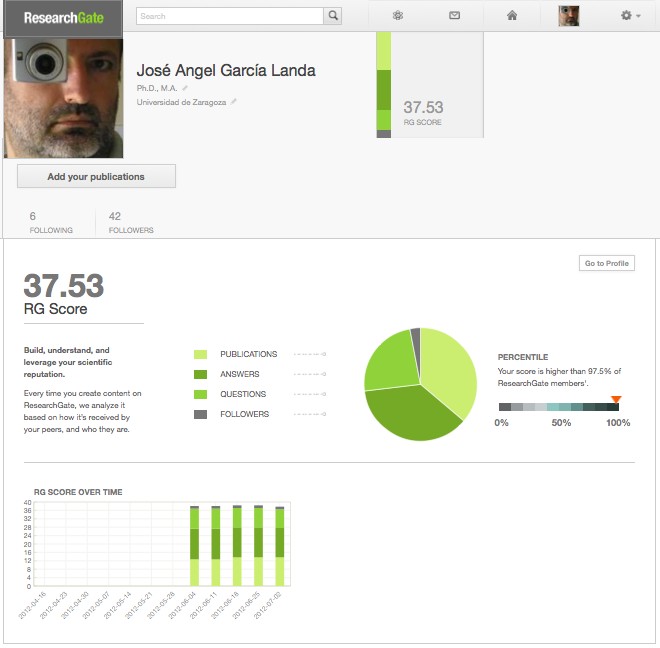
Al menos en ResearchGate, mi reputación es alta, a fecha de hoy:


RGscore2012

 Por lo que se ve, el 37.5 es sobre un máximo de 40, con lo cual saco un 9,75 sobre 10, sobre notas secuenciadas (o sea, dando un 10 al primero aunque sea de suspenso, y un 0 al último, aunque sea de notable). Mira qué curioso, una calificación parecida sacaba yo hace veinticinco años en la primera prueba globalizada que hice, el Graduate Record Examination, donde en una convocatoria a escala mundial también tuve un posicionamiento similar—se medía el resultado del examen de manera parecida, secuenciando a los candidatos. Bueno, en realidad era ligeramente mejor, allí superaba al 99% de los candidatos. Es cierto que aquí hay más gente compitiendo:  en ResearchGate hay más de 1.400.000 científicos y académicos de todas las disciplinas universitarias.

Cuando me tienen que puntuar mis vecinos y colegas, la cosa cambia: allí suelo sacar tanto los sobresalientes de rigor como suspensos súbitos de la manera más "inexplicada". Lo que nunca saco es cincos y seises.


En el dos por ciento


Ce-Uve

1/7/12


maquinaimposibleMe dijeron que a mi currículum "le perjudicaba mucho" contener tantos enlaces de Internet. Así que he hecho una versión abreviada (se llama "currículum completo abreviado") para imprimir, que me ocupa 70 páginas. Y si alguien quiere ver más, puede ir al currículum completo. ¿Que dónde lo he colocado? Pues, evidentemente, en un enlace de Internet.

Holding His Complete Works


Recurriendo al recurso

sábado, 30 de junio de 2012

Recurriendo al recurso


—Que es uno de los géneros que más cultivo. Aquí una muestra del último al que le he estado puliendo las estrofas, y que supongo me tendrá pendiente por lo menos seis meses antes de resolverse. Por lo menos va bastante fundamentado alegando cuestiones de defecto de forma como para ir a contencioso administrativo, si acaso falla el recurso de alzada.

A LA SECRETARíA DE ESTADO DE UNIVERSIDADES  E INVESTIGACIÓN
 
    JOSÉ ÁNGEL GARCÍA LANDA, mayor de edad, funcionario del Cuerpo de Profesores Titulares de Universidad, adscrito al área de Filología Inglesa en la Universidad de Zaragoza, etc. etc., comparece y, como mejor proceda en Derecho,  DICE:
 
    Que, mediante el presente escrito, viene a interponer  RECURSO DE ALZADA, contra la Resolución de la Comisión Nacional Evaluadora de la Actividad Investigadora de 6 de junio de 2012, por la que se le deniega la evaluación positiva de su actividad investigadora al efecto de serle reconocido el correspondiente complemento específico de investigación para el tramo comprendido entre 2006 y 2011.  A tal fin se formulan las siguientes


A L E G A C I O N E S

Primera.- El recurrente, Profesor Titular del Área de Filología Inglesa en la Universidad de Zaragoza, formuló en su día solicitud de evaluación del tramo comprendido entre 2006 y 2011.
    Previa constitución del Comité Asesor nº 11 correspondiente al campo de Filosofía, Filología y Lingüística, y compuesto por Catedráticos de Universidad de Estudios Árabes e Islámicos, de Literatura Hispanoamericana, de Filosofía Moral, de Filosofía, de Lengua Española, de Filología Catalana y de Filología Latina

—cuya especialidad no se corresponde con el área de conocimiento ni investigadora del solicitante, se dictó la Resolución objeto del presente recurso, acordando denegar el citado complemento con base al informe que se adjunta en el Anexo I.

Segunda.- El Comité Asesor nº 11, que evaluó la actividad investigadora del recurrente está formado por siete Catedráticos de Universidad pertenecientes a áreas de conocimiento diametralmente distintas a la que desarrolla el interesado.

Tercera.- FALTA DE MOTIVACIÓN DE LA EVALUACIÓN.
La Resolución de la CNEAI, denegatoria del complemento por sexenios de investigación, que aquí se impugna, carece en dos casos de motivación, y ha colocado al recurrente en una situación de indefensión, por cuanto éste desconoce qué razones académicas decidieron aquella evaluación del currículo científico aportado.
En efecto, la citada resolución omitió en dos de las contribuciones presentadas la motivación necesaria en todo acto restrictivo de derechos, ya que se documenta exclusivamente el resultado de la evaluación, no su razón de ser. Se trata de que, en definitiva, la Administración pueda dar cuenta al interesado del proceso de formación de la voluntad del órgano colegiado y del acierto de su decisión.
Podrá aducirse a la exposición precedente que, en el presente caso, nos hallamos ante un supuesto de discrecionalidad técnica o juicio de carácter técnico científico que no es revisable por ningún otro órgano administrativo o judicial, que a menudo constituye la válvula de escape para buscar espacios de inmunidad a determinadas decisiones administrativas. Sin embargo, por encima de esta pauta utilitarista, se encuentra el respeto a la situación jurídica del administrado que tiene derecho (incluso aunque no pueda impugnar el acto en su motivación estrictamente técnica) al porqué de una determinada resolución que tanto afecta a su vida profesional, al margen de su estricta significación económica.
La motivación, más que un acto de cortesía procedimental, debe expresar de forma sucinta, mas suficiente para conocimiento del interesado y de los tribunales, las razones en concreto para no estimar valorable la labor investigadora presentada; pues de otra manera, no hay posibilidad de saber, no ya si el criterio técnico del Comité es o no acertado, sino si lo así decidido por él se apoya en razones concretas perceptibles también para los profanos y no en la arbitrariedad, vedada a todos los poderes públicos en el art. 9.3 C.E.

Cuarta. INTRODUCCIÓN ARBITRARIA DE UN CRITERIO DESESTIMADOR NO CONTEMPLADO EN LAS BASES DE LA CONVOCATORIA (Resolución de 23 de noviembre de 2011, de la Presidencia de la Comisión Nacional Evaluadora de la Actividad Investigadora, por la que se establecen los criterios específicos en cada uno de los campos de evaluación).
 
En efecto, se aduce que el hecho de que una de las contribuciones haga uso de la lengua española "hace disminuir potencialmente su impacto internacional". Ningún aspecto de la Resolución permite suponer que el uso del catalán, valenciano, euskera, castellano o español, gallego o cualquiera de las lenguas peninsulares oficiales no sea vehículo adecuado de comunicación científica.
    En una evaluación de estas características, por otra parte, es contraria a derecho la introducción de criterios indeterminados que dieran lugar a inseguridad jurídica...


.... y en esta vena seguimos durante sesenta páginas. Aunque la comisión se despacha en cuatro líneas su evaluación. Eso es poderío y savoir faire.

—¿Que no había nadie de Filología Inglesa en el comité asesor? Pues no, pásmense. Nadie que firmase.

Sexenio 2006-2011


Solicito enlace BUZ

25/6/12


Correo enviado hoy a la Biblioteca Universitaria de Zaragoza:

Estimados compañeros:
Hace muchos años que vengo realizando una bibliografía en red sobre Filología y literatura, con énfasis especial en Filología Inglesa. Es de libre acceso y fácil consulta, y está alojada en un servidor de nuestra universidad:

A Bibliography of Literary Theory, Criticism and Philology
http://www.unizar.es/departamentos/filologia_inglesa/garciala/bibliography.html

Está referenciada como recurso de enseñanza e investigación en muchas universidades importantes: Harvard, Oxford, Chicago, el MIT, Londres, la Biblioteca del Congreso de los EE.UU., etc. Ver enlaces:
http://www.unizar.es/departamentos/filologia_inglesa/garciala/bibliography/links.html

Está incluida por otra parte entre las bases de datos de referencia del RECYT (FECYT):
http://recyt.fecyt.es/index.php/HS/about/addAboutItem

Desearía que se incluyese entre las bases de datos de consulta de la biblioteca de la Universidad.

Un saludo cordial,
JAGL

______


Mi web en mil novecientos y pico


Los Caminos de la Lengua en Google Books

Los caminos de la Lengua es un libro publicado en 2010, en recuerdo y homenaje a Enrique Alcaraz, en el que aparece mi contribución "Out of Character: Narratología del sujeto y su trayectoria vital". Puede verse en vista previa en Google Books e incluso insertarse... en mi otro blog.  


Los Caminos de la Lengua en Google Books


Mi contribución, como casi todas, aparece recortada por cuestiones de copyright. Más entera está aquí

 También la veo referenciada en la bibliografía del Centro Interdisciplinar de Narratología de la Universidad de Hamburgo.  Y aparece en este sitio llamado DRIVER (Digital Repository Infrastructure Vision for European Research), junto con otros 86 documentos míos.

Los caminos de la lengua