Blogia

Vanity Fea

Ya bajando, y aún subiendo

martes, 3 de noviembre de 2015

Ya bajando, y aún subiendo


Seguimos rozando lo que serán nuestras marcas máximas en los torneos académicos mundiales arbitrados por la Social Science Research Network.

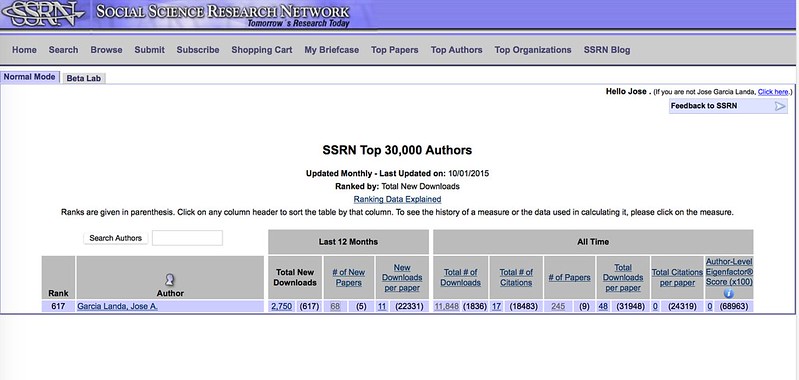
Hace un mes nos dábamos contra nuestro techo de cristal, llegando al puesto 5 como punto más alto (#of New Papers):

Sigo el 9 por número de artículos


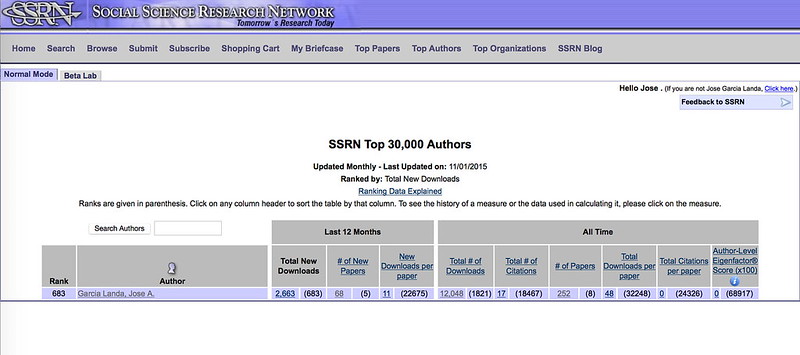
Y este mes estamos como sigue. He bajado en el ránking global, del puesto 617 al 683, ordenados por lecturas de artículos recientes. : /

SSRNnumbereight


Y en cambio aún sigo subiendo en número de lecturas totales  — BD (malo sería que sucediese lo contrario, o que alguien desleyese mis escritos). También me mantengo en mi mejor posicionamiento (el puesto 5 del total, por número de artículos nuevos) y mejoro mi segundo mejor puesto, pasando del 9 al 8—contando por número total de artículos. A estas alturas, es lo más que puedo pedir. Decían el otro día que el cuerpo humano tiene en el lobuno estado de naturaleza una fecha de caducidad de unos 50 años. Todo lo demás, en mi caso todo lo de los últimos cuatro años, nos viene de prestado o por gentileza de la casa.

No sé si subiré algo más—lo que sé es que a la larga seguro que bajo. De momento,
I'm still standing
Better than I've ever been
Looking like a true survivor
Feeling like a little kid con estas cosas.

También dice en mi página de autor que "Jose Angel Garcia Landa Author Rank is 1,840 out of 293,046"—esta vez por número de descargas totales—pero según los datos de arriba, más actualizados, estoy en el puesto 1821, con esperanzas quizá de seguir subiendo.

Y de momento, que me quiten lo bailao, tocando techo aún, en los puestos 5 y 8 de la SSRN. De entre los 293,046 autores académicos de humanidades y ciencias sociales que allí publican, procedentes de todas las universidades del mundo.


Toco techo en el puesto 5


—oOo—

Somos

Somos


John Dryden

John Dryden


From the Oxford Companion to English Literature, ed. Margaret Drabble:


DRYDEN, John (1631-1700), educated at Westminster School under *Busby and at Trinity College, Cambridge. He inherited a small estate, but supported himself mainly by his writing. His first major poem was the Heroique Stanza's (1658) on the death of Cromwell: he later celebrated the King's return with Astraea Redux and To His Sacred Majesty. Other poems were addressed to Sir Robert Howard, whose sister Lady Elizabeth Dryden married in 1663; the earl of *Clarendon, *Charleton, and Lady Castlemaine. He also published a long poem in quatrains, *Annus Mirabilis (1667), but most os his early writing was for the theatre and included several rhymed heroic plays, The Indian Queen (1664, in collaboration with Sir Robert Howard), The Indian Emperour (1665, which has the Mexican ruler Montezuma as subject), *Tyrannick Love (1669), and The Conquest of Granada in two parts (1670). He also wrote comedies, The Wild Gallant (1663), The Rival Ladies (1664), Sir Martin Mar-all (1667, in collaboration with the Duke of *Newcastle), *An Evening's Love (1668), and a radical adaptation of *The Tempest (1667, with *D'Avenant). He was most original, however, with his tragi-comedies, Secret Love (1667), *Marriage-à-la-mode (1672), The Assignation (1672), and a second Shakespeare adaptation, *Troilus and Cressida (1679). All these plays, together with the operatic adaptation of *Paradise Lost, under the title The State of Innocence, and Fall of Man (unperformed, pub 1667) and the immensely successful Oedipus (1678, with N. *Lee), reveal Dryden's considerable interest in philsoophical and political questions. He became *poet laureate in 1668, and historiographer royal in 1670.

Dryden constantly defended his own literarypractice. His first major critical work was *Of Dramatick Poesie (1668). Subsequent essays include A Defence of an Essay (1668)(, preface to An Evening's Love (1671), Of Heroick Plays (1672), Heads of an Answer (to *Rymer, c. 1677, pub. 1711), and The Grounds of Criticism in Tragedy, prefixed to preface to Troilus and Cressida (1679). *Aureng-Zebe was his bes rhymed heoric play. The prologue, however, denounces rhyme in serious drama, and his next tragedy, *All for Love (1678), was in blank verse. Much of Dryden's criticism was devoted to the assessment of his Elizabethan predecessors, Shakespeare, *Jonson, and *Fletcher. Despite his genuine respect for their achievement, Dryden was unsparing in his enumeration of what he perceived as their 'faults', although he frequently modified his critical views and his artistic practice. This flexibility as critic and dramatist left him vulnerable to attack. He was represented as Bayes in *The Rehearsal (1671) by *Buckingham, and physically assaulted in 1679, possibly at the instigation of *Rochester. His principal opponent was *Shadwell, whom Dryden ridiculed in *Mac Flecknoe (c. 1676, pub. 1682). Other poems in which he develops his critical principles include many witty and imaginative prologues and epilogues, and poems about, or addressed to, fellow writers and artists, notably Lee, *Roscommon, *Oldham, *Congreve, and *Kneller.

The constitutional crisis of the late 1670 and early 1680s saw Dryden's emergence as a formidable Tory polemicist. His contribution to the political debate included plays, especially *The Spanish Fryar (1680), The Duke of Guise (1682, written with Lee), and the operatic Albion and Albanius (1685); his celebrated satires *Absalom and Achitophel (1681), *The Medall (1682), and a number of lines for N. *Tate's The Second Part of Absalom and Achitophel (1682), as well as a host of partisan prologues and epilogues. His interest in religion was also heightened at this time. In *Religio Laici (1682) he offers a defence of the Anglican via media. However, following the accession of James II Dryden became a Catholic and wrote *The Hind and the Panther (1687) in suport of his new co-religionists. At the death of Charles II he attempted a Pindaric *ode, Threnodia Augustalis (1685), the first of several poems in this form, notably To the Pious Memory . . . of Mrs Anne Killigrew (1686), A Song for Saint Cecilia's Day (1687), 'An Ode, on the Death of Mr Henry Purcell' (1696), and Alexander's Feast (1697), which was later incorporated into *Fables Ancient and Modern (1700). Dryden also wroter numerous witty elegant songs for his many plays.

In 1689 he lost both his court offices and returned to the theatre. Two of his late plays, *Don Sebastian (1689) and *Amphitryon (1690), are excellent; Cleomenes (1692) is intellectually impressive; and only Love Triumphant (1694) is a failure; but Dryden was tired of the theatre and turned to the politically less compromising work of translating. His immense and splendid achievements in this field include translations of small pieces from *Theocritus and *Horace, and more substantial passages from *Homer, *Lucretius, *Persius, *Juvenal, *Ovid, *Boccaccio, and *Chaucer, as well as the whole of *Virgil. His version of the Georgics is especially magnificent. In all these translations he made frequent but subtle allusions to his Jacobite principles. He also returned to criticism, notably in preface to the Sylvae (1685), *A Discourse Concerning the Original and Progress of Satire (1693), Dedication to Examen Poeticum (1693), and Dedication of the Aeneis (1697). His culminating and most impressive achivement both as critic and translator was Fables Ancient and Modern, which should be read as a whole, and to which 'The Secular Masque' (1700) is a wise and noble coda. He was buried in Westminster Abbey (see also RESTORATION).

Other works by Dryden include:

Plays: Amboyna (1673, a tragedy), *Mr Limberham (1679, a sexually explicit comedy), and a dramatic opera, King Arthur (1691). Poems: 'Upon the Death of Lord Hastings' (1649), Britannia Rediviva (1688), Eleonora (1696). Prose works: His Majesty's Declaration Defended (1681), Life of Plutarch (1683), Vindication of the Duke of Guise (1683), Character of St Evrémond (1692), Character of Polybius (1693), Life of Lucian (1711), translations of Maimbourg's The History of the League (1684), Bouhours' Life of St Francis Xavier (1686), Du Fresnoy's De Arte Graphica (1695).

The standard complete edition is The Works of John Dryden, ed. E. N. Hooker et al. (1956- ), 20 vols pub. as of 1997. Other editions include Sir W. *Scott's (18 vols, 1808, with life as vol. i, rev. edn. by *Saintsbury, 18 vols, 1882-93); Dramatic Works, ed. M. Summers (6 vols, 1931-2); Poems, ed. J. Kinsley (4 vols, 1948); The Poems of John Dryden,  ed. P. Hammond (4 vols , 1995- ); Of Dramatic Poesy, and Other Critical Essays, ed. G. Watson (2 vols, 1962); Letters, ed. C. E. Ward (1942). See also J. A. Winn, John Dryden and His World (1987); J. and K. Kinsley (eds.), Dryden: The Critical Heritage (1971); P. Harth, Contexts of Dryden's Thought (1968) and Pen for a Party (1993).


—oOo— 

Notes on some works by Dryden (from the Oxford Companion):


Annus Mirabilis, a poem in quatrains by *Dryden, published 1667. 
    Its subjects are the Dutch War (1665-6) and the Fire of London. Prefaced by 'Verses to her Highness and Dutchess' [of York], it indicates that even in the 1660s Dryden's optimism about the monarchy, mercantilism, and the *Royal Society (of which he was a fellow) did not preclude the expression of an ironic vision of history. Queen Elizabeth II, to the bewilderment of some journalists, drew on Dryden's poem in a speech (24 Nov. 1992) referring to the fire of Windsor in that year, using the words 'Annus Horribilis'.
—oOo—


Tyrannick Love, or The Royal Martyr, a heroic play by *Dryden, produced and published 1669.
     Based on the legend of the martyrdom of St Catherine by the Roman emperor Maximin, it contains some of Dryden's most extravagant heroic verse. Possibly deliberately comic at times, it is also seriously concerned with contrasting Lucretian and Christian conceptions of God. It was ridiculed in *The Rehearsal, and by *Shadwell. Dryden himself satirizes its excesses in *Mac Flecknoe.
—oOo— 


An Evening's Love, or The Mock Astrologer, a comedy by Dryden, produced 1668, published 1671.  Combining elements of Spanish intrigue comedy and fast-moving farce with sexually explicit language, it proved a commercial though not an artistic success. The plog, borrowed from M. de *Scudéry, *Corneille, Quinault, *Molière, and others, shows the exploits of two English cavaliers, Wildblood and Bellamy, in Madrid at carnival time. In the course of the play Bellamy acts the part of the eponymous astrologer, and bothe men gain Spanish wives while also helping their host Don Lopez to one. Most memorable are the scenes featuring Wildblood's spirited mistress Jacinta testing her lover in the guise first of a Moor and then of a Mulatta. Despite Wildblood's spectacular failure to remain faithful to her on both occasions, Jacinta forgives him and agrees to marry him. The preface to this play is among the most stimulating of Dryden's critical essays. He defends drama as entertainment, and replies to charges of plagiarism, offering his most explicit statement on literary appropriation to this date. The preface represents his views when he was least sympathetic to *Jonson and is therefore of importance in the dispute with Jonson's champion *Shadwell which culminated in *Mac Flecknoe.


—oOo—


Marriage-à-la-Mode, a tragi-comedy by *Dryden produced 1672, published 1623.
    The main plot concerns a usurper's discovery that his daughter and his (lawful) predecerssor's son have been secretly reared together in rural seclusion and have fallen idealistically in love. The comic plot is a double intrigue involving two friends and their pursuit respectively of the wife of the one and the betrothed of the other. The counterpointing of these contrasting plots is particularly striking, especially as each ends anticlimactically, the lawful heir being restored to his throne in an overtly stagy manner, and the adulterous lovers failing to consummate their affairs. The play contains some of Dryden's finest songs, and embodies the principles of comic writing outlined in his preface to *An Evening's Love.

—oOo—


Of Dramatick Poesy: An Essay by *Dryden, published 1668.
    The essay is in the form of a dialogue between Eugenius (C. *Sackville), Crites (Sir Robert Howard), Lisideius (*Sedley), and Neander (Dryden himself), who take a boat on the Thames on the day of the battle between the English and Dutch navies in June 1665, and subsequently discuss the comparative merits of English and French drama, and of the old and new in English drama. The essay is largely concerned with justifying Dryden's current practice as a playwright. It also contains admirable appreciations of Shakespeare, J. *Fletcher, and *Jonson.

—oOo—


Aureng-Zebe, a tragedy by *Dryden, produced 1675, published 1676.
    The plot is remotely based on the contemporary events by which the Mogul Aureng-Zebe wrested the empire of India from his father and his brothers. The hero is a figure of exemplary rationality, virtue, and patience, whose stepmother lusts after him and whose father pursues the woman with whom Aureng-Zebe is himself in love. Apparently highly schematic in its organization, this last of Dryden's rhymed heroic plays evinces a deeply disturbing awareness of the anarchy and impotence which threaten every aspect of human life, emotional, moral, and political.

—oOo—


All for Love, or The World Well Lost, a tragedy by *Dryden produced and published 1678.
    Written in blank verse in acknowledged imitation of Shaespeare's *Antony and Cleopatra, it is Dryden's most performed and his best-known play. It concentrates on the last hours in the lives of its hero and heroine. In contrast to Shakespeare's play, it is an exemplary neo-classical tragedy, notable for its elaborately formal presentation of character, action, and theme. (See NEO-CLASSICISM.)


—oOo—

Mac Flecknoe (c. 1676), or A Satyr upon the True-Blew-Protestant Poet, T. S., a *mock-epic poem by *Dryden published 1682, and in a definitive edition, 1684.
    The outcome of a series of disagreements, personal, professional, and critical, between Dryden and *Shadwell, the poem represents the latter as heir to the kingdom of poetic dullness, currently governed by the minor writer *Flecknoe. It brilliantly exploits the crudity of Shadwell's farces (notably The Virtuoso) and critical writings; while the range of its allusions to 17th-cent. theatre demonstrates the complexity of Dryden's critical thought and, since he satirized his own work (notably *Tyrannick Love) as well as Shadwell's, his humility towards the tradition in which he was working. Mac Flecknoe was a vital inspiration for Pope's Dunciad.

—oOo—


The Spanish Fryar, a tragi-comedy by *Dryden, produced and published 1681.
    The serious plot is characteristically about a usurpation. Torrismond, though he does not know it, is lawful heir to the throne, and secretly marries the reigning but unlawful queen, who has allowed Torrismond's father, the true king, to be murdered in prison. The sub-plot is dominated by Father dominic, a monstrous corrupt friar, who uses the cant terms of Dissenters and who pimps for the libertine and whiggish Lorenzo. The latter is a highly dubious character, yet ironically it is through his agency that the lawful Torrismond is rescued. The woman Lorenzo is pursuing, however, turns out to be his sister. The play is like *Mr Limberham in breaching comic as well as tragic decorum and in its deeply sceptical treatemnt of religious and political orthodoxies.


—oOo—


Absalom and Achitophel, an allegorical poem by *Dryden, published 1681.
    A *mock-biblical satire based on 2 Sam. 13-19, it deals with certain aspects of the Exclusion crissi, notably the intrigues of the earl of Shafesbury and the ambition of the duke of Monmouth to replace James duke of York as Charles II's heir. Various public figures are represented under biblical names, notably Monmouth (Absalom), *Shaftesbury (Achitophel), the duke of *Buckingham (Zimri), Charles II (David), *Oates (Corah), and Slingsby Bethel, sheriff of London (Shimei). The poem concludes with a long speech by David vigorously but paradoxically affirming Royalist principles, and asserting his determination to govern ruthlessly if he cannot do so mercifully.
    In 1682 a second part appeared, mainly written  by N. *Tate. However, it contains 200 lines by Dryden, in which he attacks two literary and political enemies, *Shadwell as Og an *Settle as Doeg.

—oOo—


The Medall,  a poem by *Dryden, published 1682.
    The earl of *Shaftesbury, who is represented in *Absalom and Achitophel and possibly in *Mr Limberham, was acquitted of charges of high treason in 1681, and a medal was struck to commemorate the event. Dryden's response includes savage attacks on Shaftesbury himself, the City, and the Commons. It predicts with some accuracy the constituted instability which was to beset the country in the ensuing 30 years. *Shadwell and Samuel Pordage (1633-?91) both wrote replies.

—oOo—


Religio Laici, a poem by *Dryden, published 1682.
    Written in defence of Anglicanism against Deist, Catholic, and Dissenting arguments, Religio Laici combines an exalted recognition of religious sublimity with a defence of a 'layman's' reasonable and straightforward religious attitudes. The poem's operning lines, beginning 'Dim as the borrow'd Beams of Moon and Stars', are among the finest Dryden wrote.

—oOo—


The Hind and the Panther, a poem by *Dryden, published 1687.
    Dryden became a Catholic in 1685, and the poem represents an attempt to reconcile Anglican and Catholic political interests, while at the same time defending Catholic doctrine. The first part describes various religious sects under the guise of different beasts, and in particular the Catholic Church and the Church of England as the Hind and the Panther respectively. The second part is occupied with arguments about church authority and transubstantiation, issues full of political as well as ecclesiological implications. This leads into the third part, which constitutes half the poem, and is designed to recommend  a political alliance between both Churches and the Crown against Whigs and Dissenters. It contains two celebrated fables, that of the swallows and that of the doves. However the balance of the latter, and so of the whole poem, may have been upset by James II's Second Declaration of Indulgence, which appealed to dissenting protestant sects over the heads of the Anglican establishment.

—oOo—


Fables, Ancient and Modern, by *Dryden, published 1700.
    Verse paraphrases of tales by *Ovid, *Boccaccio, and *Chaucer are interspersed with poems of Dryden's own, and together with the preface, in itself one of the most important examples of Dryden's criticism, they compose themselves into an Ovidian and Catholic meditation on the place of nature, sex, and violence in the flux of history.

—oOo—


Don Sebastian, a tragi-comedy by *Dryden, produced 1689, published 1691.
    The play is based on the legend that King Sebastian of Portugal survived the battle of Alcazar. He and the princess Almeyda, with whom he is in love, are captured by Muley Moloch, who spares their lives until he discovers that they have secretly married. In love with Almeyda himself, he orders Dorax, a renegade Portuguese nobleman, to execute Sebastian, but Dorax, once Sebastian's favourite, refuses to do so. Muley Moloch is killed in a revolt, but Sebastian and Almeyda then discover that their marriage is incestuous, and they renounce each other and their thrones. However, they do not renounce the memory of their love, which is subsumed in ecstatic and total submission to the decrees of an inscrutable Providence. Counterpointing this main plot is a notably erotic and earthy sub-plot. The play is Dryden' most complex dramatic treatment of a number of important political, sexual, and religious themes.

—oOo—


Amphytrion, a comedy by *Dryden, produced and published 1690.
    Adapted from the comedies of *Plautus and *Molière on the same subject, it represents the story of Jupiter's seduction of Alcmena in the guise of her husband Amphytrion. In this he is aided by Mercury, who is disguised as Amphytrion's slave Sosia. The cruel abuse of mortal love by the gods is in striking contrast to the play's uninhibited eroticism. The same story was adapted by *Giraudoux in his Amphytrion 38 (1929).

—oOo—


A Discourse Concerning the Original and Progress of Satire, by *Dryden.
    The Discourse was published with The Satires (1693) of *Juvenal and *Persius, translated by various hands, among them Dryden's. Less impressive for its scholarship (which is not, however, negligible) than for its broad sense of the principles underlying literary and social history, it distinguishes between 'Varronian', 'Horatian', and 'Juvenalian' satire in a way that has considerably influenced criticism of Dryden's own satirical works and that of his Augustan successors.

—oOo—


Mr Limberham, or The Kind Keeper, a comedy by *Dryden, produced 1679, published 1680.
    The play was banned by royal decree after three performances and has been execrated since, but Dryden nonetheless thought highly of it. The title role is possibly based on *Shaftesbury. Limberham is an impotent masochist, who is cuckolded by the oversexed hero Woodall, to whom every woman in the play succumbs. In this Woodall (who has been brought up abroad and is under an assumed name) is enthusiastically abetted by his unknowing father, Aldo. By implication the play attacks the patriarchism of a sexually corrupt court, the blind hedonism of the nobility, and the hypocrisy of Dissenters.


Cold Song


—oOo—


San Isidoro sobre el teatro

San Isidoro sobre el teatro


Del libro XVIII.42-51 de las Etimologías de San Isidoro de Sevilla, hacia el año 600.  El estado del teatro a principios del siglo VII—observemos que se habla en pasado, mayormente; era cosa de antes y de paganos. La exposición sigue a Tertuliano, que escribió De spectaculis hacia el año 200.  El tratado de San Isidoro sitúa a los espectáculos teatrales después de las competiciones deportivas y antes de las peleas de gladiadores en el anfiteatro.


42. Sobre el teatro

1. Teatro es el lugar en que se encuentra un escenario; tiene forma de semicírculo y en él todos los presentes observan. Su forma fue inicialmente circular, como el anfiteatro; después, de medio anfiteatro se hizo un teatro. El nombre de theatrum le viene del espectáculo mismo, derivado de theoria, porque en él el pueblo, colocado en los lugares elevados y asistiendo como espectadores, contemplaba los juegos. 2. Al teatro se le denomina también "prostíbulo", porque, terminado el espectáculo, allí se prostituían (prostrare) las rameras. Se llama también lupanar por esas mismas meretrices que, a causa de la frivolidad de su prostituido cuerpo, reciben el nombre de lupae (lobas), pues "lobas" son llamadas las prostitutas por su rapacidad, ya que atraen hacia ellas a los desdichados y los atrapan. Pues los paganos establecieron lupanares para que allí se expusiera al público el pudor de las infelices mujeres y sufrieran deshonra tanto los que allí acudían como quienes en aquel lugar se prostituían.

43. La escena

La escena era el lugar situado en la parte inferior del teatro; tenía la apariencia de una casa dotada de una tribuna, tribuna que se denominaba orchestra y en la que cantaban los actores cómicos o trágicos, y donde bailaban los histriones y los mimos. El nombre de escena es de origen griego: se denomina así porque presentaba el aspecto de una casa. Por idéntico motivo, entre los hebreos, la dedicación de los tabernáculos se llamaba skenopégia, por la semejanza que éstos tenían con una casa.

44. La orchestra
La orchestra era la tribuna de la escena; en ella podía actuar el bailarín o representar dos personas en una disputa. A ella subían los poetas cómicos o trágicos a rivalizar en los certámenes. Y mientrs unos cantaban, otros hacían pasos de danza. Los que se dedicaban al arte escénico eran los tragediógrafos, comediógrafos, músicos, histriones, mimos y danzarines.

45. Sobre los tragediógrafos 
Los tragediógrafos son los que, con verso triste y ante el público espectador, contaban las antiguas hazañas y delitos de reyes criminales.

46. Sobre los comediógrafos

Los comediógrafos son los que, con sus palabras y sus gestos, cantaban hechos de personas particulares y representaban en sus comedias los estupros de las doncellas y los amores de las prostitutas.

47. Sobre los músicos

Thymelici eran los músicos de la escena, que iniciaban el canto con sus instrumentos musicales, de ordinario liras o cítaras. Se les denominaba thymelici porque antiguamente cantaban subidos en la orchestra, en lo alto de la tribuna, que era llamada thymele.
 
 48. Sobre los histriones

Los histriones son los que, vestidos con ropas femeninas, imitaban los gestos de las mujeres impúdicas. Asimismo, con sus danzas representaban historias y hechos ocurridos. Se les llama histriones porque este tipo de actores fue traído de Histria; o porque representaban comedias urdidas con diferentes historias, como si se les dijera historiones.

49. Sobre los mimos

A los mimos se les denomina así, con un término griego, porque son imitadores de las cosas humanas. Tenían su propio guionista; éste, antes de que se representase la acción mímica, narraba el argumento. Y es que los poetas componían las comedias de tal modo que pudieran adaptarse perfectamente al movimiento del cuerpo.

50. Sobre los danzarines

Varrón afirma que los danzarines recibieron el nombre de saltatores derivándolo del árcade Salio, a quien Eneas llevó consigo a Italia, y que fue el primero que enseñó a danzar a los jóvenes nobles romanos.

51. Qué se representa y bajo qué patronato

Es de todo punto evidente el patrocinio de Líber y de Venus en las artes escénicas y en todo lo propio y privativo de la escena, como son los gestos y flexiones del cuerpo. En efecto, ofrendaban a Líber y a Venus la sensualidad, unos por el sexo, y otros, disolutos, por el fasto. Por su parte, todo cuanto se desarrolló mediante la palabra y el canto, los instrumentos de viento y las liras, tiene como patronos a los Apolos, las Musas, las Minervas y los mercurios. Tú, cristiano, debes aborrecer este espectáculo del mismo modo que aborreciste a sus patronos.


Nota de los editores José Oroz y Manuel A. Marcos: "Todo este capítulo, con muy ligeras variantes, está tomado literalmente de Tertuliano (De Spectaculis 10.8-9). La edición de E. Castorina, en este pasaje de Tertuliano, recoge flexu; aunque—indica en la nota—"se podría aceptar también fluxu". Y continúa, en la nota, la exposición de las razones por las que prefiere flexu frente a fluxu, pese a que en los mejores códices de Isidoro se encuentra fluxu, y sólo en los deteriores encontremos flexu. Aduce la autoridad de Quintiliano (2,13,9) y Fírmico (Math. 6,30,9). En favor de fluxu señala Séneca (De tranq. animi 17,4), Apuleyo (Met. 11,,8) y Arnobio (6,12). Pese a todo, se incluna por flexu. Frente a litteris, de Tertuliano, encontramos lyris en Isidoro, número 2." San Isidoro de Sevilla, Etimologías.  2 vols. Ed. José Oroz Reta and Manuel-A. Marcos Casquero. Introd. Manuel C. Díaz y Díaz. 2nd ed. Madrid: BAC, 1993.


From Ritual to Theatre


—oOo—

Una urbanización (1)

Una urbanización (1)


Una urbanización (1)

Mis principales publicaciones de este año

Mis principales publicaciones de este año (2015)


Principales publicaciones:

José Angel García Landa. "Traducción – Interacción – Retroacción: Una relectura de Benjamin y de Man desde la teoría materialista del discurso." En La traducción: Teoría y nuevos planteamientos en la praxis y en la metodología. Ed. Azucena Penas Ibáñez. Madrid: Síntesis, 2015. 105-18.
http://dialnet.unirioja.es/servlet/articulo?codigo=5226761
2015

José Angel García Landa. "El Gran Viaje en El último mohicano (The Great Journey in The Last of the Mohicans)." Social Science Research Network 5 enero 2015.*
http://papers.ssrn.com/abstract=2544914
2015
Biological Anthropology eJournal 5 enero 2015.*
http://www.ssrn.com/link/Biological-Anthropology.html
2015
Cultural Anthropology eJournal 5 enero 2015.*
http://www.ssrn.com/link/Cultural-Anthropology.html
2015
American Literature eJournal 5 enero 2015.*
http://www.ssrn.com/link/English-American-Literature.html
2015
_____. "El Gran Viaje en El último Mohicano." En García Landa, Vanity Fea 4 enero 2015.*
http://vanityfea.blogspot.com.es/2015/01/el-gran-viaje-en-el-ultimo-mohicano.html
2015
_____. "El Gran Viaje en El último Mohicano." Academia 13 mayo 2015.*
https://www.academia.edu/12366878/
2015

José Angel García Landa.  "El derecho a ofenderse." Social Science Research Network 16 Enero 2015.*
http://papers.ssrn.com/abstract=2550428
2015
Legal Anthropology eJournal 16 Enero 2015.*
http://www.ssrn.com/link/Legal-Anthropology.html
2015
Political Anthropology eJournal 16 Enero 2015.*
http://www.ssrn.com/link/Political-Anthropology.html
 2015
Conflict Studies: Intra-State Conflict eJournal 16 Enero 2015.*
http://www.ssrn.com/link/Conflict-Studies-Intra-State-Conflict.html
2015
Conflict Studies: Domestic Politics eJournal 16 Enero 2015.*
http://www.ssrn.com/link/Conflict-Studies-Domestic-Politics.html
2015
Political Institutions: Constitutions eJournal 16 Enero 2015.*
http://www.ssrn.com/link/PI-Constitutions.html
2015
Political Theory: Political Philosophy eJournal 16 Enero 2015.*
http://www.ssrn.com/link/PT-Political-Philosophy.html
2015
Social & Political Philosophy eJournal 16 Enero 2015.
http://www.ssrn.com/link/Social-Political-Philosophy.html
2015

José Angel García Landa. "Mapas del tiempo: Evolucionismo, Anclaje narrativo y Cartografía narrativa." Social Science Research Network 24 feb. 2015.*
http://papers.ssrn.com/abstract=2568295
Psychological Anthropology eJournal 24 feb. 2015.*
http://www.ssrn.com/link/Psychological-Anthropology.html
2015
Cognition & the Arts eJournal 24 feb. 2015.*
http://www.ssrn.com/link/Cognition-Arts.html
2015
Philosophy of Science eJournal 24 feb. 2015.*
http://www.ssrn.com/link/Philosophy-Science.html
2015

José Angel García Landa. "Las mentes irreverentes: Veblen, la educación superior y el clasismo en 1899 (Irreverent Minds: Veblen, Higher Education and the Class System in 1899)." Social Science Research Network 4 marzo 2015.*
http://papers.ssrn.com/abstract=2573136
2015
Cultural Anthropology eJournal 4 marzo 2015.*
http://www.ssrn.com/link/Cultural-Anthropology.html
2015
Anthropology of Education eJournal 4 marzo 2015.*
http://www.ssrn.com/link/Anthropology-Education.html
2015
Political Anthropology eJournal 4 marzo 2015.*
http://www.ssrn.com/link/Political-Anthropology.html
2015
Political Economy: Government Expenditures and Related Policies eJournal 4 marzo 2015.*
http://www.ssrn.com/link/Pol-Econ-Gov-Expenditures-Pol.html
2015
Political Theory: History of Political Thought eJournal 4 marzo 2015.*
http://www.ssrn.com/link/PT-History-Political-Thought.html
2015
Philosophy of Science eJournal 4 marzo 2015.*
http://www.ssrn.com/link/Philosophy-Science.html
2015

José Angel García Landa. "La Falacia Cosmológica y la Falacia Modélica (The Cosmological Fallacy and the Model Fallacy)." Social Science Research Network 8 abril 2015.*
http://papers.ssrn.com/abstract=2590959
2015
Cognition in Mathematics, Science, & Technology eJournal 8 abril 2015.*
http://www.ssrn.com/link/Cognition-Math-Science-Tech.html
2015
Philosophy of Mind eJournal 8 abril 2015.*
http://www.ssrn.com/link/Philosophy-Mind.html
 2015
Philosophy of Science eJournal 8 abril 2015.*
http://www.ssrn.com/link/Philosophy-Science.html
2015
Epistemology eJournal 8 abril 2015.*
http://www.ssrn.com/link/Epistemology.html
2015

José Angel García Landa. "Hágase (a sí mismo) el Mundo: Sobre el Orden Autogenerado (Let the World Create Itself: On Self-Generated Order)." Social Science Research Network 15 abril 2015.*
http://papers.ssrn.com/abstract=2593975
2015
Biological Anthropology eJournal 15 abril 2015.*
http://www.ssrn.com/link/Biological-Anthropology.html
2015
Human Cognition in Evolution & Development eJournal 15 abril 2015.*
http://www.ssrn.com/link/Human-Cognition-Evolution-Development.html
2015
History of Western Philosophy eJournal 15 abril 2015.*
http://www.ssrn.com/link/History-of-Western-Philosophy.html
2015
Philosophy of Science eJournal 15 abril 2015.*
http://www.ssrn.com/link/Philosophy-Science.html
2015

José Angel García Landa. "Una pequeña teoría sobre el origen y desarrollo del lenguaje: Interacción interiorizada, Retroalimentación, Encefalización, Autoestimulación y Lengua de bebés. (A Small Theory on the Origin and Development of Language: Internalized Interaction, Feedback, Encephalization, Self-Stimulation, and Baby Talk)." Social Science Research Network 20 abril 2015.*
http://papers.ssrn.com/abstract=2596468
2015
Psychological Anthropology eJournal 20 abril 2015.*
http://www.ssrn.com/link/Psychological-Anthropology.html
2015
Biological Anthropology eJournal 20 abril 2015.*
http://www.ssrn.com/link/Biological-Anthropology.html
2015
Cognitive Linguistics: Cognition, Language, Gesture eJournal 20 abril 2015.*
http://www.ssrn.com/link/Cognitive-Linguistics.html
2015
Philosophy of Language eJournal 20 abril 2015.*
http://www.ssrn.com/link/Philosophy-Language.html
2015

José Angel García Landa. Respuesta a "Evolutionary Aesthetics, the Interrelationship between Viewer and Artist, and New Zealandism", de Anthony Lock. ASEBL Journal 11.2 (2015): 47-48.*
http://www.sfc.edu/uploaded/documents/publications/ASEBLv11n2Apr15.pdf
 http://www.joomag.com/magazine/asebl-journal-volume-11-number-2/0634663001430167973?short
2015

José Angel García Landa. "La complejidad del tiempo humano en George Herbert Mead (The Complexity of Human Time in George Herbert Mead)." Social Science Research Network 6 mayo 2015.*
http://papers.ssrn.com/abstract=2602926
2015
Cultural Anthropology eJournal 6 mayo 2015.*
http://www.ssrn.com/link/Cultural-Anthropology.html
2015
Psychological Anthropology eJournal 6 mayo 2015.*
http://www.ssrn.com/link/Psychological-Anthropology.html
2015
Cognitive Social Science eJournal 6 mayo 2015.*
http://www.ssrn.com/link/Cognitive-Social-Science.html
2015
History of Western Philosophy eJournal 6 mayo 2015.*
http://www.ssrn.com/link/History-of-Western-Philosophy.html
2015
Metaphysics eJournal 6 mayo 2015.*
http://www.ssrn.com/link/Metaphysics.html
2015

José Angel García Landa. "Bucles en la mente: Autointeracción, retroalimentación cerebral, y la realidad como expectativa autocumplida." Social Science Research Network 10 mayo 2015.*
http://papers.ssrn.com/abstract=2604277
2015
Psychological Anthropology eJournal 10 mayo 2015.*
http://papers.ssrn.com/abstract=2604277
2015
Biological Anthropology eJournal 10 mayo 2015.*
http://www.ssrn.com/link/Biological-Anthropology.html
2015
Human Cognition in Evolution and Development 10 mayo 2015.*
http://www.ssrn.com/link/Human-Cognition-Evolution-Development.html
2015
Metaphysics eJournal 10 mayo 2015.*
http://www.ssrn.com/link/Metaphysics.html
2015

José Angel García Landa. "Consiliencia, evolución, y anclaje narrativo: Primeros principios como cartografía narrativa de la realidad." Social Science Research Network 31 mayo 2015.*
http://ssrn.com/abstract=2612045
2015
Human Cognition in Evolution & Development eJournal 31 mayo 2015.*
http://www.ssrn.com/link/Human-Cognition-Evolution-Development.html
2015
History of Western Philosophy eJournal 31 mayo 2015.*
http://www.ssrn.com/link/History-of-Western-Philosophy.html
2015
Philosophy of Science eJournal 31 mayo 2015.*
http://www.ssrn.com/link/Philosophy-Science.html
2015
_____. "Consiliencia, evolución, y anclaje narrativo: Primeros Principios como cartografía narrativa de la realidad." En García Landa, Vanity Fea 9 junio 2015.*
http://vanityfea.blogspot.com.es/2015/06/consiliencia-evolucion-y-anclaje.html
2015

José Angel García Landa. "Intersubjetividad corporeizada (Embodied Intersubjectivity)." Social Science Research Network 7 June 2015.*
http://ssrn.com/abstract=2615069
2015
Psychological Anthropology eJournal 7 June 2015.*
http://www.ssrn.com/link/Psychological-Anthropology.html
2015
Biological Anthropology eJournal 7 June 2015.*
http://www.ssrn.com/link/Biological-Anthropology.html
2015
Cognition & the Arts eJournal 7 June 2015.*
http://www.ssrn.com/link/Cognition-Arts.html
2015
Literary Theory & Criticism eJournal 7 June 2015.*
http://www.ssrn.com/link/English-Lit-Theory-Criticism.html
2015
_____. "Intersubjetividad corporeizada (Embodied Intersubjectivity)." In García Landa, Vanity Fea 17 June 2015.*
http://vanityfea.blogspot.com.es/2015/06/intersubjetividad-corporeizada-embodied.html
2015

José Angel García Landa. "E. O. Wilson’s The Meaning of Human Existence: A Conspectus." Social Science Research Network 3 julio 2015.*
http://ssrn.com/abstract=2626377
2015

José Angel García Landa. "Origen y estructuración emergente de la interioridad." Net Sight de José Angel García Landa 10 Oct. 2015.*
http://www.unizar.es/departamentos/filologia_inglesa/garciala/publicaciones/Interioridad.html
http://www.unizar.es/departamentos/filologia_inglesa/garciala/publicaciones/Interioridad.pdf
2015
_____. "Origen y estructuración emergente de la interioridad (The Origin and Emergent Structure of Interiority)." Social Science Research Network 12 oct. 2015.*
http://ssrn.com/abstract=2672223
2015
Cultural Anthropology eJournal 12 oct. 2015.*
http://www.ssrn.com/link/Cultural-Anthropology.html
2015
Psychological Anthropology eJournal 12 oct. 2015.*
http://www.ssrn.com/link/Psychological-Anthropology.html
2015
History of Western Philosophy eJournal 12 oct. 2015.*
http://www.ssrn.com/link/History-of-Western-Philosophy.html
2015
Philosophy of Mind eJournal 12 oct. 2015.*
http://www.ssrn.com/link/Philosophy-Mind.html
2015
Social and Political Philosophy eJournal 12 oct. 2015.*
http://www.ssrn.com/link/Philosophy-Mind.html
2015


Otras publicaciones:

García Landa, José Angel. "Arqueología del lenguaje y del pensamiento (Archaeology of Language and of Thought)." Social Science Research Network 19 Oct. 2015.*
http://ssrn.com/abstract/=26761144
2015
Psychological Anthropology eJournal 19 Oct. 2015.*
http://www.ssrn.com/link/Psychological-Anthropology.html
2015
Linguistic Anthropology eJournal 19 Oct. 2015.*
http://www.ssrn.com/link/Linguistic-Anthropology.html
2015
Cognitive Linguistics: Cognition, Language, Gesture eJournal 19 Oct. 2015.*
http://www.ssrn.com/link/Cognitive-Linguistics.html
2015

José Angel García Landa. "Notas sobre El Ordenador Renacentista." Net Sight de José Angel García Landa 24 Oct. 2015.*
http://www.unizar.es/departamentos/filologia_inglesa/garciala/publicaciones/ordenadorrenacentista.html
http://www.unizer.es/departamentos/filologia_inglesa/garciala/publicaciones/ordenadorrenacentista.pdf
2015

José Angel García Landa. "Garrick, Shakespeare, y la paradoja del comediante." Academia 19 Dec. 2014.*
https://www.academia.edu/9838396/Garrick_Shakespeare_y_la_paradoja_del_comediante
2014
_____. "Garrick, Shakespeare, y la paradoja del comediante." Social Science Research Network 13 Mayo 2015.*
http://papers.ssrn.com/abstract=2605043
2015
Psychological Anthropology eJournal 13 Mayo 2015.*
http://www.ssrn.com/link/Psychological-Anthropology.html
2015
Cultural Anthropology eJournal 13 Mayo 2015.*
http://www.ssrn.com/link/Cultural-Anthropology.html
2015
Cognition & the Arts eJournal 13 Mayo 2015.*
http://www.ssrn.com/link/Cognition-Arts.html
2015
Literary Theory & Criticism eJournal 13 Mayo 2015.*
http://www.ssrn.com/link/English-Lit-Theory-Criticism.html
2015

José Angel García Landa.  "Un momento de Virginia Woolf." Social Science Research Network 28 Dec. 2014.*
http://papers.ssrn.com/abstract=2543000
2014
Cognition & the Arts eJournal 28 Dec. 2014.*
http://www.ssrn.com/link/Cognition-Arts.html
2014
English & Commonwealth Literature eJournal 28 Dec. 2014.*
http://www.ssrn.com/link/English-Commonwealth-Lit.html
2014
_____. "Un momento de Virginia Woolf." Academia 21 Abril 2015.*
https://www.academia.edu/12055141/
2015
_____. "Un momento de Virginia Woolf." En García Landa, Vanity Fea 31 Dec. 2014.*
http://vanityfea.blogspot.com.es/2014/12/un-momento-de-virginia-woolf.html
2014
_____. "Una lejana fuente de ’Kubla Khan’ (A Remote Source of ’Kubla Khan’). Social Science Research Network 26 Dec. 2014.*
http://papers.ssrn.com/abstract=2542598
2014
English & Commonwealth Literature eJournal 26 Dec. 2014.*
http://www.ssrn.com/link/English-Commonwealth-Lit.html
2015
_____. "Una lejana fuente de ’Kubla Khan’." Academia 7 Mayo 2015.*
https://www.academia.edu/12282507/
2015
_____. "Una lejana fuente de ’Kubla Khan’." En García Landa, Vanity Fea 1 Jan. 2015.*
http://vanityfea.blogspot.com.es/2015/01/una-lejana-fuente-de-kubla-khan.html
2015

José Angel García Landa. "Conversión, Reinterpretación, Topsight y Retroacción." Social Science Research Network 4 Enero 2015.*
http://papers.ssrn.com/abstract=2544823
2014
_____. "Conversión, Reinterpretación, Topsight y Retroacción." Social Science Research Network 4 Enero 2015.*
http://papers.ssrn.com/abstract=2544823
2015
Cognition & Culture: Culture, Communication… & Semiotics eJournal  4 Enero 2015.*
http://www.ssrn.com/link/Cognition-Culture.html
2015
Ethics eJournal 4 enero 2015.*
http://www.ssrn.com/link/Ethics.html
2015
Epistemology eJournal 4 Enero 2015.*
http://www.ssrn.com/link/Epistemology.html
2015
_____. "Conversión, Reinterpretación, Topsight y Retroacción." Academia 6 Mayo 2015.*
https://www.academia.edu/12296749/
2015

José Angel García Landa. "The Fleeting Systems Lapse Like Foam: La angustia de la evolución (The Fleeting Systems Lapse Like Foam: The Anxiety of Evolution)." Social Science Research Network 5 Enero 2015.*
http://ssrn.com/abstract=2545013.*
2015
_____. "The Fleeting Systems Lapse Like Foam: La angustia de la Evolución." Academia 15 Mayo 2015.*
https://www.academia.edu/12401435/
2015

José Angel García Landa. "Darwin, la selección natural, y la selección sexual: Un grácil bucle, o dos (Darwin, Natural Selection, and Sexual Selection: A Golden Braid, or Two)." Social Science Research Network 7 Enero 2015.*
http://papers.ssrn.com/abstract=2545684
2015
Biological Anthropology eJournal 7 Enero 2015.*
http://www.ssrn.com/link/Biological-Anthropology.html
2015
Human Cognition in Evolution & Development eJournal 8 enero 2015.*
http://www.ssrn.com/link/Human-Cognition-Evolution-Development.html
2015
Philosophy of Science eJournal 8 enero 2015.*
http://www.ssrn.com/link/Philosophy-Science.html
2015

José Angel García Landa. "Addison on Aliens." Social Science Research Network 8 enero 2015.*
http://ssrn.com/abstract=2543435
2015
_____. "Addison on Aliens." Academia 30 mayo 2015.*
https://www.academia.edu/12682907
2015

José Angel García Landa.  "Time and the Conways (y la falacia narrativa) (Time and the Conways (and the Narrative Fallacy)). Social Science Research Network 10 enero 2015.*
http://papers.ssrn.com/abstract=2547409
2015
Cognition & the Arts eJournal 10 enero 2015.*
http://www.ssrn.com/link/Cognition-Arts.html
2015
English & Commonwealth Literature eJournal 10 enero 2015.*
http://www.ssrn.com/link/English-Commonwealth-Lit.html
2015

José Angel García Landa. "Al oeste de la muerte (Westward from Death)." Social Science Research Network 16 enero 2015.*
http://ssrn.com/abstract=2549655
2015

José Angel García Landa. "Primeros Principios, Resumen y Conclusión." Social Science Research Network 15 enero 2015.*
http://ssrn.com/abstract=2549438
2015

José Angel García Landa. "Contando cómo le paramos los pies: Relatos de autoafirmación y solidaridad de grupo." Social Science Research Network 15 enero 2015.*
http://ssrn.com/abstract=2550089
2015

José Angel García Landa. "The Road & Company." Social Science Research Network 15 Enero 2015.*
http://papers.ssrn.com/abstract=2549563
2015
American Literature eJournal 15 Enero 2015.*
http://www.ssrn.com/link/English-American-Literature.html
2015


José Angel García Landa. "El paradigma evolucionista en Físíca y en Cosmología (The Evolutionary Paradigm in Physics and in Cosmology)." Social Science Research Network 16 Enero 2015.*
http://papers.ssrn.com/abstract=2550659
2015
Human Cognition in Evolution & Development eJournal 16 Enero 2015.*
http://www.ssrn.com/link/Human-Cognition-Evolution-Development.html
2015
Philosophy of Science eJournal 16 Enero 2015.*
http://www.ssrn.com/link/Philosophy-Science.html
2015

José Angel García Landa. "Neurología de la intencionalidad y Perspectiva Dominante." Social Science Research Network 20 Enero 2015.*
http://papers.ssrn.com/abstract=2552377
2015
Psychological Anthropology eJournal 20 Enero 2015.*
http://www.ssrn.com/link/Psychological-Anthropology.html
2015
Biological Anthropology eJournal 20 Enero 2015.*
http://www.ssrn.com/link/Biological-Anthropology.html
2015
Cognitive Social Science eJournal 20 Enero 2015.*
http://www.ssrn.com/link/Cognitive-Social-Science.html
2015
Philosophy of Mind eJournal 20 Enero 2015.*
http://www.ssrn.com/link/Philosophy-Mind.html
2015
Philosophy of Action eJournal 20 Enero 2015.*
http://www.ssrn.com/link/Philosophy-Action.html
2015

José Angel García Landa. "El momento fílmico: ’He estado en una película’ (The Filmic Moment: ’I Have Been in a Film’). Social Science Research Network 26 Enero 2015.*
http://papers.ssrn.com/abstract=2555324
2015
Cognition & the Arts eJournal 26 Enero 2015.*
http://www.ssrn.com/link/Cognition-Arts.html
2015
Philosophy of Mind eJournal 26 Enero 2015.*
http://www.ssrn.com/link/Philosophy-Mind.html
2015

José Angel García Landa. "La ficción como escultura mental: Sobre Una Obra de Arte." Social Science Research Network 30 Enero 2015.*
http://papers.ssrn.com/abstract=2557004
2015

José Angel García Landa. "’The Fundamental Things Apply’—La comedia romántica: renovarse y vivir (’The Fundamental Things Apply’—Romantic Comedy: Renewing oneself in order to survive."Social Science Research Network 30 Enero 2015.*
http://papers.ssrn.com/abstract=2557366
2015
Psychological Anthropology eJournal 30 Enero 2015.*
http://www.ssrn.com/link/Psychological-Anthropology.html
2015
Cultural Anthropology eJournal 30 Enero 2015.*
http://www.ssrn.com/link/Cultural-Anthropology.html
2015
Cognition & the Arts eJournal 30 Enero 2015.*
http://www.ssrn.com/link/Cognition-Arts.html
2015
Aesthetics & Philosophy of Art eJournal 30 Enero 2015.*
http://www.ssrn.com/link/Aesthetics-Philosophy-Art.html
2015

José Angel García Landa. "Extrasomatizaciones: Panorama de la evolución humana (Extrasomatizations: An overview of Human Evolution)." Social Science Research Network 2 Febrero 2015.*
http://papers.ssrn.com/abstract=2558404
2015
Psychological Anthropology eJournal 2 Febrero 2015.*
http://www.ssrn.com/link/Psychological-Anthropology.html
2015
Biological Anthropology eJournal 2 Febrero 2015.*
http://www.ssrn.com/link/Biological-Anthropology.html
2015
Human Cognition in Evolution & Development eJournal 2 Febrero 2015.
http://www.ssrn.com/link/Human-Cognition-Evolution-Development.html
2015

José Angel García Landa. "Historia(s) de todo (History(ies) of Everything)." Social Science Research Network 3 febrero 2015.*
http://papers.ssrn.com/abstract=2559890
2015
Cognitive Linguistics: Cognition, Language, Gesture eJournal 3 febrero 2015.*
http://www.ssrn.com/link/Cognitive-Linguistics.html
2015
Philosophy of Science eJournal 3 febrero 2015.*
http://www.ssrn.com/link/Philosophy-Science.html
2015
Epistemology eJournal 3 febrero 2015.*
http://www.ssrn.com/link/Epistemology.html
2015

José Angel García Landa. "Con quién cooperamos (Who We Cooperate With)." Social Science Research Network 7 febrero 2015.*
http://papers.ssrn.com/abstract=2561064
2015
Psychological Anthropology eJournal 7 Febrero 2015.*
http://www.ssrn.com/link/Psychological-Anthropology.html
2015
Biological Anthropology eJournal 7 Febrero 2015.*
http://www.ssrn.com/link/Biological-Anthropology.html
2015
Social & Political Philosophy eJournal 7 febrero 2015.*
http://www.ssrn.com/link/Social-Political-Philosophy.html
2015

José Angel García Landa. "Filosofía de la verdad (The Philosophy of Truth)." Social Science Research Network 15 febrero 2015.* (G. E. R. Lloyd)
http://ssrn.com/abstract=2565014
2105

José Angel García Landa. "The Stand: La Mano de Dios en la América Profunda." Social Science Research Network 16 febrero 2015.*
http://ssrn.com/abstract=2565175
2015

José Angel García Landa.  "Hacia un saber sobre el alma: Lo que nos es dado pensar (Towards a Knowledge of the Soul: What Is Possible for Us to Think)." Social Science Research Network 20 feb. 2015.* (María Zambrano).
http://papers.ssrn.com/abstract=2567612
2015
Cultural Anthropology eJournal 20 feb. 2015.*
http://www.ssrn.com/link/Cultural-Anthropology.html
2015
Literary Theory & Criticism eJournal 20 feb. 2015.*
http://www.ssrn.com/link/English-Lit-Theory-Criticism.html
2015
Philosophy of Mind eJournal 20 feb. 2015.*
http://www.ssrn.com/link/Philosophy-Mind.html
2015

José Angel García Landa. "Margarethe von Trotta, Hannah Arendt." Social Science Research Network 23 febrero 2015.*
http://ssrn.com/abstract=2568351
2015

José Angel García Landa. "Annotations on V. N. Voloshinov’s Marxism and the Philosophy of Language." Social Science Research Network 24 febrero 2015.*
http://ssrn.com/abstract=2568793
2015

_____. "Dialéctica de hominización y humanización: Autoconstruyéndonos con los materiales disponibles (The Dialectics of Hominization and Humanization: Building Ourselves with the Available Materials)." Social Science Research Network 24 feb. 2015.*
http://papers.ssrn.com/abstract=2567395
2015
Environmental Anthropology eJournal 24 feb. 2015.*
http://www.ssrn.com/link/Environmental-Anthropology.html
2015
Biological Anthropology eJournal 24 feb. 2015.*
http://www.ssrn.com/link/Biological-Anthropology.html
2015
Cultural Anthropology eJournal 24 feb. 2015.*
http://www.ssrn.com/link/Cultural-Anthropology.html
2015
Human Cognition in Evolution & Development eJournal 24 feb. 2015.*
http://www.ssrn.com/link/Human-Cognition-Evolution-Development.html
2015
Socially Responsible Investment eJournal 24 feb. 2015.*
http://www.ssrn.com/link/Socially-Responsible-Investment.html
2015

José Angel García Landa. "Hemingway, días de vino y muerte: Blanqueando sepulcros (Hemingway Cutthroat: Whitening sepulchres)." Social Science Research Network 3 marzo 2015.* (Michael Atkinson).*
http://papers.ssrn.com/abstract=2572828
2015
Conflict Studies: Intra-State Conflict eJournal  3 marzo 2015.*
http://www.ssrn.com/link/Conflict-Studies-Intra-State-Conflict.html
2015
American Literature eJournal 3 marzo 2015.*
http://www.ssrn.com/link/English-American-Literature.html
2015


José Angel García Landa.  "Inferno de Dan Brown: Solución imaginaria a problema real (Dan Brown’s Inferno: An Imaginary Solution to a Real Problem)." Social Science Research Network 11 marzo 2015.*
http://ssrn.com/abstract=2575905
2015

José Angel García Landa.  "Darwin: Del Big Bang al Hombre (Primera parte): perspectivas actuales sobre la evolución (Darwin: From the Big Bang to Man (First Part): Current Perspectives on Evolution)." Social Science Research Network 21 marzo 2015.*
http://papers.ssrn.com/abstract=2581513
2015
Biological Anthropology eJournal 21 marzo 2015.*
http://www.ssrn.com/link/Biological-Anthropology.html
2015
Cultural Anthropology eJournal 21 marzo 2015.*
http://www.ssrn.com/link/Cultural-Anthropology.html
2015
Philosophy of Science eJournal 21marzo 2015.*
http://www.ssrn.com/link/Philosophy-Science.html
2015
_____. "Darwin: Del Big Bang al Hombre (Segunda parte): perspectivas actuales sobre la evolución (Darwin: From the Big Bang to Man (Second Part): Current Perspectives on Evolution)." Social Science Research Network 22 marzo 2015.*
http://papers.ssrn.com/abstract=2582799
2015
Biological Anthropology eJournal 22 marzo 2015.*
http://www.ssrn.com/link/Biological-Anthropology.html
2015
Cultural Anthropology eJournal 22 marzo 2015.*
http://www.ssrn.com/link/Cultural-Anthropology.html
2015
Philosophy of Science eJournal 22 marzo 2015.*
http://www.ssrn.com/link/Philosophy-Science.html
2015

José Angel García Landa. "La complejidad sale cara: Panorama de la Evolución antes de la Disolución (Complexity Is Expensive: A Panorama of Evolution before Dissolution)." Social Science Research Network 5 abril 2015.*
http://papers.ssrn.com/abstract=2589662
2015
Environmental Anthropology eJournal 5 abril 2015.*
http://www.ssrn.com/link/Environmental-Anthropology.html
2015
Biological Anthropology eJournal 5 abril 2015.*
http://www.ssrn.com/link/Biological-Anthropology.html
2015
Human Cognition in Evolution & Development eJournal 5 abril 2015.*
http://www.ssrn.com/link/Biological-Anthropology.html
2015
Socially Responsible Investment eJournal 5 abril 2015.*
http://www.ssrn.com/link/Socially-Responsible-Investment.html
2015
History of Western Philosophy eJournal 5 abril 2015.*
http://www.ssrn.com/link/History-of-Western-Philosophy.html
2015
Philosophy of Science eJournal 5 abril 2015.*
http://www.ssrn.com/link/Philosophy-Science.html
2015

José Angel García Landa. "Contar y seguir el hilo: La trama que va de la técnica al texto (Telling and Following the Thread: Weaving Together Technique and Text). Social Science Research Network 17 Abril 2015.*
http://papers.ssrn.com/abstract=2594747
2015
Cognition and Culture (…) eJournal 17 Abril 2015.*
http://www.ssrn.com/link/Cognition-Culture.html
Literary Theory and Criticism eJournal 17 abril 2015.*
http://www.ssrn.com/link/English-Lit-Theory-Criticism.html
2015
Continental Philosophy eJournal 17 abril 2015.*
http://www.ssrn.com/link/Continental-Philosophy.html
2015

José Angel García Landa. "Autojustificaciones: La disonancia cognitiva en la manipulación de grupos (Self-Justifications: Cognitive Dissonance and Group Manipulation)." Social Science Research Network 22 abril 2015.*
    http://ssrn.com/abstract=2597196
    2015
    Psychological Anthropology eJournal 22 abril 2015.*
http://www.ssrn.com/link/Psychological-Anthropology.html
    2015
    Cognition & Culture: Culture, Communication…. eJournal 22 abril 2015.*
http://www.ssrn.com/link/Cognition-Culture.html
    2015
Philosophy of Mind eJournal 22 abril 2015.*
http://www.ssrn.com/link/Philosophy-Mind.html
2015

José Angel García Landa. "Nombrar en femenino: Género lingüístico y feminismo (Naming in Feminine: Linguistic Gender and Feminism)." Social Science Research Network 25 abril 2015.*
http://ssrn.com/abstract=2598292
2015
Cultural Anthropology eJournal 25 abril 2015.*
http://www.ssrn.com/link/Cultural-Anthropology.html
2015
Social & Political Philosophy eJournal 25 abril 2015.*
http://www.ssrn.com/link/Social-Political-Philosophy.html
2015
Philosophy of Language eJournal 25 abril 2015.*
http://www.ssrn.com/link/Philosophy-Language.html
2015
_____. "Nombrar en femenino." In García Landa, Vanity Fea 11 May 2015.*
http://vanityfea.blogspot.com.es/2015/05/nombrar-en-femenino.html
2015

José Angel García Landa. "El acoso laboral en la Universidad (Workplace harassment at the University)." Social Science Research Network 18 mayo 2015.*
http://ssrn.com/abstract=2607374
2015mo print
Legal Anthropology eJournal 18 mayo 2015.*
http://www.ssrn.com/link/Legal-Anthropology.html
2015
Psychological Anthropology eJournal 18 mayo 2015.*
http://www.ssrn.com/link/Psychological-Anthropology.html
2015
Anthropology of Education eJournal 18 mayo 2015.*
http://www.ssrn.com/link/Anthropology-Education.html
2015
Cognitive Social Science eJournal 18 mayo 2015.*
http://www.ssrn.com/link/Cognitive-Social-Science.html
2015
Employment Law eJournal 18 mayo 2015.*
http://www.ssrn.com/link/employment-law.html
2015
Education Law eJournal 18 mayo 2015.*
http://www.ssrn.com/link/Education-Law.html
 2015
Law & Society: Private Law eJournal 18 mayo 2015.*
http://www.ssrn.com/link/law-society-private-law.html
2015
Law & Society: Private Law —Discrimination Law eJournal 18 mayo 2015.*
http://www.ssrn.com/link/law-society-discrimination.html
2015
Power, Politics, & Organizational Behavior eJournal 18 mayo 2015.*
http://www.ssrn.com/link/Power-Politics-Org-Behavior.html
2015
Individual Issues & Organizational Behavior eJournal 18 mayo 2015.*
http://www.ssrn.com/link/Individual-Issues-Org-Behavior.html
2015

José Angel García Landa. "Shakespeare y los cien clones." Social Science Research Network 18 mayo 2015.*
http://ssrn.com/abtract=2607154
2015

José Angel García Landa. "Diez mil millones de años luz de evoluciones (Ten Billion Light Years of Evolutions)." Social Science Research Network 19 Mayo 2015.*
http://ssrn.com/abstract=2607801
2015
Human Cognition in Evolution & Development eJournal 19 Mayo 2015.*
http://www.ssrn.com/link/Human-Cognition-Evolution-Development.html
2015
Philosophy of Science eJournal 19 Mayo 2015.*
http://www.ssrn.com/link/Philosophy-Science.html
2015
_____. "Diez mil millones de años luz de evoluciones." In García Landa, Vanity Fea 6 June 2015.*   
http://vanityfea.blogspot.com.es/2015/06/diez-mil-millones-de-anos-luz-de.html
2015

José Angel García Landa.  "Internet en 1908 (The Internet in 1908)." Social Science Research Network 21 mayo 2015.*
http://ssrn.com/abstract=2608820
2015

José Angel García Landa. "Stevenson y Olalla (Stevenson and Olalla)." Social Science Research Network 20 mayo 2015.*
http://papers.ssrn.com/abstract=2607745
2015
Medical Anthropology eJournal 22 mayo 2015.*
http://www.ssrn.com/link/Medical-Anthropology.html
2015
Psychological Anthropology eJournal 22 mayo 2015.*
http://www.ssrn.com/link/Psychological-Anthropology.html
2015
English & Commonwealth Literature eJournal 22 mayo 2015.*
http://www.ssrn.com/link/English-Commonwealth-Lit.html
2015

José Angel García Landa. "El anclaje narrativo (Narrative Anchoring)." Social Science Research Network 22 mayo 2015.*
http://ssrn.com/abstract=2608438
2015

José Angel García Landa. "Negra espalda del Tiempo: Sobre la dificultad de contar (Dark Back of Time: On the Difficulty of Storytelling)." Social Science Research Network 22 May 2015.*
http://ssrn.com/abstract=2608999
2015
_____. "Negra espalda del tiempo: Sobre la dificultad de contar." In García Landa, Vanity Fea 15 June 2015.*
http://vanityfea.blogspot.com.es/2015/06/negra-espalda-del-tiempo-sobre-la.html
2015

José Angel García Landa. "Cayo Largo en clave sociobiológica (Sociobiological Key Largo)." Social Science Research Network 23 Mayo 2015.*
http://ssrn.com/abstract=2612557
2015

José Angel García Landa. "Cuádruple superveniencia (Fourfold Supervenience)." Social Science Research Network 24 Mayo 2015.*
http://papers.ssrn.com/abstract=2609447
2015
Psychological Anthropology eJournal 24 Mayo 2015.*
http://www.ssrn.com/link/Psychological-Anthropology.html
2015
Cultural Anthropology eJournal 24 Mayo 2015.*
http://www.ssrn.com/link/Cultural-Anthropology.html
2015
Biological Anthropology eJournal 24 Mayo 2015.*
http://www.ssrn.com/link/Biological-Anthropology.html
2015
Cognition & the Arts eJournal 24 Mayo 2015.*
http://www.ssrn.com/link/Cognition-Arts.html
2015
Philosophy of Mind eJournal 24 Mayo 2015.*
http://www.ssrn.com/link/Philosophy-Mind.html
2015

José Angel García Landa. "Materia oscura victoriana (Victorian Dark Matter)." Social Science Research Network 27 Mayo 2015.*
http://papers.ssrn.com/abstract=2610587
2015
Cognition in Mathematics, Science and Technology eJournal 27 Mayo 2015.*
http://www.ssrn.com/link/Cognition-Math-Science-Tech.html
2015
History of Western Philosophy eJournal
http://www.ssrn.com/link/History-of-Western-Philosophy.html
2015
Philosophy of Science eJournal 27 Mayo 2015.*
http://www.ssrn.com/link/Philosophy-Science.html
2015
_____. "Materia oscura victoriana." In García Landa, Vanity Fea 7 June 2015.*
http://vanityfea.blogspot.com.es/2015/06/materia-oscura-victoriana-victorian.html
2015

José Angel García Landa. "El orden natural y la complejidad: Paley, Lamarck, Vico, y el Génesis." Social Science Research Network 25 Mayo 2015.*
http://ssrn.com/abstract=2609894
2015
_____. "El orden natural y la complejidad: Paley, Lamarck, Vico, y el Génesis." In García Landa, Vanity Fea 2 June 2015.*
http://vanityfea.blogspot.com.es/2015/06/el-orden-natural-y-la-complejidad-paley.html
2015


José Angel García Landa. "’La Peste Escarlata’ y la epidemiología evolutiva." Social Science Research Network 1 junio 2015.*
http://ssrn.com/abstract=2612661
2015
_____. "’La Peste Escarlata’ y la epidemiología evolutiva." En García Landa, Vanity Fea 9 junio 2015.*
http://vanityfea.blogspot.com.es/2015/06/la-peste-escarlata-y-la-epidemiologia.html
2015

José Angel García Landa. "Sin destino (No Fate)." Social Science Research Network 1 junio 2015.*
http://ssrn.com/abstract=2612661
2015
_____. "Sin Destino." In García Landa, Vanity Fea 5 junio 2015.*
http://vanityfea.blogspot.com.es/2015/06/sin-destino.html
2015

José Angel García Landa. "Tiempo congelado: Vivimos en una máquina del tiempo (Frozen Time: We Live in a Time Machine)." Social Science Research Network 5 June 2015.*
http://ssrn.com/abstract=2614032
2015
Psychological Anthropology eJournal 5 June 2015.*
http://www.ssrn.com/link/Psychological-Anthropology.html
2015   
Cognition & the Arts eJournal 5 June 2015.*
http://www.ssrn.com/link/Cognition-Arts.html   
2015
_____. "Tiempo congelado: Vivimos en una máquina del tiempo." In García Landa, Vanity Fea 17 June 2015.*
http://vanityfea.blogspot.com.es/2015/06/tiempo-congelado-vivimos-en-una-maquina.html
2015

García Landa, José Angel. "El momento fílmico: de Hamlet a Saraband." Social Science Research Network 7 June 2015.*
http://ssrn.com/abstract=2602490
2015
Cognition & the Arts eJournal 7 June 2015.*
http://www.ssrn.com/link/Cognition-Arts.html
2015
Literary Theory & Criticism eJournal 7 June 2015.*
http://www.ssrn.com/link/English-Lit-Theory-Criticism.html
2015
Aesthetics & Philosophy of Art eJournal 7 June 2015.*
http://www.ssrn.com/link/Aesthetics-Philosophy-Art.html
2015
_____. "El momento fílmico: de Hamlet a Saraband." Academia 19 July 2015.*
https://www.academia.edu/14107431/
2015

García Landa, José Angel. "Herramientas para pensar: La materia (y forma) del pensamiento (Tools for Thinking: The Stuff (and the Shape) of Thought). Social Science Research Network 8 June 2015.*
http://papers.ssrn.com/abstract=2615557
2015
Psychological Anthropology eJournal 8 June 2015.*
http://www.ssrn.com/link/Psychological-Anthropology.html
2015
Linguistic Anthropology eJournal 8 June 2015.*
http://www.ssrn.com/link/Linguistic-Anthropology.html
2015
Biological Anthropology eJournal 8 June 2015.*
http://www.ssrn.com/link/Biological-Anthropology.html
2015
Cognitive Linguistics: Cognition, Language, Gesture eJournal 8 June 2015.*
http://www.ssrn.com/link/Cognitive-Linguistics.html
2015
Philosophy of Mind eJournal 8 June 2015.*
http://www.ssrn.com/link/Philosophy-Mind.html
2015
Philosophy of Language eJournal 8 June 2015.*
http://www.ssrn.com/link/Philosophy-Language.html
2015
_____. "Herramientas para pensar: La materia (y la forma) del pensamiento." In García Landa, Vanity Fea 19 June 2015.*
http://vanityfea.blogspot.com.es/2015/06/herramientas-para-pensar-la-materia-y.html
2015

José Angel García Landa. "Historias raras (desencarrilamientos mentales)." Social Science Research Network 11 junio 2015.*
http://ssrn.com/abstract=2616621
2015
_____. "Historias raras (desencarrilamientos mentales)." En García Landa, Vanity Fea 12 junio 2015.*
http://vanityfea.blogspot.com.es/2015/06/historias-raras-desencarrilamientos.html
2015

García Landa, José Angel. "La evolución de las lenguas (las de carne y las otras) (The Evolution of Tongues (Fleshy and Otherwise))." Social Science Research Network 21 junio 2015.*
http://ssrn.com/abstract=2620851
2015
_____. "La evolución de las lenguas (las de carne y las otras)." En García Landa, Vanity Fea 22 junio 2015.*
http://vanityfea.blogspot.com.es/2015/06/la-evolucion-de-las-lenguas-las-de.html
2015

García Landa, José Angel. "Notas sobre literatura y cibercultura (Notes on Literature and Cyberculture)." Social Science Research Network 21 junio 2015.*
http://ssrn.com/abstract=2620954
2015
Anthropology of Education eJournal 21 junio 2015.*
http://www.ssrn.com/link/Anthropology-Education.html
2015
Cultural Anthropology eJournal 21 junio 2015.*
http://www.ssrn.com/link/Cultural-Anthropology.html
2015
Cognition & the Arts eJournal 21 junio 2015.*
http://www.ssrn.com/link/Cognition-Arts.html
2015
Information Systems: Behavioral & Social Methods eJournal 21 junio 2015.*
http://www.ssrn.com/link/info-sys-behavioral-social-methods.html
2015
Literary Theory & Criticism eJournal 21 junio 2015.*
http://www.ssrn.com/link/English-Lit-Theory-Criticism.html   
2015
Economic and Social Impacts of Innovation eJournal 21 junio 2015.*
http://www.ssrn.com/link/Economic-Social-Impacts-Innovation.html
2015

García Landa, José Angel. "Redes, Regiones y Público (Networks, Regions, and Audiences)." Social Science Research Network 21 junio 2015.*
http://ssrn.com/abstract=2623861
2015
_____. "Redes, regiones y público (Networks, Regions and Audiences)." In García Landa, Vanity Fea 30 junio 2015.*
http://vanityfea.blogspot.com.es/2015/06/redes-regiones-y-publico-networks.html
2015

José Angel García Landa. "Novelista espiándose (Novelist Spying on Himself)." Social Science Research Network 23 junio 2015.*
http://ssrn.com/abstract=2621950
2015
_____. "Novelista espiándose." En García Landa, Vanity Fea 25 junio 2015.*
http://vanityfea.blogspot.com.es/2015/06/novelista-espiandose.html
2015

José Angel García Landa. "Resurrección Simbólica de Hamlet Shakespeare (Symbolic Resurrection  of Hamlet Shakespeare)." Social Science Research Network 24 junio 2015.*
http://ssrn.com/abstract=2622247
2015
Literary Theory & Criticism eJournal 24 junio 2015.
http://www.ssrn.com/link/English-Commonwealth-Lit.html
2015
_____."Resurrección simbólica de Hamlet Shakespeare." In García Landa, Vanity Fea 26 junio 2015.*
http://vanityfea.blogspot.com.es/2015/06/resurreccion-simbolica-de-hamlet.html
2015

José Angel García Landa. "Kuhn y el calzador metodológico (Kuhn and Methodological Shoehorning)." Social Science Research Network 3 julio 2015.*
http://ssrn.com/abstract=2625976
2015
_____. "Kuhn y el calzador metodológico." Academia (julio 2015).*
https://www.academia.edu/13480300/
2015
_____. "Kuhn y el calzador metodológico." En García Landa, Vanity Fea 1 julio 2015.*
http://vanityfea.blogspot.com.es/2015/07/kuhn-y-el-calzador-metodologico.html
2015

José Angel García Landa. "La emergencia del símbolo (The Emergence of the Symbol)." Social Science Research Network 8 julio 2015.*
    http://ssrn.com/abstract=2627604
    2015
    Psychological Anthropology eJournal 8 julio 2015.*
    http://www.ssrn.com/link/Psychological-Anthropology.html
    2015
    Biological Anthropology eJournal 8 julio 2015.*
    http://www.ssrn.com/link/Biological-Anthropology.html
    2015
    Human Cognition in Evolution & Development eJournal 8 julio 2015.*
    http://www.ssrn.com/link/Human-Cognition-Evolution-Development.html
    2015
    Philosophy of Mind eJournal 8 julio 2015.*
    http://www.ssrn.com/link/Philosophy-Mind.html
    2015

José Angel García Landa. "Possession: Dos reseñas." Net Sight de José Angel García Landa 11 julio 2015.*   
http://www.unizar.es/departamentos/filologia_inglesa/garciala/publicaciones/Possession.html
    2015
_____. "Possession: Dos reseñas." Academia 11 julio 2015.*
https://www.academia.edu/13918377/
2015

José Angel García Landa. "Sobre la evolución humana, Juan Luis Arsuaga, y el Enigma de la Esfinge / On Human Evolution, Juan Luis Arsuaga, and the Riddle of the Sphinx." Social Science Research Network 1 agosto 2015.*
http://ssrn.com/abstract=2637312
2015

José Angel García Landa. "’Lo mismo despiertos, que soñando’: Hobbes sobre la virtualidad de lo real." Social Science Research Network 15 agosto 2015.*
http://ssrn.com/abstract=2644166
2015

José Angel García Landa. "Origen y estructuración emergente de la interioridad." Net Sight de José Angel García Landa 10 Oct. 2015.*
http://www.unizar.es/departamentos/filologia_inglesa/garciala/publicaciones/Interioridad.html
http://www.unizar.es/departamentos/filologia_inglesa/garciala/publicaciones/Interioridad.pdf
2015
_____. "Origen y estructuración emergente de la interioridad (The Origin and Emergent Structure of Interiority)." Social Science Research Network 10 oct. 2015.*
http://ssrn.com/abstract=2672223
2015

José Angel García Landa.  "Notes from David Bordwell’s Narration in the Fiction Film." Net Sight de José Angel García Landa 11 oct. 2015.*
http://www.unizar.es/departamentos/filologia_inglesa/garciala/publicaciones/Notes.Bordwell.NFF.html
http://www.unizar.es/departamentos/filologia_inglesa/garciala/publicaciones/Notes.Bordwell.NFF.pdf
2015

José Angel García Landa. "Philippe Hamon: Pour un statut sémiologique du personnage / Constitución semiótica del personaje." Net Sight de José Angel García Landa 12 Oct. 2015.*
http://www.unizar.es/departamentos/filologia_inglesa/garciala/publicaciones/HamonStatut.html
http://www.unizar.es/departamentos/filologia_inglesa/garciala/publicaciones/HamonStatut.pdf
2015

José Angel García Landa. "En tiempos de los cíclopes (In the Times of the Cyclopes)." Social Science Research Network 19 Oct. 2015.*
http://ssrn.com/abstract=2676053
2015

José Angel García Landa. "Entrenando el tren de las ideas (Training the Train of Ideas)." Social Science Research Network 24 Oct. 2015.*
http://ssrn.com/abstract=2678212
2015

José Angel García Landa. "De la experiencia al lenguaje (From Experience to Language)." Social Science Research Network 18 Oct. 2015.*
http://ssrn.com/abstract=2675343
2015
Cultural Anthropology eJournal 18 Oct. 2015.*
http://www.ssrn.com/link/Cultural-Anthropology.html
2015
Linguistic Anthropology eJournal 18 Oct. 2015.*
http://www.ssrn.com/link/Linguistic-Anthropology.html
2015
Literary Theory and Criticism eJournal 18 Oct. 2015.*
http://www.ssrn.com/link/English-Lit-Theory-Criticism.html
2015
History of Western Philosophy eJournal 18 Oct. 2015.*
http://www.ssrn.com/link/History-of-Western-Philosophy.html
2015
Philosophy of Language eJournal 18 Oct. 2015.*
http://www.ssrn.com/link/Philosophy-Language.html
2015

José Angel García Landa.  "Panorámica de los panoramas." Ibercampus (Vanity Fea) 28 feb. 2015.*
http://www.ibercampus.es/panoramica-de-los-panoramas-29709.htm
2015   

José Angel García Landa. "Los circuitos neurales de la consciencia: Modo offline." Ibercampus (Vanity Fea) 13 Oct. 2015.*
http://www.ibercampus.es/los-circuitos-neurales-de-la-consciencia-modo-offline-31375.htm
2015

José Angel García Landa.  "How to Make Artificial Persons." Ibercampus (Vanity Fea) 13 Oct. 2015.*
http://www.ibercampus.eu/how-to-make-artificial-people-3485.htm
2015

El Gran Teatro del Mundo / Le Grand Théâtre du Monde / This Huge Stage.  Blog (Facebook). 2014-
https://www.facebook.com/elgranteatrodelmundo
2015

Academia: José Ángel García Landa  (Top 0,1 % desde 2014).
    http://unizar.academia.edu/Jos%C3%A9AngelGarc%C3%ADaLanda
    2009

Miembro del  consejo científico de la serie Narratologia (Berlín: De Gruyter)
http://www.degruyter.com/view/serial/19096
2015


—Y si no les gustan estas, tengo otras.


CV


—oOo—

Origen y estructuración emergente de la interioridad

lunes, 2 de noviembre de 2015

Origen y estructuración emergente de la interioridad


Este artículo relaciona una teoría de la interioridad surgida de la concepción dramatística de la persona expuesta por Goffman, con las teorías foucaultianas y deleuzianas de la subjetividad, remontándose también a la inspiración nietzscheana originaria sobre la génesis de la interioridad a partir de la represión, formulada en 'La genealogía de la moral'. La noción postestructuralista de los 'pliegues del sujeto', procedente de Deleuze y Foucault, y en concreto tal como es formulada por Nikolas Rose, proporciona un marco teórico complementario que arroja luz adicional sobre el dramatismo de Goffman, y es a su vez esclarecida por este enfoque interaccionista.

Origen y estructuración emergente de la interioridad

http://ssrn.com/abstract=2672223

 English Abstract:  The Origin and Emergent Structure of Interiority 

This paper relates a theory of interiority derived from Erving Goffman's dramatistic conception of the self with the Deleuzian and Focuauldian constructivist theories of the self, going also back to Nietzsche's original inspiration of the genesis of interiority through repression formulated in 'The Genealogy of Morals'. The post-structuralist notion of the 'folds of the self', coming from Deleuze and Foucault, in particular as formulated by Nikolas Rose, provides a complementary theoretical framework which throws additional light on Goffman's dramatism and is, in its turn, illuminated by this interactional approach.

mirror gaze

Note: Downloadable document is in Spanish.
 

Number of Pages in PDF File: 20
Keywords: Erving Goffman, Dramatism, Dramatistic sociology, Self, Emergence, Nietzsche, Dialectics, Interiority, Psychology, Subject, Foucault, Post-structuralism, Nikolas Rose, Deleuze, Symbolic interactionalism


 Reference Info: Vanity Fea 21 de enero de 2011
  

eJournal Classifications (Date posted: October 12, 2015)
AARN Subject Matter eJournals


AARN Subject Matter eJournals


PRN Subject Matter eJournals
    
        
PRN Subject Matter eJournals
    
        
PRN Subject Matter eJournals


"Origen y estructuración emergente de la interioridad" en mi Net Sight (HTML) (PDF)

Origen y estructuración emergente de la interioridad


 Origen y estructuración emergente de la interioridad


—oOo—


Rajoy y Rivera frente al desafío separatista

Rajoy y Rivera frente al desafío separatista  (Audio de EsRadio)