Blogia
Vanity Fea

Semiótica

Retropost - Apophenia; Referential Mania

Retropost #608 (15 de noviembre de 2005): Apophenia / Referential Mania


From Wikipedia, the free encyclopedia.
 
Apophenia is the experience of seeing patterns or connections in random or meaningless data. The term was coined in 1958 by Klaus Conrad, who defined it as the "unmotivated seeing of connections" accompanied by a "specific experience of an abnormal meaningfulness".
Conrad originally described this phenomenon in relation to the distortion of reality present in psychosis, but it has become more widely used to describe this tendency in healthy individuals without necessarily implying the presence of neurological or mental illness.
In statistics, apophenia would be classed as a Type I error (False Alarm). Apophenia is often used as an explanation of paranormal and religious claims. It has been suggested that apophenia is a link between psychosis and creativity.
Postmodern novelists and film-makers have reflected on apophenia-related phenomena, such as paranoid narrativization or fuzzy plotting (e.g. Nabokov, "Signs and Symbols"; Pynchon, The Crying of Lot 49; Eco, The Name of the Rose; Gibson, Pattern Recognition; Conspiracy Theory (film)). As narrative is one of our major cognitive instruments for structuring reality, there is some common ground between apophenia and narrative fallacies such as hindsight bias. As pattern recognition may be related to plans, goals, and ideology, and may be a matter of group ideology rather than a matter of solitary delusion, the interpreter attempting to diagnose or identify apophenia may have to face a conflict of interpretations.

En este artículo de la Wikipedia he añadido hoy el último párrafo, así como las referencias al hindsight bias, a la narrativización, a la interpretación y a Pattern Recognition de William Gibson. La palabra "apophenia" (apofenia, aunque no figura ni en el OED ni en el Diccionario de la Academia) la encontré en esta novela, cito (del capítulo "Apophenia"), cuando la heroína se pregunta si hay argumento en los fragmentos de narración que va reuniendo o si la apariencia de orden argumental es una ilusión:


Apophenia. She stares blankly into the cold, beautifully illuminated interior of Damien’s German fridge. What if the sense of nascent meaning they all perceive in the footage is simply that: an illusion of meaningfulness, faulty pattern recognition? She’s been over this with Parkaboy and he’s taken it places (the neuromechanics of hallucination, August Strindberg’s personal account of his psychotic break, and a peak drug experience during his teens in which he, Parkaboy, had felt himself to be ’channeling some kind of Linear B angelic machine language’), none of which have really helped. (New York: Berkley Books, 2004, p. 115)

Es un fenómeno muy parecido a uno que describe Nabokov, que aqueja al protagonista de su relato "Signs and Symbols". Allí se le llama "referential mania":


In these very rare cases the patient imagines that everything happening around him is a veiled reference to his personality and existence. He excludes real people from the conspiracy - because he considers himself to be so much more intelligent than other men. Phenomenal nature shadows him wherever he goes. Clouds in the staring sky transmit to one another, by means of slow signs, incredibly detailed information regarding him. His inmost thoughts are discussed at nightfall, in manual alphabet, by darkly gesticulating trees. Pebbles or sun flecks form patterns representing in some awful way messages which he must interpret. Everything is a cipher and of everything he is the theme. He must be always on his guard and devote every minute and module of life to the decoding of the undulation of things. The very air he exhales is indexed and filed away. If the only interest he provokes were limited to his immediate surroundings - but alas it is not! With distance the torrents of wild scandal increase in volume and volubility. The silhouettes of his blood corpuscles, magnified a million times, flit over vast plains; and still farther, great mountains of unbearable solidity and height sum up in terms of granite and groaning firs the ultimate truth of his being.

Esta subcategoría de apofenia, como se ve, tiene algo que ver con el egocentrismo obsesivo, aparte de con una cierta manía persecutoria o paranoia. Hay, como apuntaba en la Wikipedia, toda una categoría de "literatura paranoica" o de "cine paranoico" que pone a trabajar al servicio de la película la analogía que existe entre un personaje que cree descubrir complots increíbles (que luego pueden ser ciertos o no) y otro personaje que tiene que desentrañar sentidos y complots: el espectador. El espectador apofénico crea conexiones, establece enlaces, historias, causas y efectos, anticipa posibles desarrollos y conclusiones. Como se puede apreciar, todo espectador es un tanto apofénico, todos lo somos en parte en tanto que usuarios de la narración, y víctimas por tanto de la falacia narrativa o hindsight bias que indefectiblemente la acompaña. (1). La narración nos ayuda a conocer la realidad en la que vivimos, pero a la vez también construye esa realidad.Apophenia

Delirio, verdad. Apofenia, epifanía (2). A veces no sabemos si estamos frente a una o a la otra. Y si estamos seguros de que lo nuestro no es apofenia, cómo convencer a los demás. En la definición de apofenia de la Wikipedia, los "patterns or connections" se ven en datos que se nos presentan, en la omnisciencia presupuesta de la definición, como "random or meaningless". Pero en el conflicto de las interpretaciones, ¿son los datos realmente inconexos y carentes de sentido? He ahí la cuestión. Las narraciones increíbles, falaces o paranoicas son siempre las de los otros, nunca las nuestras.

El relato de Nabokov, "Signs and Symbols", produce su efecto explotando esta tendencia apofénica inherente al lector de textos literarios modernos, y efectúa en cierto modo una desconstrucción de este fenómeno, mostrando cómo la barrera entre la cordura y la razón, el sentido y la carencia de sentido, no puede darse por sentada. Todos experimentamos esa manía referencial, o apofenia, al leer este cuento – y eso nos hace darnos cuenta de que sin establecer conexiones, verdaderas o falsas, entre los acontecimientos, no crearíamos el mundo de sentido en el que habitamos.


(1). http://garciala.blogia.com/2005/102201-en-el-retrovisor.php
(2). http://garciala.blogia.com/2005/101608-mas-baudelaire-y-mas-epifania.php


Retroposts


—oOo—

Retropost: Canon

Retropost #600 (12 de noviembre de 2005): Canon


Aquí está una solicitud de patente del caballero Andrew F. Knight, oriundo de Viena (Virginia), publicada por la Oficina de Patentes de EE.UU. Tiene cierto encanto monstruoso, en tanto que híbrido entre un manual de narratología básica y un contrato redactado ante notario. Quiere este buen hombre que la Oficina de Patentes de Estados Unidos admita patentes de argumentos narrativos – de modo que quien invente un argumento y lo defina en abstracto y lo patente, pueda reclamar derechos pecuniarios por las obras que lo utilizasen, derechos que canalizaría el bufete de este caballero mediante los oportunos pleitos. La cosa aún está pendiente de aprobación. Quizá no sea casual que este buen hombre habite en Canon (Georgia) – en una calle con nombre de mina de oro aérea. Y su website es... la quimera del oro, prometiendo sustanciosos dividendos a quienes se le apunten. (Vía Barrapunto). Pero, ojo, ¡que si luego no se admite el copyright de los argumentos, tendrá él en todo caso una buena colección de los que le hayan llegado!


Retroposts


—oOo—


Retropost: Lenguaje y gesto

jueves, 28 de enero de 2016

Retropost #578 (1 de noviembre de 2005): Lenguaje y gesto


En The Loom, un artículo sobre el origen del lenguaje humano, por analogía a la comunicación entre los simios. ¿Fue en origen un lenguaje vocal, o manual, según ha estado de moda sostener recientemente? Pongo el siguiente comentario:

If language evolves in the direction of ever increasing abstraction and independence from face-to-face communication (as happens with the development of writing, then print, etc.), it makes sense to think of early forms of language (which must be verbal, if it is ordinary human language we are referring to) as closely tied to specific and concrete situations and to face-to-face communication, in which gestures, sounds, and overall understanding of the situation at hand go together.

El gesto y el lenguaje no sólo estuvieron en contacto originalmente, en el principio de la historia humana; también lo están cada vez que un niño aprende a hablar: los tonos y los gestos son al principio más importantes que la gramática, desde luego. Y también están en contacto en lo que podríamos llamar el momento creativo del lenguaje, o el lenguaje emergente: el lenguaje no está "ya hecho", sino que está apareciendo en cada momento, y aparece en relación al elemento no lingüístico de la comunicación, sin el cual no tiene sentido. El lenguaje emerge constantemente de esa base indiferenciada de sentido que crea la interacción de la situación globalmente comprendida, la gestualidad en la que afloran las actitudes prelingüísticas, y las formas ya gramaticalmente construidas. El ensayo de R. P. Blackmur "Language and Gesture" atiende a algunos aspectos de este fenómeno que son importantes para la estilística: el estilo es como un gesto no gramaticalizado, que ha de comprenderse como la manifestación de ese momento creativo del lenguaje. Un poquito en esta línea de pensamiento iba un artículo que escribí ya hace tiempo y que me dicen que acaba de aparecer, por fin, en Endoxa, "Tematización retroactiva, interacción e interpretación: La espiral hermenéutica de Schleiermacher a Goffman". Aquí hay un trocito en el que intentaba explicar cómo la creación de sentido explícitamente verbalizado se basa muchas veces en una interpretación de ese elemento emergente, "estilístico-gestual" del lenguaje, del que se han ocupado indirectamente Goffman, Bajtín, y otros:

Si Bajtín y Voloshinov proporcionan un modelo avant la lettre de lingüística integracional e interaccional, Erving Goffman proporciona otro. Podemos comparar brevemente algunos de los conceptos de su lingüística interaccional con las nociones de reelaboración hermenéutica ya expuestas.

Goffman critica los enfoques que descuidan el contexto (en gramática, y en pragmática también-Goffman 1981: 31). Parte de las limitaciones de los enfoques criticados es que tienden a limitar el contexto al cotexto lingüístico, ignorando que el principio rector de la interacción descansa a veces no en la coherencia semántica del discurso, sino en la coherencia pragmática de la acción no verbal. Muchas veces estos aspectos contextuales no verbales se vuelven visibles gradualmente en el proceso interactivo, en las respuestas a la enunciación original, que con frecuencia verbalizan explícitamente una respuesta al posicionamiento interactivo propuesto no verbalmente por el interlocutor. La interacción enunciativa actúa así como interpretación de lo que se ha dicho hasta entonces, para los interlocutores y especialmente para el investigador de la comunicación que analiza una transcripción descontextualizada (Goffman 1981: 33-34).

Siguiendo a Gunter (1974), Goffman observa que los participantes en una interacción comunicativa, o bien el analista que la examina a posteriori, no pueden predecir en qué consistirá el siguiente movimiento en un intercambio comunicativo dado, sino que sólo se puede establecer retrospectivamente la conexión temática entre las dos enunciaciones.

what is available to the student (as also to the actual participants) is not the possiblity of predicting forward from a statement to a reply-as we might from a cause to its effects-but rather quite a different prospect, that of locating in what is said now the sense of what it is a response to. For the individual who had accepted replying to the original statement will have been obliged to display that he has discovered the meaningfulness and relevance of the statement and that a relevant action is now provided. (Goffman 1981: 33)

A veces el sentido que se descubre retrospectivamente y se trae a la luz mediante la respuesta no es un sentido intencional en origen. Por ejemplo, con nuestra respuesta podemos descubrir retrospectivamente juegos de palabras o sentidos obscenos no intencionados en las palabras de nuestro interlocutor, llamando la atención sobre ellos. Aún más: la respuesta, verbal o no, puede referirse a un elemento no verbal de la actuación comunicativa del primer interlocutor, con lo cual cada turno conversacional resalta retrospectivamente aquellos elementos de la intervención previa del otro interlocutor a los que elige responder el hablante: "And what conversation becomes then is a sustained strip or tract of referencings, each referencing tending to bear, but often deviously, some retrospectively perceivable connection to the immediately prior one" (Goffman 1981: 72). Goffman observa que el uso del lenguaje hablado no descansa sobre una estructura verbal de turnos conversacionales, sino sobre una secuencia interactiva en la que la acción no verbal es primordial, y la verbalización interviene con frecuencia como un modo de posicionar a los hablantes explícitamente sobre la base de una interacción no verbal previa. Aquí podríamos decir también, como hacía Trotski parodiando el comienzo del Evangelio de San Juan, que "in the beginning was the deed. The word followed, as its phonetic shadow" (1971: 827).
Hemos señalado que, de acuerdo con Goffman, una respuesta puede referirse a elementos no verbales de la interacción comunicativa, y contribuir así a reelaborar o reconducir la interacción. Especifiquemos algo más: la respuesta a elementos no verbales puede estar más o menos verbalizada. Una respuesta que formule verbalmente elementos no explícitamente verbalizados se puede interpretar en un análisis lingüístico como un cambio en el tema de la conversación (en la medida en que restringimos la noción de tema a la coherencia de lo verbalmente expresado, y no de lo expresado en general). Aquí podemos introducir una observación sobre diferentes tipos de no verbalidad que pueden estar sujetos a reinterpretación interactiva. Por una parte están los fenómenos no lingüísticos o paralingüísticos, proxémicos, los gestos, el tono, etc., que son el objeto del análisis de Goffman, ya que sus estudios se dirigen siempre a los aspectos presenciales de la interacción. Por otra parte, este proceso interpretativo retroactivo tiene lugar también a la hora de comprender la información no codificada, y la no explícitamente tematizada, que son así un tipo de "gestualidad" lingüística, aunque se presenten en forma verbalmente accesible-como estilo individual, o como la forma concreta dada al mensaje. (Nota El concepto de "language as gesture" expuesto por R. P. Blackmur (1977) es susceptible así de una reformulación pragmalingüística-lo cual nos sirve también como ejemplo práctico de reelaboración retroactiva). 

    Muchas modalidades de interpretación literaria pueden explicarse, al menos en parte, siguiendo esta línea de razonamiento. Se trata de reelaboraciones retroactivas en el curso de un un diálogo diferido con la obra original o con otras lecturas de esa obra (aquí es el crítico quien delimita quiénes son los participantes "ratificados" en la interacción crítica concreta). El crítico puede, a la manera de lo que suelo denominar "crítica amistosa", elaborar un discurso crítico que no tematiza elementos no tematizados por el autor, o si lo hace, son temas ideológicamente consonantes con el tema de la obra o subordinados a él. Por otra parte, lo que Judith Fetterley llama "resisting reading" y que podríamos llamar crítica crítica, o crítica confrontacional, trata más bien de hacer verbalmente explícitos elementos "gestuales" estilísticos o ideológicos que son disonantes, ya sea con la temática explíticamente propuesta por la obra, o con las valoraciones del propio crítico.

    Un recorrido de lectura que es marginal en un texto determinado puede tematizarse y volverse el objeto principal de interpretación para una lectura crítica. De este modo los procesos críticos ejemplifican los principios generales de la interacción comunicativa, y se pueden establecer conexiones relevantes entre las teorías lingüísticas que describen la interacción comunicativa básica (oral y presencial), como son los análisis conversacionales, y otras teorías críticas, como la deconstrucción, que parecerían estar alejadas de estos planteamientos.
Otro día más, en teoría. En la práctica, es lo que hacemos todo el día.


Retroposts


—oOo—

Что такое нарративная картина мира?

lunes, 25 de enero de 2016

Что такое нарративная картина мира?

 ПОСЛЕДНИЕ ПУБЛИКАЦИИ: 
ПОИСК ПО КЛЮЧЕВЫМ СЛОВАМ:
Что такое нарративная картина мира?


Как картина мира влияет на определение события и почему «Мертвые души» сохраняют верность средневековому миросозерцанию? У нас новая статья для тех, кто хочет разобраться с понятием нарративной картины мира.


Posted by OpeNarratology on Lunes, 25 de enero de 2016

Mieke Bal, 'Mise en abyme et iconicité'

jueves, 21 de enero de 2016

Mieke Bal, 'Mise en abyme et iconicité'

Más sobre simulación, detección y autoengaño

Más sobre simulación, detección y autoengaño


Comentamos los descubrimientos sobre engaño y autoengaño comunicativos expuestos por Michael Gazzaniga en ¿Qué nos hace humanos?, conjuntándolos con algunas reflexiones sobre la dinámica compleja de la indirección comunicativa derivadas de la teoría goffmaniana de la interacción estratégica, y de la lingüística cognitiva de Pinker.

Más sobre simulación, detección y autoengaño 

http://ssrn.com/abstract=2700028


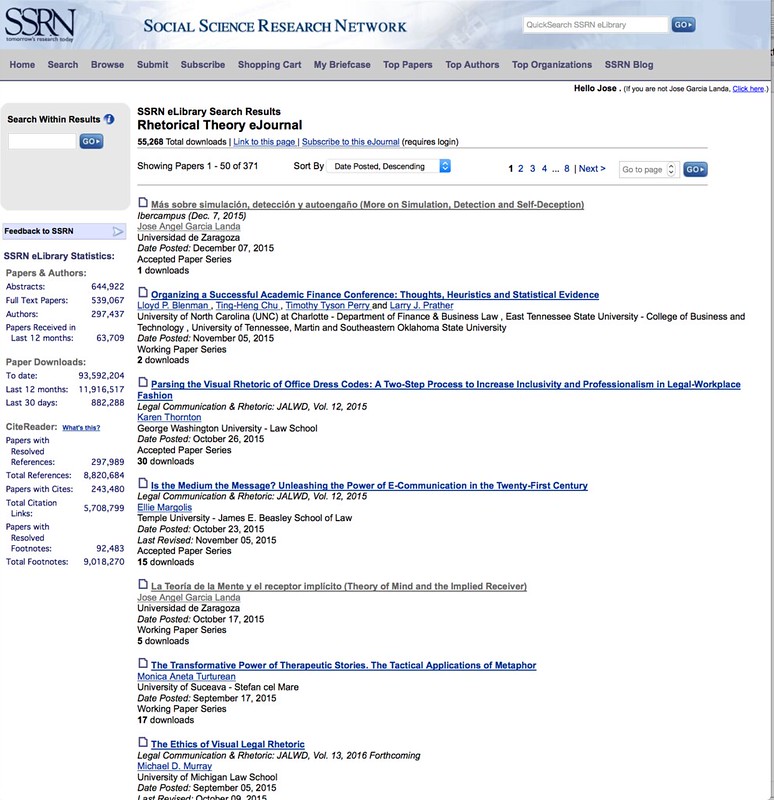
 Más sobre simulación —en el Rhetorical Theory eJournal


English abstract:

More on Simulation, Detection and Self-Deception

lobo y cordero
The insights on communicational deception and self-deception expounded in Michael Gazzaniga's Human are supplemented with some reflections on the complex dynamics of indirect communication drawn from Goffman's theory of strategic interaction and Pinker's cognitive linguistics.

Note: Downloadable document is in Spanish
 
Number of Pages in PDF File: 8
Keywords: Simulation, Detection, Communication, Interaction, Strategy, Lies, Psychology, Nonverbal communication, Proxemics


eJournal Classifications (Date posted: December 07, 2015)
AARN Subject Matter eJournals
    
        
 CSN Subject Matter eJournals
    
        
PRN Subject Matter eJournals
    
        
 PRN Subject Matter eJournals
    
        
RCRN Subject Matter eJournals


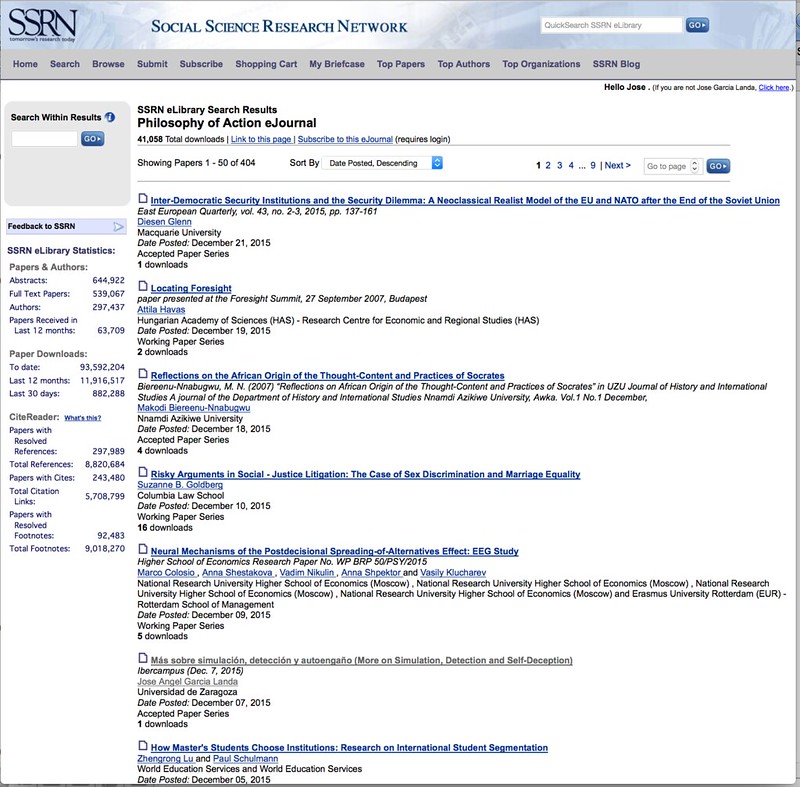
Más sobre simulación — en Philosophy of Action eJournal


Más sobre simulación, detección y autoengaño


—oOo—


(In)definición de la realidad

jueves, 31 de diciembre de 2015

(In)definición de la realidad


Propongamos una definición de la realidad, o quizá una perspectiva sobre ella. La realidad es lo que sucede entre líneas.

Aunque quizá la perspectiva a que aludo sea eso precisamente, el enfatizar lo que sucede entre líneas. Seamos más precisos: la realidad es el juego, la dinámica que se da, entre lo que sucede oficialmente, y lo que sucede entre líneas.

Porque la realidad está oficialmente definida, aunque no lleve carteles: está definida por sobreentendidos, por hábitos y rutinas establecidos, por marcos de interacción comunicativa. Lo que sucede oficialmente es, por ejemplo, una reunión de trabajo, una clase, una misa. Una conversación entre amigos. Cualquier función de esas que orquestan la realidad en cuanto que es teatro vivido.

Lo que sucede entre líneas es lo que Goffman llamaba un canal secundario—la actividad alternativa que involucra no a todos los participantes en el acto oficial, sino sólo a unos pocos, o quizá sólo a uno: el observador de esa dimensión oculta de la realidad que está sucediendo entre  líneas, el que ve lo que otros no ven, lo que se les escapa de la realidad.

(Puede suceder que dos miembros de una reunión estén interactuando por lo bajini mientras el jefe expone y predica.  La realidad se multiplica y articula en esa interacción secreta que viene ya definida como secundaria por su propia ubicación. Pero si esa interacción secreta es percibida y espiada por un tercero, la realidad se triplica, en un juego de perspectivas interaccionales. Es el tercero quien más realidad percibe, en nuestra descripción, el observador-que-observa-a-los-que-creen-que-observan-sin-ser-observados. Perspectiva cuasi-divina, engañosa por tanto, analizada por Lacan en su seminario sobre la carta robada de Poe, y más comentada por mí en mi artículo Poe-tics of Topsight).

Otro ejemplo. Hablamos con alguien. Lo que nos dice es una cosa, la actividad oficialmente establecida, el canal dominante. Lo que nos muestra es otra cosa. Vemos proxémica, kinésica, paralenguaje. El cuerpo dice la verdad que las palabras disimulan. O al menos es allí donde intentamos descubrir esa realidad elusiva: en el gesto, o en el subgesto.

Habría que dar una nueva definición de eso que Barthes llamaba el efecto de realidad. Para mí no está donde decía él (en los detalles irrelevantes o no significativos, aunque también), sino ante todo en ese juego de perspectivas, donde se confrontan dos realidades diferentes, definidas por dos marcos interaccionales diferentes. Dos o más. Y donde se ventila qué es lo que está pasando, o donde pasamos inconsistentemente de un juego de realidad a otro (en esas incertidumbres y caos la realidad se desbarata, pero a la vez se revela como lo que realmente es, detrás del juego de las apariencias organizadas).secondary channel

La realidad dominante es la realidad oficial, la públicamente reconocida, y organizada en una ceremonia interaccional ampliamente compartida o difundida.  Tiene, hay que reconocerlo, una cierta precedencia pública, y una autoridad que parece ser la autoridad de la evidencia misma (—de hecho, tan sólida parece a veces esa realidad primaria que olvidamos que es también una función del teatro de la vida cotidiana).

Pero frente a la realidad oficial, al Canal 1 de la realidad, tiene su propia solidez y su propia primacía la segunda cadena, el canal de comunicación subsidiario o el paréntesis de realidad provisional que se abre en el marco de la Realidad 1. Adquiere una intensidad especial, una inmediatez que le viene precisamente de esa contraposición a la realidad primera, y de la continuación de ésta como telón de fondo o como apoyatura donde edificar este segundo nivel de realidad. Si estamos en el segundo piso, es ése el que más inmediatamente nos sostiene, aun cuando su misma estructura consista en estar edificado sobre el primer piso.

La realidad extraoficial, por tanto, tiene un cierto caché, una prioridad ontológica —y si no ontológica, experiencial— que nos permite habitar la vida no como una ceremonia teatral ya sabida y previsible, sino como un lugar resbaladizo de semiosis intensificada, un lugar de riesgo interaccional e incertidumbre interpretativa. Lo auténtico se define como tal en las bambalinas del teatro de la vida cotidiana.


Goffman: El teatro de la interioridad


Reseña de SEMIOSPHERE OF NARRATOLOGY

ábado, 26 de diciembre de 2015

Reseña de SEMIOSPHERE OF NARRATOLOGY

Aparcada

Realizada por mi coeditora y editora principal, Ludmila Comuzzi (Tataru), aparece en el número 9 del boletín de la Sociedad Europea de Narratología, PDF aquí:
http://www.narratology.net/sites/www.narratology.net/files/webfm/stories/NL11_ENN_December_2014_0.pdf


Semiosphere of Narratology: A Dialogue of Languages and Cultures . Edited by Ludmila Tataru & José Ángel García Landa. Balashov: Nikolayev, 2013. 196 pages . ISBN 978 - 5 - 94035 - 511 - 3

Book review published in ENN Newsletter (NarrNet) 11 (2014) http://www.narratology.net/newsletter


Semiosphere of Narratology is an anthology of articles by Russian and Western scholars bearing on a variety of subjects ranging from theories and methods in postclassical narratology to the play and semiotic aspects of literary narratives, the narrativity of mass media and photoblogs to the use of narratives in the social sphere and in pedagogy.

The volume was edited by Ludmila Tataru, Professor at the Balashov Institute of Saratov State University (Balashov, Russia), and José Ángel García Landa, Senior lecturer in the Department of English and German Philology at the University of Zaragoza (Spain).

As a theoretical basis for conceptualizing narrative, the editors proposed the concept of semiosphere, a concept brilliantly formulated by Yuri M. Lotman. Viewing semiosphere in analogy to V. I. Vernadsky’s biosphere, Lotman represented it as a heterogeneous, asymmetrical environment, crucial for the existence, interaction and rejuvenation of languages and cultures, a particular scientific and cultural space within which there exist, interact and collide “old,” “new” and “yet-to-be-born” ideas, languages, systems and subsystems.

On this basis, the aims of the volume were set as follows:

1) to select contributions reflecting on Lotman’s ideas in their relation to the latest tendencie s in the theory of narrative; and

2) to structure a “polylogue of voices” focusing on the same concept – narrative – from the positions of various disciplines.
The book also represents a dialogue between two languages, Russian and English, in which the articles were submitted.

The first thematic section, “Semiosphere of Narratology: In Search of a Method,” includes five articles.

Greger Andersson (Professor of Comparative Literature at Örebro University, Sweden): “ Postclassical Narratology vs. Poetics: David Herman’s ‘Hypothetical Focalization’ as a Test Case”

The article discusses David Herman’s thesis of “hypothetical focalization” in relation to different theories about reader interpretation of narrative fiction. The author singles out two theoretical approaches to the problem. The first is based on the assumption that fictional narrative is a secondary variant of factual narrative with the simple modifier “as if” and a fictional narrator informing a narratee about events using linguistic means that work according to common grammatical rules. The alternative approach, advocated by theoreticians such as Käte Hamburger, Lars-Åke Skalin and Richard Walsh, is qualified as “separatist,” presenting fiction as a form of “language game” wherein an author stipulates motifs that will have an aesthetic impact on readers. According to Andersson, the first of the two approaches will generate “disquieting” interpretations that run against readers’ intuitions.

Boris Fyodorovich Yegorov (Leading researcher at St. Petersburg Institute of History, Russian Academy of Sciences): “The Play Aspects of Culture: The Conceptions of Yuri M. Lotman and V. S. Vakhrushev”

The author analyses the approaches to the cultural - philosophical category of play advocated by the two Russian scholars: Vladimir Vakhrushev and Yuri Lotman. Yegorov, who had incredible fortune to be a colleague and friend of both Vakhrushev and Lotman, presents their conceptions as a dialogue of distant voices, or, to be more exact, as Vakhrushev’s discourse on Lotman’s conceptualization of “play” paralleled by Vakhrushev’s own understanding of this category as it was presented in his book Image. Text. Play (2002) and in his articles on culture, philosophy, literary theory and history, etc. as well as in a number of his unpublished essays. Yegorov’s own mediating voice is clearly heard through references to Lotman’s life, theoretical heritage and personal correspondence. As Yegorov shows, the concept of play, fundamental for Lotman’s cultural-semiotic theory, gains greater scope and precision when seen from the perspective of Vakhrushev’s treatment of the same category.

Ludmila Tataru (Balashov Institute of Saratov State University, Russia): “Rhythm as a Category of Lotman’s Text Theory and as a Principle of Narrative Discourse”

Tataru suggests a theoretical model based largely on Lotman’s structural-semiotic theory, but updated in response to the contemporary trend of focusing on cognitive processes in narrative structures. She singles out for discussion Lotman’s interpretation of rhythm as presented in his earlier literary theory and in his later theory of cultural semiotics. The fact that rhythm has fallen out of the narratological debate is seen as unfortunate, for rhythm might be helpful in confronting the methodological challenge of heteroglossia in the narratological semiosphere. The cognitive-communicative functions of rhythm are illustrated in the analysis of a few stories from Joyce’s Dubliners. Tataru further argues that her method can also be effective for the study of non-fictional stories. Closer attention to narrative rhythm, she claims, might help to coordinate a number of meta-languages of narratological research that are often deaf to one another’s messages.

Valery Igorevitch Tyupa (Head of Theoretical and Historical Poetics, Russian State University for the Humanities, Moscow): “The Category of Narrative Strategies”

This article provides insight into the category of narrative strategies, defined as particular kinds of communicative strategies of culture. Tyupa suggests that positioning the narrator as a witness and judge of the eventfulness of existence is determined by the author’s modality of discursive behavior. He singles out four basic types of narrative modality: a) the modality of neutral knowledge, b) that of authoritative persuasion, c) that of an unre liable narrator’s subjective opinion (in Booth’s sense of the term) and d) the modality of understanding, which is neither subjective nor absolutely objective. Further on, Tyupa argues that the given types of modality are determined by three fundamental ba selines: a) the rhetorical modality of narration, b) world view and c) plot. He characterizes each of these baselines for the strategic choice to assert that a narrative strategy stipulates a text’s communicative unity, since the three baselines are mutually exclusive. That a strategic unity pertains even in complex narratives is demonstrated by an analysis of Mikhail Bulgakov’s novel The Master and Margarita. Another important idea put forward in the article is that of a specifically “historical narratology” as a promising sphere of humanist knowledge.

Dmitry Urusikov (independent scholar, Yeletz, Russia): “The Cognitive Turn in Narratology: In Search of a Method”

This highly theoretical article presents a critical analysis of the state of the art in contemporary Western narratology and the unlikelihood that it will take root in Russian scientific soil. Making a critical appraisal of David Herman’s opposition between classical and postclassical narratologies, which emphasizes cognitive narratology’s interest in mental structures, and going on to disclaim the poststructuralist status of postclassical narratology, Urusikov qualifies this development as a heterogeneous proliferation of narrative disciplines. He suggests an alternative map of that includes descriptive, generative and cognitive narratologies. The first considers classifications of narratives; the second, a new variant of structuralism, concentrates on narrative models; the reader reception and mental processes. The author doubts whether cognitive and postclassical narratologies can easily be naturalized in Russia for two reasons: 1) the dearth of Russian translations of the principal works on narrative theory and 2) a general trend within the philological community to stick to the traditional, hermeneutic methods of analysis.


The second part of the volume, “Narrative as a Meta-genre of Modern Culture,” features the following five articles.

Saule Altybayeva (Associate Professor and Chair of Philological Specialties at the Kazakh National Pedagogical University named after Abai; Almaty, Kazakhstan): “Documentary and Quasi - documentary Narratives in Modern Kazakh Prose”

This paper discusses documentary and quasi-documentary narratives in modern Kazakh historical prose and characterizes them in terms of their typical content and functions. The author suggests working definitions of the narrative types in question and points out that they do not supplant fictionality but only assume new functions and enrich literary narratives with new meanings. Documentary narratives, which narrate real historical events, directly or indirectly confirmed by facts, are capable of forming eventuality within a wider existential range. Events are rearranged (e.g., dates and times of battles) as if overlapping one another. Altybayeva claims that quasi-documentary narrative is compatible with the fictional content of the novel, although its “molecules” – quasi-documents – are fictional and often fantastic.

Svetlana Bozrikova (Senior Lecturer in Foreign Languages, Balashov Institute of the Saratov State University):

“Criminal Story in Journalism: The Typical Traits of Narrative Temporality” The author looks at the crime story as a genre in terms of its tempor ality. One of its specific traits, she suggests, consists in correlations between temporal perspectives which perform particular cognitive functions while presenting the events at varying speed and frequency and in a particular sequence. The reader is immersed into the storyworld thanks to the literary technique employed by journalists to narrate events via scenes and slow - downs, retrospections and foreshadowings, breaking up the story sequence and regular repetitions of the crucial points of the chronotope viewed from different temporal perspectives, thus giving narration a rhythm Bozrikova illustrates her theoretical model with a detailed analysis of Eli Sanders’ essay “The Bravest Woman in Seattle” (published in The Stranger, 2011).

José Ángel García Landa (University of Zaragoza, Spain): “Narrativity of the Photoblog”

This paper examines the storytelling dimension of personal photoblogs from the point of view of narrative semiotics as a shifting multiplicity of interconnected semiotic sub - systems and communicative practices. García Landa takes into account both deliberate and spontaneous narrativity and the narrative sequences constructed by the medium as well as those constructed by the viewers. The aim is to gain further insight into the nature of the photoblog as an emerging genre of narrative, thus opening up a promising perspective for narratologically-minded cybertheory. García Landa keeps a Flickr photoblog himself, and the cover of the volume Semiosphere of Narratology is decorated with his two photos of dead leaves, suggestive of “the narrativity of experience” – the temporal cycles or, symbolically, the narrativity of life. He concludes that the photographs in photoblogs are intermedial, intertextual and hypertextual genres, thus exerting an indirect influence on photographic practices and on the way photographs and ideas about them are viewed, read and circulated.

Maria Roginska (Institute of Sociology and Philosophy, Krakow Pedagogical University, Poland): “The Crisis Chronotope of the Transformation Period: The Orthodox Liminal Narrative”

This contribution emphasizes the socially dependent significance of non - literary narratives as accounts of past experiences. It focuses on liminal narratives considered as both stories about crisis and stories that are generated by the transitional critical context. Roginska attempts to reconstruct liminal narratives of Russian orthodox believers dating back to the transformation after the collapse of the Soviet Union (1991–2003). She shows the significance of the crisis chronotope as a universal interpretive scheme by which orthodox narrators conceptualize spatial and temporal changes, national history and the “miraculous” private experience of the transformation period.

Ondřej Sládek ( Institute of Czech Literature, Academy of Sciences of the Czech Republic, Prague): “The Use of Narrative in Education" The author praises “the magic power of stories” in education. Applying the classic model of literary communication to the triad “the educator – t he curriculum – the student,” he discusses, respectively, “the use of narratives by the educator,” “the use of narratives by students” and “the use of narratives in presenting the curriculum.” Sládek specifies the six modeling functions of narrative in sci ence and education: illustrative, historical, popularizing, didactic, legitimizing and narrative. He insists that narratives should be used in varying degrees and in different ways depending on the disciplines taught, and he recommends that educators look for a balance between the macro-story (presenting the wide context of the problem) and micro-stories (minor stories within the big story), as is the practice with documentary films. The article concludes with idea that the loss of storyness would mean the loss of the order of one’s own life, the loss of the ability to perceive things in context and the loss of awareness of sequence in everyday situations.

The third section, “Philosophical and Semiotic Dimensions of the 20th - and 21st - Century Literary Nar ratives,” features the following five articles:

Svetlana Bessmertnova (Ph.D. student in literature, teacher of Russian and literature at the Alexander Nevsky Gymnasium, Saint Petersburg): “Semiotic Aspects of Bertold Brecht’s Drama”

The author examines Berthold Brecht’s method of estrangement ( Verfremdung ), the key principle of Brecht’s epic theater. She proceeds from the affinity of the pragmatics of existential philosophy and the pragmatics of Brecht’s dramaturgy, viewing this affinity in the more gene ral context of the triad “the signified – the signifier – the perceiving consciousness.” She believes that the situation of existential nothingness, understood as an acquisition of clarity of mind at the expense of the loss of illusion, is to be found in the basic mechanisms of estrangement which are made manifest, in the first place, in the narrative structure of Brecht’s plays. Narrative tools serve to “expose” the conventional semiotic codes and, by means of the latter, to expose fatalism, demonstrating at the same time the possibility and the necessity of making a choice and responsibility for one’s choice, the latter being a consequence of nothingness. 

Irina Galutzkikh (Associate Professor of English, Zaporizhzhya National University; Zaporizhzh ya, Ukraine): “Processes of Semiotization of Corporeality in the Postmodern Period and their Reflection in the Imaginative Space of the Literary Text (a conceptual analysis)”

This essay specifies the semiotic and discursive nature of the conceptual framework of the human body within the context of English postmodernist literary prose. It focuses on the mode of imagery conceptualization activating the conceptual metaphor the “human body as a sign.” The author analyses the “bodily” preoccupation of postmodern philosophy, touching upon the phenomenological, social and textual interpretations of the body in Merleau-Ponty’s, Deleuze and Guattari’s and Barthes’ works, basing her own argument mainly on the latter. Applying the semantic-cognitive method of linguistic analysis to Jeanette Winterson’s “Written on the Body” and Peter Ackroyd’s “The Process of Elizabeth Cree,” Galutzkikh makes clear that the body functions in postmodernism as a semiotic code to accentuate the eroticized and sensual aspects of human life as well as one’s individual existential experience.

Sergey Orobiy (Associate Professor at the Blagoveschensk State Pedagogical University; Blagoveschensk, Russia): “‘Anything but the Novel’: Joyce, Jobs and Poetics of Flood”

Written in “the cyber-culture vein,” this article correlates with García Landa’s interest in the way the Internet affects narrativity. Orobiy, a blogger like his Spanish ”companion-in-arms,” analyses the paradoxical nature of the term “poetics of flood,” combining associations wit h the Aristotelian roots of literary theory and idle talk in the Internet over the end of “real literature.” The author finds parallels between the new “low genres” found in Live Journals, blogs, lifelogging, Narrato Journal and other apps and “the small genres” of earlier literary periods, e.g., the epistolary genre in Pushkin’s time and “the literature of fact” praised by the formalists. The new formats of storytelling are qualified as proto-narrative techniques of registering eventfulness non-stop. Orobiy analyses four books recently published in Russia illustrative of the new textuality and comes to the conclusion that today literary narrative has been transformed into a fluid proto-novel, “a new Ulysses ” written daily by millions of authors creating a huge semantic space organized in the form of a matrix.

Beatriz Penas-Ibáñez ( Senior Lecturer in English, University of Zaragoza, Spain): “Semiotic Roles of Narrative Standardness : Securing Cultural Change and Integration. Haiku-Aesthetics and the Anglo-American Literary Semiosphere”

This paper focuses on the socio-pragmatic functions of standardness, considering standard vs. non-standard narrativity , namely, the facilitating of cultural transfer between different literary semiospheres. Culture-specific types of text are seen as translatable through processes of cultural contact, change, assimilation and transfer. Among other things, Penas-Ibáñez theorizes hybridity as a semiotic artifact and the cultural transfer between eastern and western literary practices at the beginning of the 20th century. She characterizes the mutual influence and revulsion of the Sino-Japanese and the western avant-garde genres which had interwoven the two literary semiospheres and led to displacement of the standard poetic and narrative forms dominant in the West during the 19th century by non-standard narrativities like Pound’s and Hemingway’s haiku-like ones.

Svetlana Shiena (Professor at Balashov Institute of Saratov State University) and O. V. Zatonskaya ( Ph.D. student in Literature, Balashov Institute of Saratov State University):

“Poetic Philosophy of S. Beckett and F. Nietzsche” Sheina and Zatonskaya examine the langu age philosophy of Nietzsche and Beckett. They find similarities between the German philosopher’s and the Irish dramatist’s conceptions of poetic language in their respective ways of searching for a language capable of expressing ideas. Both were to give preference to metaphors and aphorisms. The editors of Semiosphere of Narratology believe that such a collective a look at the heteroglossia of contemporary narratology’s Babylon Tower from the perspective of Lotman’s semiotic theory, based on various mechanisms of the mutual attraction/repulsion of cultures and discourses, has been illustrative, if not explanatory, of some of its patterns. The general picture is paradoxical: diverse intellectual spheres have created a productive dialogue of scientific cultures, but at the same time have built impermeable membranes between discursive formations within the global semiosphere of narratology.


Ludmila Comuzzi (Tataru) Saratov State University


—oOo—