Blogia

Vanity Fea

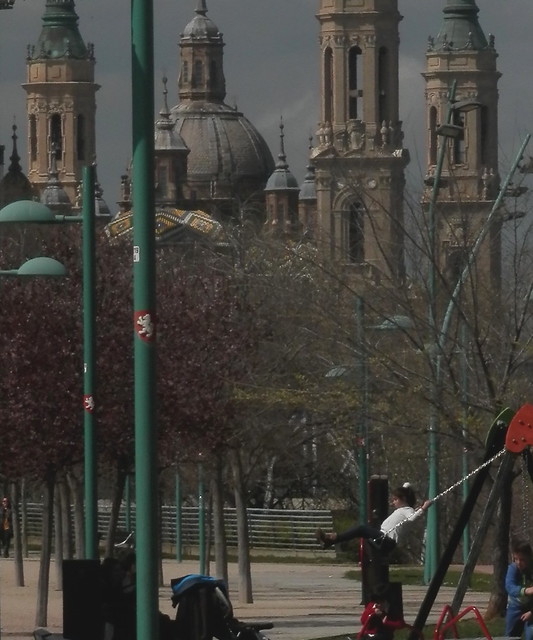
Columpio y Pilar

Columpio y Pilar


Columpio y Pilar copia

Retropost: Podéis explorar Marte

Retropost #828 (25 de marzo de 2006): Podéis explorar Marte


Pues después de la Tierra y de la Luna, aquí viene Google Mars.

Me he enterado a través del blog de ciencia de Time, Eye on Science, que también promete. Quién sabe, igual mirando mirando das con cosas que ningún ojo humano ha visto antes en Marte. Como ahora hemos automatizado la exploración, seguro que muchas fotos se cuelgan, y se colgarán, a piñón fijo, las del Mars Reconnaissance Orbiter, que acaba de situarse, y ya han empezado a llegar. También podéis explorar la Tierra, claro. ¿O creéis que hay alguien que haya mirado toda la superficie terráquea en el Google Earth?

Otas, Swift, Phobos, Deimos, Titán, Brown

Retroposts

—oOo—

Retroposts: Aquí enclaustrados

Retropost #827 (25 de marzo de 2006): Aquí enclaustrados


Con un 30% de la familia con varicela: ahora la han pillado Álvaro y Oscar. Pues en estas circunstancias no nos movemos de casa. Quien la haya pasado, que se venga a tomar un café, si le apetece.


El sábado por la tarde nos lo hemos pasado en un parque, con Ivo y Oscar trepando por todo tipo de artefactos de juegos, y Álvaro derrengado releyéndose La Isla Misteriosa. Yo me termino una de Ian McEwan, y luego me voy a revisar el coche, y limpiarlo, que la semana que viene tengo que pasear en él invitados universitarios. Hoy me pitan dos veces conductores desde atrás: la primera, por rueda deshinchada; la segunda, por llevar la quinta puerta abierta de par en par. Cielos. Debe ser la astenia, o algo...

PS: Domingo, lo mismo. Los tenemos pintarrajeados con un líquido blanco contra picaduras, que parecen comanches en pie de guerra. Oscarelo tiene granos hasta en la lengua y dentro de las orejas. En la lengua no le hemos puesto antipicante. Está derrengado; se tumba en el sofá cabeza abajo, y dice "Quielo que me expliman".

Pibo, en cambio, animado; hoy se ha dado el primer paseo en moto conmigo, para celebrar que ya tiene siete años, y hemos ido al Parque del Tío Jorge, para él "el parque de los cangrejos", a ver cómo pescaban cangrejos los niños. Mientras, nos han cambiado la hora y nos han robado por tanto una hora de tarde de primavera sin que nos enterásemos.

La prima Vera: se arrima, la maldita prima. Aunque no es lo que era. Vera, Vera...


Retroposts

—oOo—

1177 B.C.: The Year Civilization Collapsed

sábado, 9 de abril de 2016

1177 B.C.: The Year Civilization Collapsed

Eric H. Cline
1177 B.C.
The Year Civilization Collapsed (interview from NEW BOOKS IN HISTORY)
Princeton University Press 2014
October 7, 2015 Robert Broadway

It quickly sold out in hardback, and then, within a matter of days, sold out in paperback. Available again as a 2nd edition hardback, and soon in the 10th edition paperback with a new Afterword by the author, Eric H. Cline‘s 1177 B.C.: The Year Civilization Collapsed (Princeton University Press, 2015) is THE must have, must read book of 2014, and 2015. Why? Because it’s serious archaeology, history and anthropology, but it reads like a mystery novel. The prose is superb; so good that it’s hard to put down. Homer wrote about the Age of Olympians: Zeus and Apollo, Odysseus, Achilles and Hector. Cline writes about the Minoans and Mycenaeans, the Trojans and the Egyptians, Hittites and Babylonians. And both epics, one mythology and one history, are about the same extraordinary time.
Cline recreates the late Bronze Age in fascinating detail and then describes its utter and complete destruction. City after city, empire after empire, civilization after civilization: annihilated to extinction, one right after another, and in a shockingly short amount of time. What caused a catastrophe so extreme that the First Dark Age descended over the world: a mysterious invading culture–the Sea People, plague and pestilence, earthquake, climate change, all of the above? 1177 B.C.: The Year Civilization Collapsed discusses each possibility in turn. A great interview with a world-class researcher–it easily could have gone for three-hours.

Carlos Madrid: Entre Ciencia y Filosofía: la cara oculta del Big-Bang

Carlos Madrid: Entre Ciencia y Filosofía: la cara oculta del Big-Bang


Iñigo Ongay: Del oso de las cavernas al Estado Islámico: una breve historia de Dios y la Relición

Iñigo Ongay: Del oso de las cavernas al Estado Islámico: una breve historia de Dios y la Relición


Comento:

Excelente conferencia, y sin embargo:

Entra sólo en determinados aspectos de la religión (por ejemplo no trata para nada su papel de organizador de la moral y de la vida social, su papel político, etc.). Una seria limitación de perspectiva, naturalmente. A la que acompañan otras carencias de perspectiva. Por ejemplo, arguye que con el dios terciario no se puede uno hablar ni comunicarse con el. Pero esto es sólo verdad a medias, pues con ese dios se puede hablar en la modalidad de 'amigo imaginario' o 'amigo invisible', que es una experiencia importante para muchos creyentes. Y es precisamente su invisibilidad (o su inexistencia real) la que le permite la ubicuidad, la plasticidad, etc. que le hace tan útil como maniobra psicológica (de autoengaño, si se quiere) para estos creyentes. Es otra dimensión en la que habría que entrar, aunque no exijo yo que se haga en una conferencia de menos de una hora.


—oOo—

It's All Over Now Baby Blue (2)

It's All Over Now Baby Blue (2)


—oOo—

Retropost: Disgrace

Retropost #826 (24 de marzo de 2006): Disgrace


Pongo aquí un trocito del principio de la novela de J. M. Coetzee Disgrace (Secker & Warburg, 1999), que ganó el premio Booker a finales del siglo pasado. Aquí aún estamos por llegar a esa fase, pero no tardará. O, en todo caso, me gusta ponerlo aquí. Yo solía tener la superstición de creer que si pensabas con detalle en cómo iba a ser el futuro, reducías las posibilidades de que fuese por allí la cosa. Es la superstición más intelectualmente consistente que conozco.

About his own job he says little, not wanting to bore her. He earns his living at the Cape Technical University, formerly Cape Town University College. Once a professor of modern languages, he has been, since Classics and Modern Languages were closed down as part of the great rationalization, adjunct professor of communications. Like all rationalized personnel, he is allowed to offer one special-field course a year, irrespective of enrolment, because that is good for morale. This year he is offering a course in the Romantic poets. For the rest he teaches Commmunications 101, 'Communication Skills', and Communications 201, 'Advanced Communication Skills'.
Although he devotes hours of each day to his own discipline, he finds its first premise, as enunciated in the Communications 101 handbook, preposterous: 'Human society has created language in order that we may communicate our thoughts, feelings and intentions to each other.' his own opinion, which he does not air, is that the origins of speech lie in song, and the origins of song in the need to fill out with sound the overlarge and rather empty human soul.
In the course of a career stretching back a quarter of a century he has published three books, none of which has caused a stir or even a ripple: the first on opera (Boito and the Faust Legend: The Genesis of Mefistofele), the second on vision as eros (The Vision of Richard of St Victor), the third on Wordsworth and history (Wordsworth and the Burden of the Past).
In the past few years he has been playing with the idea of a work on Byron. At first he had thought it would be another book, another critical opus. But all his sallies at writing it have bogged down in tedium. The truth is, he is tired of criticism, tired of prose measured by the yard. What he wants to write is music: Byron in Italy, a meditation on love between the sexes in the form of a chamber opera.
Through his mind, while he faces his Communications classes, flit phrases, tunes, fragments of song from the unwritten work. He has never been much of a teacher; in this transformed and, to his mind, emasculated institution of learning he is more out of place than ever. But then, so are other of his colleagues from the old days, burdened with upbringings inappropriate to the tasks they are set to perform; clerks in a post-religious age.
Because he has no respect for the material he teaches, he makes no impression on his students. They look through him when he speaks, forget his name. Their indifference galls him more than he will admit. Nevertheless he fulfils to the letter his obligations toward them, their parents, and the state. Month after month he sets, collects, reads, and annotates their assignments, correcting lapses in punctuation, spelling and usage, interrogating weak arguments, appending to each paper a brief, considered critique.
He continues to teach because it provides him with a livelihood; also because it teaches him humility, brings it home to him who he is in the world. The irony does not escape him: that the one who comes to teach learns the keenest of lessons, while those who come to learn learn nothing. It is a feature of his profession on which he does not remark to Soraya. He doubts there is an irony to match it in hers.


(La reforma de aquí, por su parte, pasito a pasito sigue. La Comunidad de Madrid ha aprobado un Programa de Postgrado que incluye el Máster en Lingüística Inglesa: Nuevas Aplicaciones y Comunicación Internacional. Aquí en Zaragoza tendremos, al parecer, máster en "Estudios Textuales y Culturales en Lengua Inglesa". Pues que sea enhorabuena: lo malo no es lo que se añade, claro, sino lo que se quita. Ha habido algunos mensajes de respuesta al que envié ayer a la lista de AEDEAN (y que me volvieron a colgar en Fírgoa ; sobre todo mensajes privados, felicitándome o manifestando sorpresa o intercambiando opiniones; creo captar que hay mucha marea de fondo, e intereses muy encontrados debajo de la supuesta unanimidad de la profesión; pero la gente no es tan dada como yo a manifestarse en sitios visibles, con lo cual el panorama sigue confuso).

Unto This Last


Retroposts

—oOo—