Introduction to the Old Testament
100.000 en Academia
miércoles, 1 de abril de 2015
100.000 en Academia
Acabo de cumplir 100.000 visitantes en mi página de Academia. Oigan, no está mal, que no tiene vídeos de Lady Gaga. Aquí queda fotografiado el momento, no quería yo perdérmelo:
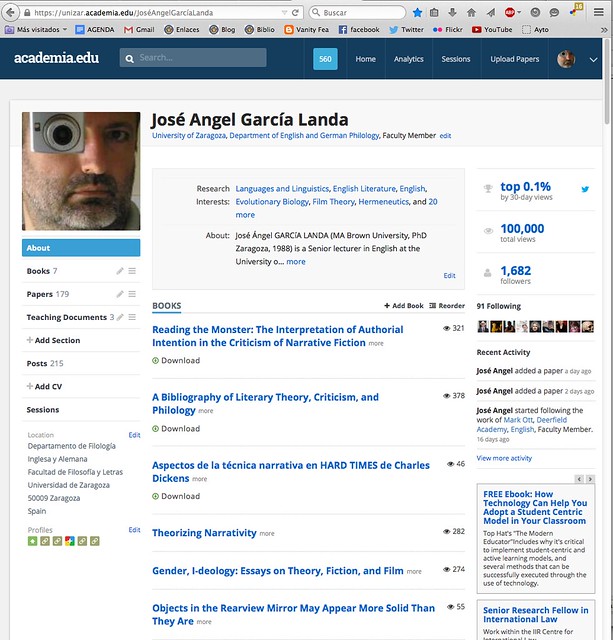
Se acerca Academia a los veinte millones de usuarios (académicos, se supone). Con lo cual mi posicionamiento por visitas recientes, que me ubica desde hace meses en el "Top uno por mil" tiene cierta fiabilidad estadística.
Sitio de citas
Darwin: Del Big Bang al hombre
Darwin: Del Big Bang al hombre
Un artículo sobre darwinismo y evolución, en dos partes, que empezó como un post en directo aquí, y luego pasó a Ibercampus, al SSRN, etc.
Darwin: Del Big Bang al hombre (Primera parte) - Perspectivas actuales sobre la evolución
Notas tomadas en la Jornada de la Obra Social de IberCaja en colaboración con el Instituto Francés, "Darwin: Del Big Bang al Hombre" (2013); organizadas simultáneamente en la sede de IberCaja en Zaragoza, y en el ayuntamiento de Brive (Francia). Las ponencias de la primera parte de la jornada versan sobre el contexto histórico y científico de Charles Darwin y de su obra, el desarrollo del darwinismo, el asociacionismo atómico y molecular desde el Big Bang a la materia, la selección natural y física, y el darwinismo y el origen de la vida.
Darwin: From the Big Bang to Man (First Part) - Current Perspectives on Evolution
Notes from the symposium organized by IberCaja and the French Institute, "Darwin: From the Big Bang to Man" (2013), and held at the Zaragoza IberCaja conference room and the Council House of Brive (France). The presentations from the first part of the symposium deal with the historical and scientific context of Charles Darwin's work; the development of darwinism; the development of atomic and molecular associationism from the Big Bang to the formation of matter; natural and physical selection; and Darwinism and the origin of life.
Note: Downloadable document is in Spanish.
Number of Pages in PDF File: 16
| eJournal Classifications |
AARN Subject Matter eJournals |
| AARN Subject Matter eJournals |
| PRN Subject Matter eJournals |
Darwin: Del Big Bang Al Hombre (Segunda Parte) - Perspectivas Actuales Sobre La Evolución
Ibercampus (March 10, 2015)
Abstract:
Las ponencias de la segunda parte de la jornada versan sobre la evolución molecular y el ADN mitocondrial, la coevolución y la interacción entre organismos, la ecología y la evolución, la filosofía y la evolución, y la influencia del darwinismo en antropología. Termina la jornada con un coloquio con el público.
Darwin: From the Big Bang to Man (Second Part) - Current Perspectives on Evolution
The presentations from the second part of the symposium deal with molecular evolution and mitochondrial DNA; coevolution and the interaction between organisms; ecology and evolution; philosophy and evolution; and the influence of Darwinism on anthropology. The symposium ends with a colloquy with the audience.
Note: Downloadable document is in Spanish.
Number of Pages in PDF File: 17
Keywords: Evolution, Darwinism, Biology, Anthropology, Ecology, Biochemistry, Genetics
| eJournal Classifications |
| AARN Subject Matter eJournals |
| AARN Subject Matter eJournals |
| PRN Subject Matter eJournals |
—oOo—
Incrustar este periódico
Al poco tiempo, deja de poderse incrustar este periódico.
Aquí pasando el tiempo

On McCahon and His Critics
lunes, 30 de marzo de 2015
On McCahon and His Critics
Comment on Anthony Lock's "Evolutionary Aesthetics, the Interrelationship Between Viewer and Artist, and New Zealandism"
For a forthcoming discussion at the ASEBL Journal
Lock's paper is highly cogent, informative and well argued, and I have found much to learn from it. Let me also make clear that I strongly dislike, with whatever strength indifference can muster, the modernist-primitivist art represented by his example of choice, ColinMcCahon. But the paper does an excellent job in arguing a number of cultural, cognitive and evolutionary reasons why McCahon's work might be successful. It is not so effective, in my view, when it comes to conveying why it has actually been successful in the struggle for life of the art world ecosystem. By way of critique, the paper is too deliberately restricted to one context of response, evolutionary aesthetics, and to that extent it is an exercise in keeping out other approaches. It does that so smoothly that one does not even notice it has been done. But the paper lacks (much) discussion of the cultural context of art in New Zealand, of artistic traditions in twentieth-century painting, of the dynamics of the art world and the art profession.
Are these matters irrelevant? (Well, perhaps they are within the scope of Lock's notion of evolutionary aesthetics). But what has created the bandwagon effect? It is arguable that once the discourse of New Zealandism is active, any New Zealand artist hailed as a New Zealander might have been able to occupy the slot and have the discourse stick to him and characterize him. I take the technical incompetence of McCahon's, and the lack of a militant focus on New Zealand in his work as proof that any other artist might have filled the bill equally well—or better, indeed, in the case of more explicitly regional painters. But the vortex of attention selected McCahon, Rita Angus, and a handful of others. Lock devotes some attention to the role of critics in selecting artists (quite arbitrarily, it would seem) and creating a tradition, but some elements seem to be missing from the discussion. What makes those critics' views influential, for instance, or what is the actual functioning of the art world as a profession where things are bought and sold, who does the buying and the selling and the reviewing, what other class interests, business interests, prestige markers, political interests, whatever, are active in this small world. There is though the danger of a vicious circle here, because Lock might perhaps answer that it is the inherent qualities in McCahon's work that helped bring out his critics as perceptive ones in drawing attention to him, or that it was those qualities that furthered his marketability or emblematic potential in the NZ context. Still (in my current act as an Anti-McCahonian) I tend to see the dominance of pure arbitrariness in the bandwagon effect. Success in modern art (and we wouldn't be discussing McCahon else) is the result of a chaotic matrix of circumstances, and that argues somewhat against the fitness dimension in McCahon's argument.
A theory such as Lock's selects some elements from a tangled web of complexity in order to foreground them or to show the way they are active. Still the clarity of the theory plays against itself insofar as there are many elements left outside the complex which are just as entwined with it as those which are brought to the light by the theory. The theory then creates a kind of hindsight bias effect regarding its views on those artists who are eventually consecrated.
Perhaps I'm just saying that Lock explains the success of some elements which are present in art in general, as a scientific theory should, but does not really account for the preeminence of specific artists, because this preeminence is not to be fully explained at this level of reasoning. One would have to engage in a more detailed way dominant discourses and counterdiscourses in the 20th century, postcolonial dynamics of representation, and the whole shebang of historical, biographic, cultural-aesthetic and poststructuralist criticism, which would make the paper less distinctive as an intervention in evolutionary aesthetics. There would be downsides, and upsides. As it is, the paper is an interesting specimen of Third Culture (i.e. cultural theory written under the aegis of sociobiology and cognitivism). To its credit, it does make some moves in the direction of what I would like to call Fourth Culture—integrating within an evolutionary perspective the insights of cultural criticism, historical scholarship, aesthetics… instead of dismissing them and restricting the scope to what can be seen from a neo-paleolithic viewpoint.
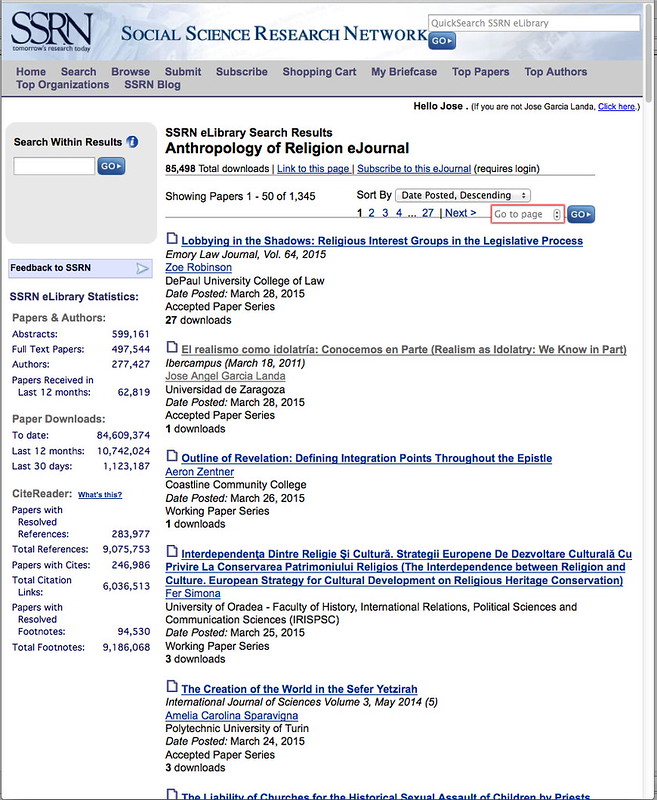
Salgo en el Anthropology of Religion eJournal
lunes, 30 de marzo de 2015
Salgo en el Anthropology of Religion eJournal
—con fecha 28 de marzo de 2015