
The Arts
miércoles, 16 de noviembre de 2016
The Arts
Citan mi bibliografía como "referencia externa" en este libro colectivo, redactado por los "Wikipedians" y procedente de los artículos de la Wikipedia sobre arte.
Más allá de Lapamán
A Couple of Bacons & Coke
miércoles, 16 de noviembre de 2016
A Couple of Bacons & Coke
(From The Oxford Companion to English Literature, ed. Margaret Drabble).
BACON, Francis, first Baron Verulam and Viscount St Albans (1561-1626), the fifth son of Sir Nicholas Bacon, lord keeper to Queen Elizabeth 1558-79, by his second marriage to Lady Anne Cooke. Bacon's mother was the daughter of Sir Anthony Cooke, tutor to King Edward VI, and was an exceptionally gifted scholar and translator in her own right. One of her sisters married the queen's chief minister *Burleigh. Bacon was born in London, at York House in the Strand, and with his brother Antony went up to Trinity College, Cambridge, between 1573 and 1575; they were tutored by the master, John Whitgift, subsequently archbishop of Canterbury. As part of his grooming for high public office he spent from 1576 to 1579 with the queen's ambassador to France, Sir Amias Paulet, studying statecraft and performing diplomatic duties. Bacon's public career suffered two serious setbacks. His father died suddenly, in Feb. 1579, having settled estates on his first four sons, and in the process of doing so for his youngest. Deprived of an inheritance, Bacon returned to England to become a lawyer, entering Gray's Inn in 1579, graduating in 1582. His abilities were soon recognized, and he was appointed a lecturer and invited to sit on government legal committees while still in his twenties. In 1581 he became an MP (for Bossiney, Cornwall) and served in every parliament until 1621, first in the Commons, then in the Lords. He achieved recognition as a parliamentary speaker, but his boldness in the 1593 session in opposing the unusally heavy taxes the queen wanted led to his being expelled from royal favour, promotion to higher legal office going to his rival, *Coke. The queen continued to employ Bacon in various legal offices, severely testing his loyalty to the Crown by appointing him one of the prosecutors of his former patron the earl of *Essex, whose increasingly headstrong behaviour led him eventually to the scaffold. Under King James, Bacon achieved the public office for which he had so long been preparing. Knighted in 1603, he became king's counsel in 1604, solicitor-general in 1607, attorney-general in 1623, a privy counsellor in 1616, lord keeper in 1617, and lord chancellor in 1618. Having more than emulated his father in public office, he excelled him in rank, being elevated to the House of Lords as Baron Verulam in 1613. and created Viscount St. Albans in 1621. Although remarkable, the promotion was well deserved, for Bacon impressed everybody with his forensic skills, intellectual penetration, and abilty to present complex issues clearly. But the higher reaches of state office carried their own dangers, and Bacon increasingly found that his carefully worked out advice and counsel were ignored both by James and by the court favourite, the first earl of *Buckingham. In the absence of a proper salary structure, government officials under James depended for their livelihood on gifts from suitors and on selling their office, leading to a high degree of corruption from which many (particularly Buckingham) profited. In 1621 a parliamentary group was bent on reform, led by Coke and Sir Lionel Cranfield, attacked the system of monopolies, where lucrative patents were allocated by nepotism (Buckingham's two brothers benefited richly) and enforced by illegal means. While attempting to censure Bacon, who as head of the court of Chancery had issued licenses to patentees at the king's request, they heard of two aggrieved suitors who had followed the custom of giving presents to Bacon as presiding judge, but had not won their case. The government's enemies succeeded in having him impeached in the House of Lords on charges of bribery, even though (unlike other venial judges) he had never allowed such presents to sway his judgement, and at this point both James and Buckingham abandoned him as scapegoat for their own unpopular policies. Bacon's career was ruined: he was given a huge fine, imprisoned in the Tower, and forbidden to come within 10 miles of the court. But the fine was never collected, the imprisonment lasted three days, the whole affair being cynically intended to placate the reform party, while the real abuses continued. Deprived of power, Bacon was vulnerable to Buckingham's greed, and was made to sell York House in the Strand. Out of office, he devoted himself fully to writing, producing in quick succession A History of the Life and Reign of King *Henry VIII (1622), the De Dignitate & Augmentis Scientiarum (1623, a Latin expansion of *The Advancement of Learning), the *Essays (1625), and the posthumously published New Atlantis (1627). Until his downfall, Bacon's writings were the product of the vacations or other leisure time in a busy public career. Simultaneously a Protestant or moderate Calvinist (as his Confession of Faith shows) and a humanist, sharing that movement's emphasis on the individual's duty to take part in a vita activa for the common good, all Bacon's intellectual activities were directed towards practical ends, from which the whole of society would benefit. He outlined many schemes for reforming the laws, making them easier to understand and more coherent; he wanted the universties to widen their curriculum from the three traditional professions (theology, law, medicine) to take in the 'arts and sciences at large'; and he was ahead of his time in realizing that a continous growth of knowledge was possible. Bacon's plan to reform the whole of natural philosophy (or science), outlined in the fragmentary Instauratio Magna (1620), of which the *Novum Organum was the only more or less complete part, aimed to effect a new union beween 'the mind and the universe', from which would spring a range of inventions to 'overcome the necessities and miseries of humanity' (See also BACONIAN THEORY).
Bacon's writings inpired the founding of the *Royal Society in 1662, and had a considerable influence on *Hobbes, *Boyle, *Locke, *Defoe, and many others. The fullest edition of his works was prepared by James Spedding (14 vols, 1857-74); see also Francis Bacon, ed. Brian Vickers.
Advancement of Learning, The, a treatise by F. *Bacon, published 1605, systematizing his ideas for the reform and renewal of knowledge. Book I has a dual task: to defend knowledge in general from all its enemies, ecclesiastical and secular, and to argue for its dignity and value. Surveying the discredits that learning has brought upon itself, Bacon writes brilliantly satirical accounts of medieval Scholasticism, which restricted intellectual enquiry to the text of *Aristotle, and Renaissance Ciceronianism, with its slavish imitation of *Cicero's style. Thse, and other 'diseases' have deflected knowledgte from its true goal, 'the benefit and use of man'.
Book II then undertakes a 'general and faithful perambulation of learning', identifying 'what parts thereof lie fresh and waste', not properly developed. Bacon surveys the whole of knowledge, human and divine (that is, theology), under three headings, history, poetry, and philosophy, corresponding to the three faculties of memory, imagination, and reason. The result is a tour de force, showing a ramarkably wide grasp of many subjects and a penetrating insight into the kind of research needed to develop them, including original analyses of rhetoric, psychology, ethics, and politics. Bacon's 'small globe of the intellectual world', as he called it, has important links with his essays.
Essays, The, of F. *Bacon, first published in 1597, together with the 'Christian Meditations' and 'Of the Colours of Good and Evil', consisted of ten essays, in extremely bare style. The sentences are printed separately, marked with a paragraph sign, giving them the status of aphorisms, discrete observations drawn from experience, in the realm of public life. The second edition (1612) contained 38 essays, in a more varied style, and on a wider range of topics; a manuscript copy now in the British library describes them as his 'writings . . . in Moralitie, Policie [politics] and Historie'. In this collection Bacon began to fill a lacuna he had noted in his *Advancement of Learning (1605), the lack of concrete knowledge of the different 'natures and dispositions' of human beings, and how they were affected by psychological and social factors (such as gender, health, social standing, physical appearance). The final version, now called Essays or Counsels, Civil and Moral (1625), included 58 essays, filling in more of these gaps in treating both 'civil' or public life, and the mores or behaviour of private individuals. Bacon's approach varies greatly from essay to essay, approaching each topic from several different viewpoints, juxtaposing systematic analysis with brilliant aperçus. The styles used range from the detached and laconic to the passionately engaged, especially when expressing his moral beliefs. Dr. *Johnson said that the Essays were 'the observations of a strong mind operating upon life; and in consequence you find what you seldom find in other books'.
Novum Organum, a Latin treatise on scientific method, which F. *Bacon included in his Instauratio Magna (1620). This 'great renewal' of natural philosophy (which Bacon never completed) involved a systematic methodology, starting with fresh observation of natural phenomena. followed by carefully controlled experiments, to provide data from which scientific laws could be formulated. The 'new instrument' outlined here (the title alludes to the corpus of Aristotelian philosophy, known as the Organon) abandoned the main tool of logic, the syllogism, which Bacon criticized as a self-contained verbal procedure starting from an a priori premiss. Instead, he advocated an inductive method, generalizing upward from experimental results, tested by the use of 'negative instances' (if 100 white swans are observed, the discovery of a single black one is enough to falsify the thesis that all swans are white).
Book I of the Novum Organum restates in the form of detached aphorisms Bacon's fundamental criticisms of science and his plans for its renewal. Calling for the direct observation of nature (rather than recycling *Aristotle's texts) Bacon was nonetheless aware of the ossible distortions involved, brilliantly analysing the four 'Idols' (from the Greek eidola, illusions) to which human beings are prone. These are the Idols of the Tribe, Cave, Market Place, and Theatre: respectively, the distortions caused by sense perception, which are common to all; distortions caused by differences of temperament and education, arising from particular circumstances of each individual; distortions arising from the treacherous medium of language and the illusions of philosophic systems, these systems being in Bacon's view like so many stage plays, representing imaginary worlds of their own manufacture. In the more technical Book II Bacon gives a worked example of inductive method as applied to heat, using experimental data to construct tables of absence and presence, concluding that heat is a form of motion. Bacon's inductive method has often been misrepresented as a purely mechanical procedure, but recent research has shown that it includes hypothetico-deductive elements, representing a substantial contribution to natural science.
—oOo—
BACON, Roger (1210-14 - after 1292), the 'Doctor Mirabilis', a phiosopher who studied at Oxford and Paris where he probably became Doctor before returning to England c. 1250, at which time, probably, he joined the Franciscan order. It is likely that he remained at Oxford until c. 1257 when he incurred the suspicion of the Franciscans and was sent under surveillance to Paris where he remained in confinement for ten years. He produced at the request of his friend Pope Clement IV (1265-8) Latin treatises on the sciences (grammar, logic, mathematics, physics, and modern philosophy); his grea work is the Opus Maius, and he also completed an Opus Minus and an Opus Tertium. He was again in confinement for his heretical propositions, c. 1278-92, and is said to have died and been buried at Oxford. He has been described as the founder of English philosophy. A conservative in theology, which he regarded as incomparably supreme among the arts, he advocated support for it from an appeal to experience, rather than from the Scholastic method of argument employed in the Summa of *Albertus Magnus and *Alexander of Hales. He begins by stating the chief causes of error to be ignorance of languages, especially Greek, bad Latin translations, and lack of knowledge of the natural sciences, especially mathematics. At the same time, his outlook remained partly mystical. His attack on the Scholastic method was taken up again and developed by William of *Ockham in the next century. He was a man of immense learning, with a wide knowledge of the sciences and of languages: Greek, Hebrew, and Aramaic. He was also a practical scientist; he invented spectacles and indicated the method by which a telescope might be constructed. He was vulgarly regarded as a necromancer in the Middle Ages because of his interest in the new sciences, especially chemistry and alchemy.
—oOo—
COKE, Sir Edward (1552-1634), English jurist, called to the bar in 1578. by favour of *Burleigh, he became recorder of London in 1592 and attorney general in 1594, in which capacity he represented the Crown at the trials of *Essex and Southampton (1600-1). *Ralegh, and the Gunpowder Plot conspirators (1605). He became chief justice of the Common Pleas in 1606 and in that capacity came into conflict with King James about the jurisdiction of the common law courts. In 1613 he became chief justice of the King's Bench and a member of the Privy Council, but conflict with the king continued, and in 1616 he was dismissed by the Council. Coke's importance as a jurist rests on his Reports (1600-15), the first textbook of early modern law. The first book of the Institutes, known as 'Coke upon Littleton' (1628) is a legal encyclopaedia; the last three books (1641) form the basis of modern British constitutional law.
—oOo—
John Webster : The Duchess of Malfi
Retropost (2006): Mira a ver si lleva el sello
Mira a ver si lleva el sello
Publicado en Universidad. com. José Ángel García Landa
Qué raro. Si se mira esta memoria de postgrado (PDF), dice que en este programa (oficial y de una universidad pública) sólo podrán dirigir tesis los señores que pertenezcan a unos equipos de investigación determinados. Lo cual contraviene la LOU (PDF) cuando dice (Art. 56.1) que todos los profesores titulares y catedráticos tienen plena capacidad docente e investigadora. Contraviene también la normativa interna de la Universidad de Zaragoza, que establece estos otros criterios para la dirección de tesis (nada de participación en los proyectos de investigación de los catedráticos). Contraviene los Estatutos de la Universidad (PDF), que dicen que la pertenencia a grupos de investigación no puede ser criterio excluyente (para recibir recursos de investigación—cuánto menos, supondría uno, para estar capacitado administrativamente para la docencia en programas oficiales o la dirección de tesis). Y contraviene el dictamen de la Comisión de Doctorado de la Universidad.
Que contraviene estas normas lo sabe muy bien el presidente de la Comisión de Postgrado (o sea, el Rector de la Universidad de Zaragoza, y por delegación el Vicerrector) porque se le hizo llegar un recurso contra este programa de postgrado (del cual se habla aquí).
Y sin embargo, la Comisión de Postgrado emite hoy este informe (PDF) donde puede apreciarse que todo está perfecto: informe positivo hecho con tiralíneas, y especificando en el punto clave que "¿se cumplen los criterios para dirección de tesis y trabajos?— SÍ". Pues lo siento, pero yo opino que es más bien que NO. Y no se cumple, además, la Ley Orgánica de Universidades, aunque eso no lo pregunte el cuestionario del informe.
¿Será este informe positivo de la Comisión de Postgrado una respuesta al recurso? No creo que haya de tomarse como una respuesta negativa implícita... de momento. La universidad funciona bastante a piñón fijo, y da curso a los papeles de modo cansino, sin examinar mucho el fondo de los asuntos a menos que se vea obligada a hacerlo. Es decir, si se contesta el recurso, se anulará esta decisión de la Comisión de postgrado, y la del Consejo de Gobierno también si aprueba los postgrados presentados en su próxima reunión. Entretanto, todo el mundo procura mojarse lo menos posible... y que nos gobierne la Asesoría Jurídica, que es la única que sabe de leyes.
Entiendo esta manera de proceder—digo que la entiendo, porque conozco la Universidad. Entiendo también que desde el punto de vista de los proponentes del postgrado, que creen que cumplen la legalidad (?—corramos aquí un tupido velo de duda)—se vea como el proceder más adecuado. Ahora bien, me opongo a esta manera de actuar, y al informe de la Comisión de postgrado, en tanto que firmante del recurso presentado. Pues a la espera del informe jurídico y de la posible respuesta del Rectorado al recurso, lo que hace la Comisión de Postgrado es dar por buenos los criterios de este postgrado, que incumplen las normas, informando de que a su entender sí cumplen las normas. Producen un informe que ni sabe ni contesta sobre el recurso que conocen, y que no entra a valorar los argumentos que allí se presentan. Y eso me perjudica: a mí y al buen hacer en la Universidad. Porque de optar el Rector por el silencio administrativo, resulta que aquí no ha pasado nada, ni nadie en la Universidad ha opinado nada, en los órganos relevantes, sobre el meollo del tema: a saber, si sólo han de poder dirigir tesis doctorales los doctores que estén en proyectos de investigación dirigidos por los coordinadores del postgrado. Es que dicho así suena patético y absurdo—es que lo es. No hace falta tener un doctorado en leyes para verlo. Son unos criterios para dirección de tesis que no se han visto hasta ahora ni en las tiranías orientales. Sólo les falta poner nombre y apellidos de los interesados en lugar de normas, o especificar dónde han de tener el lunar quienes aspiren dirigir tesis. Y ahora con el marchamo de Calidad que les ha endosado la Comisión de Postgrado, ¡PLAS!, —siguiente.
Desde luego, de aprobarse los postgrados a nivel de Universidad, el asunto irá a contencioso administrativo ipso facto, sin esperar a una hipotética respuesta al recurso, ni a que el silencio administrativo nos juegue la mala pasada de hacer transcurrir los plazos de recurso en los tribunales.
El tiempo que se pierde con este acoso administrativo de los corros de influencia. Atacan primero, y así atacan dos veces, y te hacen perder el tiempo deshaciendo intrigas que nunca dan lugar a una sanción. Si no tuviera yo que estar redactando recursos contra normas abusivas que nos quieren hacer tragar los poderes fácticos (catedráticos y directores de proyectos) con cuchara y cucharón, pues estaría estudiando Filología Inglesa, que es para lo que me pagan. Pero nada. Lo triste es cuando las instancias superiores prefieren dar paso libre a quien va apartando a la gente del camino a empujones y contraviniendo la normativa. Now it's the time for your tears, que decía Bob Dylan.
Retropost (2006): Alias prohibido
Alias prohibido
Publicado en Blogs. com. José Ángel García Landa
Se está preparando en China la prohibición de nicknames en los blogs y la obligación de registrar y firmar el blog con el nombre real. Me pregunto si no lo veremos pronto aquí también. Dicen que en cien años todos chinos; igual empezamos por allí.
—oOo—
Vuelvo al Top Uno por Mil
miércoles, 16 de noviembre de 2016
Vuelvo al Top Uno por Mil
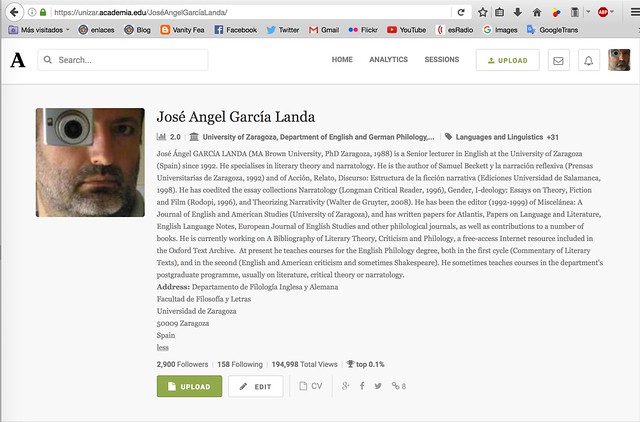
Durante unos días he bajado al top 0,5% de entre los usuarios de Academia.edu - que son más de 30 millones de universitarios: en.wikipedia.org/wiki/Academia.edu. Pero parece que vuelvo a subir al top 0,1%, donde me vengo manteniendo desde hace más de un año.
Al parecer el top 0,1% es el ránking más alto en Academia; al menos nunca he visto uno superior a ése. Lo que sí me hace pensar mi bajada provisional es que dentro de ese 0,1% estoy más cerca del 0,1% que del 0,01%. O sea, en posiciones con opción a descenso—y es que todo lo que sube, baja, aunque luego vuelva a subir. Y en última instancia, por citar a Heráclito, "el camino arriba y abajo es uno y el mismo."
—oOo—