Blogia

Vanity Fea

25-F

martes, 25 de febrero de 2014

25-F

Después del 23-F viene el 24-F, cuando se reacciona a la cosa sin inteligencia, y luego el 25-F, cuando se pone una perspectiva crítica sobre el asunto. No sé si estamos en el 25-F—el país desde luego no lo estará en mucho tiempo. Vamos a hablar de engaños de verdad, no de engaños de mentira.

Aquí se comentan las reacciones al programa Operación Palace, de Jordi Évole, uno de los mayores éxitos de televisión recientes, aunque sólo sea por la regla del "que hablen, aunque sea mal". Y que lo vean.

Es patético que las reacciones vayan encaminadas a si engañó o dejó de engañar a la gente. De acuerdo, si hubo quien se dejó engañar durante la emisión del programa, tanto peor para él (si dio señales visibles), y tanto más mérito para el director. Algo haría bien—su manejo de la retórica verista del documental nomás— aunque en conjunto diga la cosa bien poco del nivel de cultura, de lógica y de entendederas del país. Que es el que es y por eso estamos donde estamos, por ejemplo still under The Same King, 23 F..., and 33 F...  Years Later! 

A lo que voy es que es bien pobre que el debate se centre en quién se dejó engañar y quién no, dado que el propio programa incluía una confesión de su falsedad, hay que ser LERDO para sostener que se quería engañar a alguien o que se es perverso periodista o algo así por eso.  A la gente es que le falta un hervor en metaficción, y en parodia, y en todo lo que no sea la telebasura más elemental, y ya está, ha quedado en triste evidencia.

A lo que sí voy es que el presentar una falsa versión "conspiranoica" del 23-F, sin ir más lejos, y trufándola de alianzas inexistentes y detalles absurdos, es de hecho REFORZAR LA VERSIÓN OFICIAL. Ya saben, esa en la que los servicios secretos del Estado no tenían nada que ver, ni el rey sabía nada, ni el PSOE intrigaba contra Suárez, y Armada era un siniestro fascista que buscaba manipular al rey. Esa versión en la que EL REY SALVÓ A LA NACIÓN DE UN GOLPE FASCISTA, dando lugar al mito de la democracia juancarlista, y a la realidad del Sistema partitocrático que nos rige, de buena entente subterránea entre el Bipartido, la Corona, y los nacionalistas-secesionistas.

Secretos inconfesables sí hay en el 23-F. O, ¿por qué creen que hay 50 años de secreto de sumario?


Aquí pongo algunas pistas sobre versiones alternativas del 23-F.


"Narratología del 23-F."
   
"Ills Like White Elephants."  
   
"23-F, la verdad."

"Vislumbrando más sobre el 23-F."

"El discurso del Rey."

"La versión extraoficial del 23-F."


Historias conspiranoicas donde el papel del rey, y de los partidos, es bastante más cuestionable. Hoy un poquito más desacreditadas, gracias a la gracieta irresponsable de Évole.

Porque donde hay una verdadera historia que contar, que todavía no se ha contado, es una farsa siniestra desviar la atención con versiones que no hacen sino hacerle el juego a los auténticos creadores de PELÍCULAS FALSAS, QUE (esas sí) ENGAÑAN AL POPULACHO.


____


Y miren por donde, va a ser la ingenua Talegón la única que dice algo sensato sobre el efecto real y significado real, o Real, de este episodio.

Cuánto cuento el 23-F


Las ofensas de los secesionistas al Príncipe

Las ofensas de los secesionistas al Príncipe (Rey).

Hemingway delira (2)

lunes, 24 de febrero de 2014

Hemingway delira (2)


Hemingway delira (2)

En la UZ hoy

lunes, 24 de febrero de 2014

En la UZ hoy

Mi lista de resultados en el buscador Roble de la BUZ: hoy son 23.
En AlcorZe, buscando Jose Angel García Landa, son 215 (hm. No todos míos).

Inauguro mi Refworks, aunque no sé si lo usaré mucho. El segundo registro que incluyo es mi bibibliografía—que por eso no uso Refworks:

A Bibliography of Literary Theory, Criticism, and Philology

Y en el repositorio Zagúan me salen 101 resultados.  (Usuario namberguán).

Veo por cierto que muchos de mis artículos o capítulos de libro tienen ahora entrada personalizada en la web de la Biblioteca Universitaria. Por ejemplo este sobre actos de habla en literatura.... En fin, demasiados para detallarlos; la información prolifera que no hay quien le siga la pista a uno mismo.

Y yendo de un lado a otro, llego a un generador de códigos QR. Este es el código de puntos de mi bibliografía. Lo añadiré a la próxima edición, pronto en sus pantallas:


QR biblio


Mapping the Bibliography

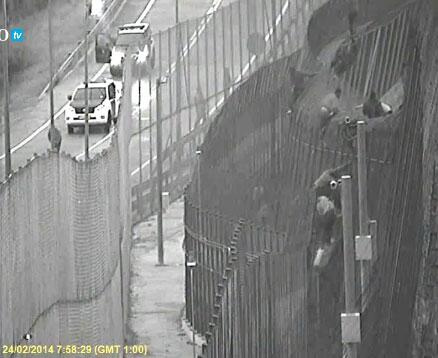
La valla de Melilla hoy

lunes, 24 de febrero de 2014

La valla de Melilla hoy

La valla de Melilla hoy by JoseAngelGarciaLanda
La valla de Melilla hoy, a photo by JoseAngelGarciaLanda on Flickr.  Foto del vídeo de la Delegación del Gobierno.

La orilla blanca, la orilla negra: http://mp3strip.com/dl/m442tFMAZ44/iva-zanicchi-la-orilla-blanca-la-orilla-negra-canta-en-espa%C3%B1ol-mpg.html

Carrion de Luxe

Carrion de Luxe

SYMMETRY - A Palindromic Film

lunes, 24 de febrero de 2014

SYMMETRY - A PALINDROMIC FILM

A Prediction on Remediation

lunes, 24 de febrero de 2014

A Prediction on Remediation

The final section, "The Future of Remediation", from Jay David Bolter and Richard Grusin's Remediation: Understanding New Media (MIT Press, 1999):

Our second observation concerns our culture's insistence on the newness of new media. It is not surprising that enthusiasts should continue to make the claim of novelty, for they have inherited from modernism the assumption that a medium must be new in order to be significant. As Cavell (1979) has remarked, the task of the modern artist was always "one of creating not a new instance of his art, but a new medium in it" (104). In digital media today, as in modern art in the first half of the century, the medium must pretend to be utterly new in order to promote its claim of immediacy. It must constitute itself as a medium that (finally) provides the unmediated experience that all previous media sought, but failed to achieve. This is why each innovation on the World Wide Web must be represented by its promoters as a revolution. Streaming audio, streaming video, Java, VRML—each of these cannot merely imprve what the Web offered before but must "reinvent" the Web. As we have shown what is in fact new is the particular way in which each innovation arranges and reconstitutes the meaning of earlier elements. What is new about new media is therefore also old and familiar: that they promise the new by remediating what has gone before.

The film Strange Days, with which we began our study, is not really a prediction about the future, but a description of our culture's current fascination with both transparent and hypermediated technologies of representation. Throughout this book, we too have tried to describe the present moment and to resist the urge, so tempting when writing about new media, to make predictions. We surely cannot predict how digital media will work their particular remediations in the coming years and decades. Today, virtual reality refashions film; the World Wide Web refashions television and evereything else. However, as they develop, these technologies may change the focus of their remediations. Other digital hardware and software may be invented and deployed against the same targets (particularly television and film) or perhaps against others. Our one prediction is that any future media will also define their cultural meaning with reference to estalished technologies. They will isolate some features of those technologies (point of view, motion, interactivity, and so on) and refashion the to make a claim of greater immediacy.

The true novelty would be a new medium that did not refer for its meaning to other media at all. For our culture, such mediation without remediation seems to be impossible.


Imaginative within Bound (Concluding Reading Matters)
A photo on Flickr